

Telescope Fish Explained: The Ocean Predator Built for Complete Darkness
Discover the telescope fish, a deep-sea predator with powerful eyes built to survive and hunt in complete ocean darkness. Explore its unique adaptations.
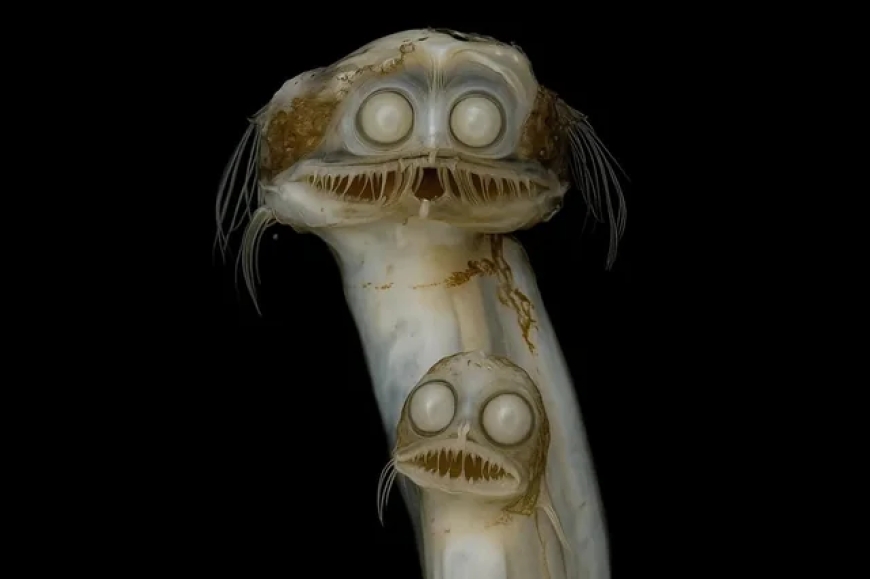
The deep ocean is not a friendly place. No sunlight. Crushing pressure. Freezing temperatures. And yet, life thrives there in ways that feel almost unreal. One of the strangest and most fascinating examples is the telescope fish.
At first glance, it looks like something imagined for a sci-fi movie. Bulging, upward-facing eyes. A fragile, almost transparent body. A slow, ghost-like way of moving through pitch-black water. But every odd feature serves a purpose. The telescope fish is not weird by accident. It is engineered by nature to survive where almost nothing else can.
Let’s break it down and understand how this deep-sea predator is built for complete darkness.
What Is a Telescope Fish?
“Telescope fish” isn’t a single species. It’s a common name used for several deep-sea fish with extremely large, protruding eyes that point upward like tiny telescopes. These fish mostly belong to families such as Giganturidae and Opisthoproctidae.
They typically live at depths ranging from 500 to over 3,000 meters, far below where sunlight can reach. In these zones, darkness is constant. Vision is limited. Food is scarce. Survival depends on detecting the smallest hint of movement or light.
That’s where the telescope fish excels.
Why Are the Eyes So Large?
Here’s the thing. In the deep ocean, light doesn’t come from the sun. It comes from bioluminescence. Tiny flashes produced by jellyfish, shrimp, and other organisms.
 Image Credit: Smithsonian Ocean
The telescope fish’s oversized eyes are designed to capture every possible photon.
These eyes:
Face upward, not forward
Have large lenses to collect faint light
Are highly sensitive to movement above them
This positioning makes sense. Most prey swim above. Any flash of bioluminescence could mean food. Or danger.
By staring upward into the dark, the telescope fish increases its chances of spotting prey before the prey spots it.
Living in a World of Total Darkness
Imagine hunting in a place where you can barely see your own fins. That’s everyday life for the telescope fish.
To survive, it relies on a mix of:
Extreme visual sensitivity
Slow, energy-saving movement
Opportunistic feeding
 Image Credit: Smithsonian Ocean
Unlike fast predators in shallow waters, telescope fish don’t chase. They wait. They float almost motionless, conserving energy. When something passes overhead, they strike quickly and efficiently.
This ambush style of hunting is perfect for a place where meals are rare and calories matter.
The Fragile, Transparent Body
Another striking feature is the telescope fish’s body. It often looks:
Thin
Soft
Nearly transparent
That’s not a weakness. It’s a strategy.
In deep-sea environments, heavy muscles and dense bones are unnecessary. Movement is slow. Predators rely more on surprise than speed. A lightweight body helps the fish:
Float with minimal effort
Avoid detection
Survive with less food
Some species even have reduced scales or none at all, further lowering energy needs.
What Does the Telescope Fish Eat?
The telescope fish isn’t picky. It can’t afford to be.
Its diet usually includes:
Small fish
Crustaceans
Jellyfish
Zooplankton
Anything that drifts into reach is fair game. Because prey encounters are unpredictable, the telescope fish has a large mouth relative to its body, allowing it to swallow animals almost its own size.
In the deep sea, missing a meal could mean waiting days or weeks for the next one.
Built to Handle Crushing Pressure
At extreme depths, water pressure is intense enough to crush most surface-dwelling creatures instantly. Telescope fish survive because their bodies are adapted at a cellular level.
Key adaptations include:
No air-filled swim bladder that could collapse
Flexible bones and tissues
Special proteins that keep cells stable under pressure
This allows them to function normally in conditions that would destroy other animals.
Are Telescope Fish Dangerous?
Not to humans.
Despite being predators, telescope fish are small and fragile. Most species measure 15 to 30 centimeters in length. They pose no threat to divers or people.
In fact, humans are a far greater danger to them. Deep-sea trawling and exploration can damage habitats that took millions of years to form.
How Rare Are Telescope Fish?
Very rare to see. And even harder to study.
Because they live so deep, most telescope fish specimens come from:
Deep-sea trawls
Submersible observations
Accidental catches
Many species are still poorly understood. Some have only been observed a handful of times. Scientists believe there may be undiscovered species living even deeper.
This makes telescope fish important indicators of how little we truly know about the ocean.
Telescope Fish vs Barreleye Fish: Are They the Same?
People often confuse telescope fish with the barreleye fish, another deep-sea oddity.
They share similarities, but they are not the same.
Telescope fish:
Have protruding, external eyes
Eyes usually face upward permanently
Barreleye fish:
Have eyes inside a transparent dome
Can rotate eyes forward or upward
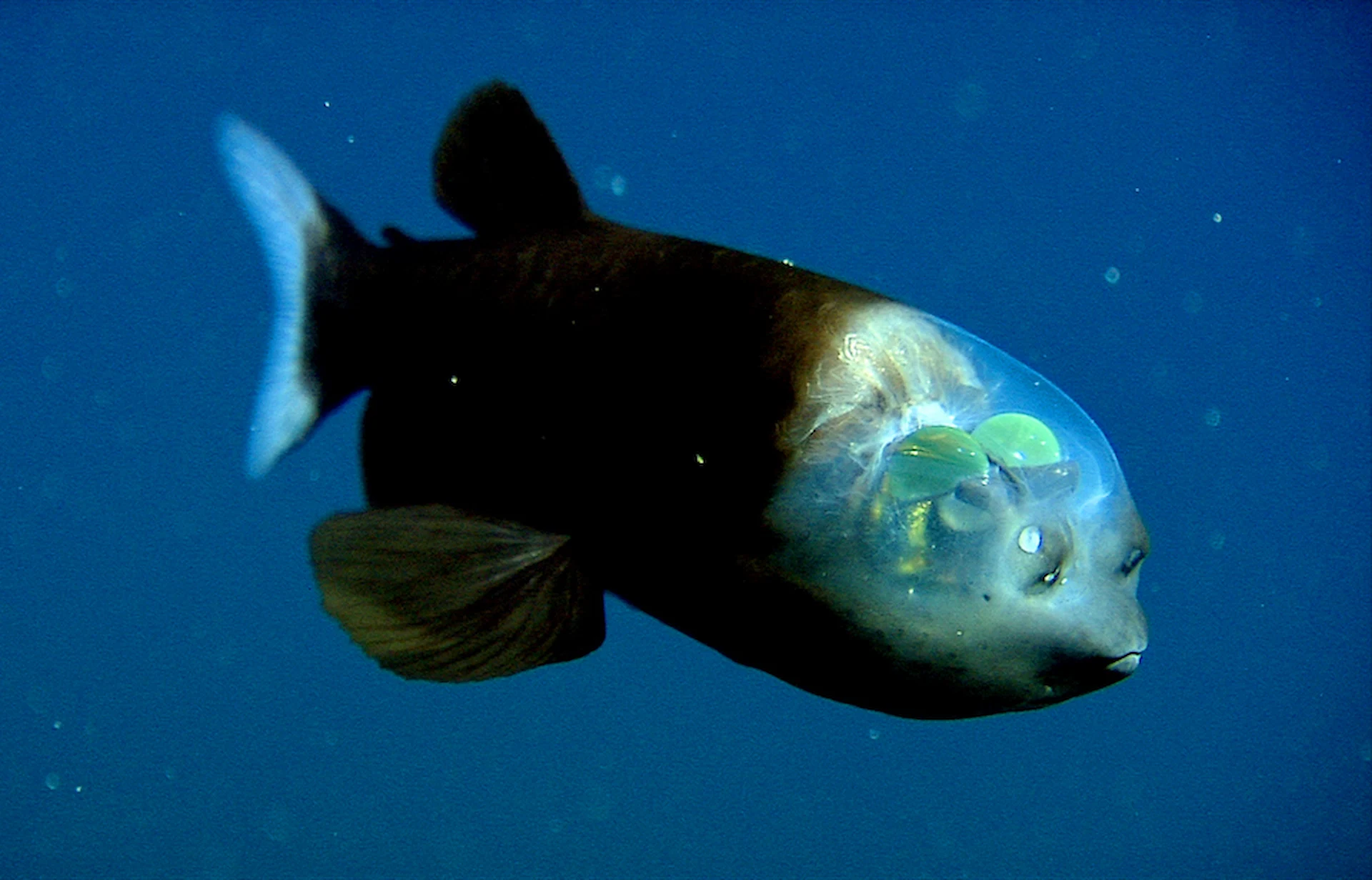 Image Credit: Ocean Conservancy
Both are masters of low-light vision, but they evolved different solutions to the same problem: darkness.
Why Telescope Fish Matter to Science
Studying telescope fish helps scientists understand:
Vision in extreme environments
How life adapts to pressure and darkness
The limits of biological survival on Earth
These insights don’t just apply to oceans. They influence research into space biology, medical imaging, and low-light optical technology.
Nature often solves problems more elegantly than humans ever could.
The Ocean Still Has Secrets
The telescope fish is a reminder that Earth still holds mysteries that rival anything in space. Thousands of meters below the surface, creatures live entire lives without sunlight, without sound, and without ever being seen by humans.
And yet, they are perfectly adapted to their world.
What this really means is simple. The deep ocean isn’t empty. It’s alive. Complex. And still largely unexplored.
Every time we learn about creatures like the telescope fish, we get a glimpse into a hidden ecosystem that has been evolving quietly for millions of years.
Final Thoughts
The telescope fish may not be beautiful in a traditional sense, but it is one of the most impressive examples of adaptation on the planet. Every feature, from its massive eyes to its fragile body, is shaped by the demands of total darkness.
It doesn’t need speed. It doesn’t need strength. It needs awareness. Patience. And the ability to see what others can’t.
In the deepest parts of the ocean, that’s what survival looks like.
If you ever wondered how life persists where light never reaches, the telescope fish has your answer.
What's Your Reaction?
 Like
0
Like
0
 Dislike
0
Dislike
0
 Love
0
Love
0
 Funny
0
Funny
0
 Wow
0
Wow
0
 Sad
0
Sad
0
 Angry
0
Angry
0

I’m Ryan Rehan, Business Development Executive and a passionate blogger dedicated to sharing insights, tips, and experiences that inspire and inform. Through my blogs, I explore topics that matter, spark curiosity, and encourage thoughtful conversations. Whether I’m breaking down complex ideas, offering practical advice, or simply sharing stories, my goal is to create content that adds real value to a growing community of curious minds and passionate readers.












Comments (0)