

All Aboard Argentina's First Solar Train: A Ride Through 10,000 Years of History
Ride Latin America's first solar-powered train through Argentina's Quebrada de Humahuaca, a UNESCO World Heritage valley with 10,000 years of human history, rainbow mountains, and living Andean culture. Here's everything you need to know
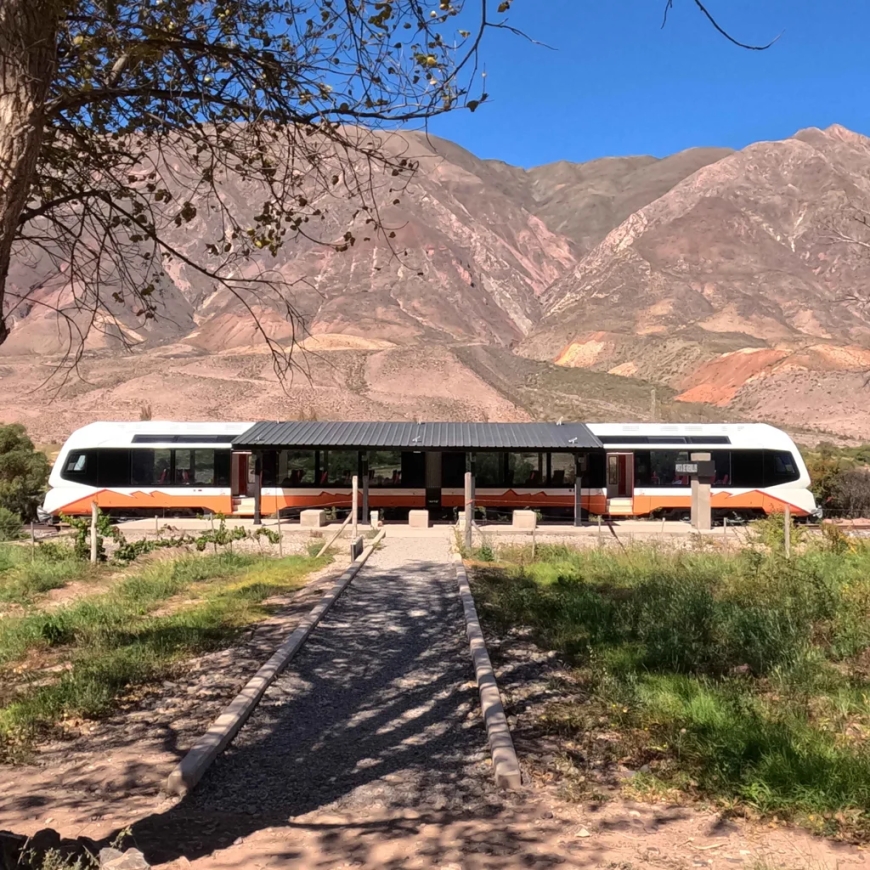
Table of Contents
- Introduction: A Train Unlike Any Other in the Americas
- What Exactly Is the Tren Solar de la Quebrada?
- The Quebrada de Humahuaca: 10,000 Years in One Valley
- The Route: Station by Station
- How the Solar Train Actually Works
- The 360° and 180° Experiences Explained
- Tickets, Prices and Practical Information
- When to Ride: Best Seasons for the Quebrada
- Beyond the Train: What Else to See in Jujuy
- Why This Train Matters for the Future of Travel
- Final Thoughts: A Journey Worth Making
-
Introduction: A Train Unlike Any Other in the Americas
Somewhere in the far north of Argentina, a sleek, panoramic train glides almost silently between mountains striped in ochre, violet, rust and green. There's no diesel rumble, no plume of smoke trailing behind it. The train runs on sunlight.
This is the Tren Solar de la Quebrada, the Solar Train of the Quebrada de Humahuaca and it is quietly one of the most remarkable travel experiences to launch anywhere in the world in recent years. It's the first solar-powered train in Latin America, and it carries its passengers not just through spectacular Andean scenery, but through a valley where human beings have lived, farmed, traded and worshipped for roughly ten millennia.
Most train journeys promise scenery. This one delivers scenery, sustainability, and a genuine passage through deep human history, all in a single unhurried day. If you're planning a trip to Argentina and your itinerary stops at Buenos Aires, Mendoza and Patagonia, this is your invitation to look north.
-
What Exactly Is the Tren Solar de la Quebrada?
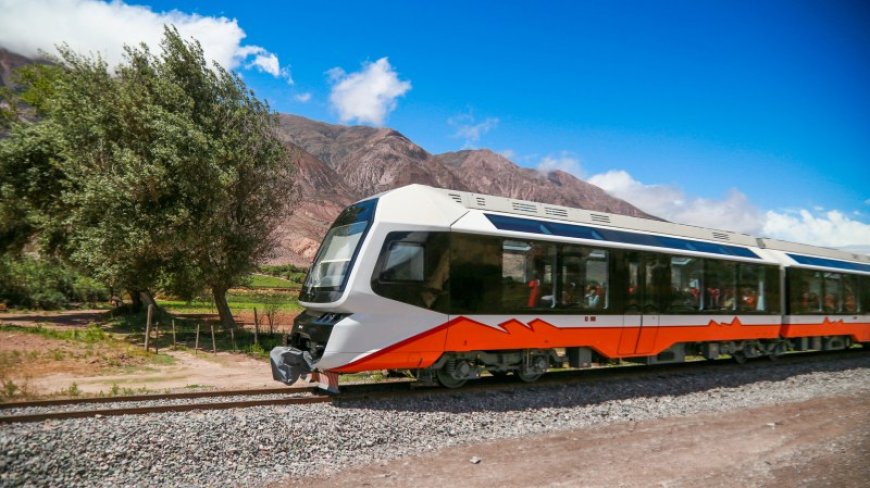
The Solar Train is a regional tourist service running through the province of Jujuy, in Argentina's mountainous northwest near the Bolivian border. The route covers 42 kilometres between the towns of Volcán and Tilcara, following the course of the Quebrada de Humahuaca, a long, dramatic mountain valley that has served as a corridor of human movement since prehistory.
The service began operating in June 2024, running on tracks that once belonged to Argentina's historic Belgrano railway network. For decades, this stretch of line sat largely dormant, a relic of an era when trains connected northern Argentina to Bolivia and beyond. Its revival as a cutting-edge solar service is a story of transformation in itself: old stations have been lovingly restored in the architectural style of the region, and a route that once carried freight now carries travellers in panoramic comfort.
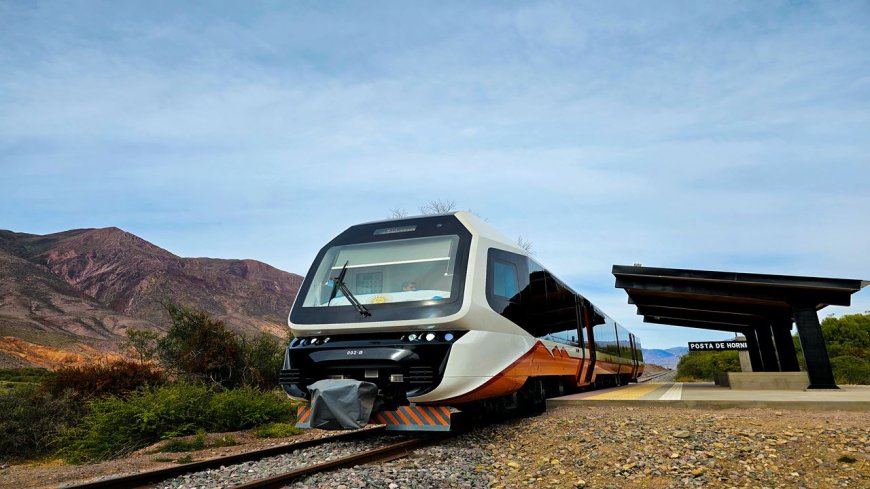
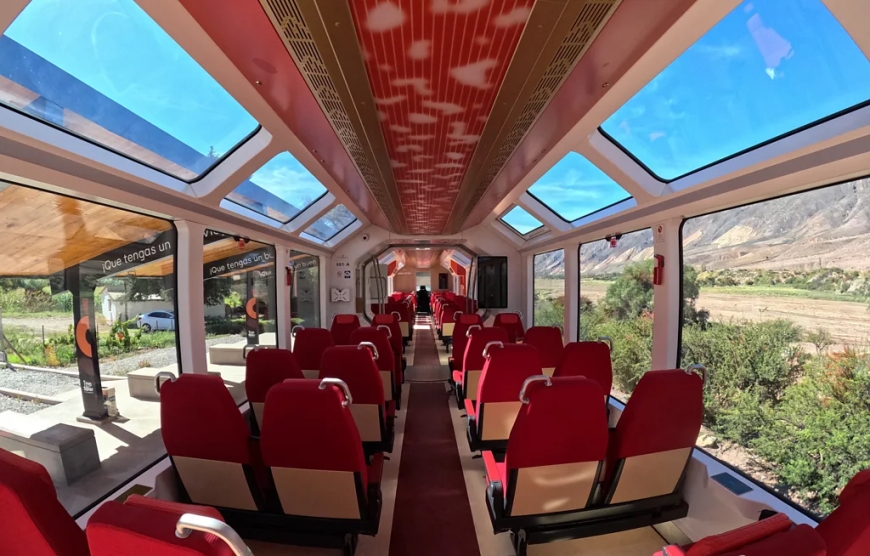
It holds the distinction of being the first solar train in the Americas, and only the second in the world, after Australia's Byron Bay Train. It is also Argentina's first panoramic train, with expansive windows designed to frame the extraordinary mountain landscapes it passes through, drawing natural comparisons to Switzerland's famous Bernina Express.
But where the Bernina crosses Alpine glaciers, the Tren Solar crosses something arguably rarer: a living cultural landscape recognised by UNESCO for its unbroken record of human civilisation.
-
The Quebrada de Humahuaca: 10,000 Years in One Valley
To understand why this journey is so special, you need to understand the valley it travels through.
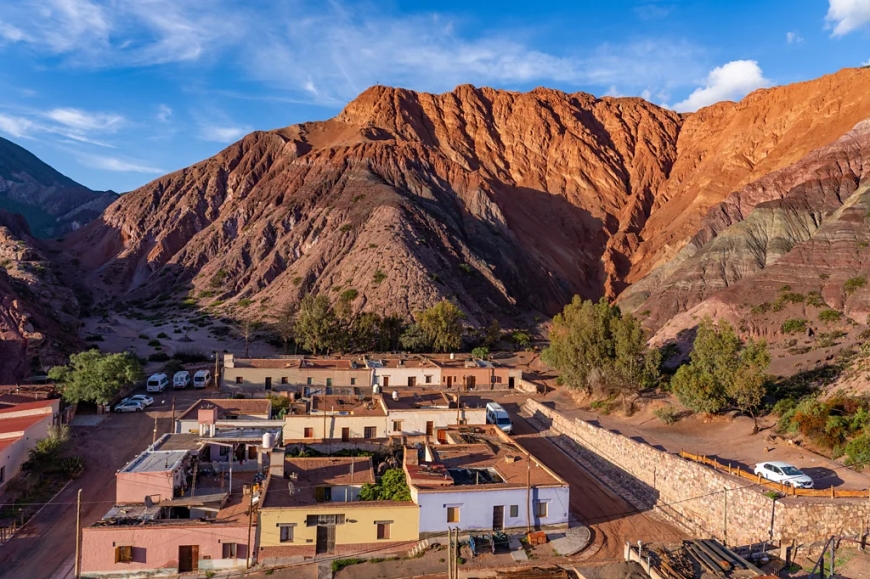
The Quebrada de Humahuaca is a roughly 155-kilometre gorge carved by the Río Grande, flanked by mountains whose mineral layers have oxidised into bands of astonishing colour. In 2003, UNESCO inscribed it as a World Heritage Site not primarily for its geology, but for its human story. Archaeological evidence shows that hunter-gatherer communities were living in this valley around 10,000 years ago. Over the millennia that followed, it became a major caravan route for pre-Hispanic Andean societies, later forming part of the Camino Inca, the vast Inca road network. Spanish colonists passed through it, armies of Argentina's independence wars fought along it, and today its towns remain home to communities whose traditions, textiles, music and agriculture stretch back centuries.
This is what makes the train's marketing line "a ride through 10,000 years of history" more than a slogan. Every station on the route sits in a town layered with that history. You're not travelling past museum pieces behind glass; you're travelling through villages where the past is still visibly, audibly alive in the coplas sung at festivals, in the pre-Columbian agricultural terraces still in use, and in the ancient hilltop fortifications overlooking the valley.
-
The Route: Station by Station
The Solar Train runs through the Quebrada de Humahuaca with stops at stations in Volcán, Tumbaya, Purmamarca, Maimará and Tilcara. Each stop is a destination in its own right.
Volcán is the southern terminus and the journey's starting point. Its station is the old Ramal C station of the Belgrano Norte line, fully renovated for the Solar Train, with the historic building preserved alongside a new station built to respect the architecture and materials of the region. There's a pleasant café here, and the town itself sitting where the lush lowlands begin giving way to arid mountain country makes a fitting gateway.
Tumbaya is a small, tranquil village anchored by a whitewashed colonial chapel. It's the quietest stop on the line, and all the more charming for it, a place to feel the slower rhythm of Quebrada life before the better-known towns ahead.
Purmamarca is, for many travellers, the emotional high point. The train makes a small deviation from the main valley to reach this famous town, which huddles beneath the Cerro de los Siete Colores, the Hill of Seven Colours. This mountain, banded in shades of pink, violet, green and gold, is one of the most photographed natural features in all of Argentina. The town below it is a delight of adobe buildings, an artisan market spilling across the central plaza, and cardón cactus-timber doorways.
Maimará sits beneath its own geological masterpiece: the Paleta del Pintor, or Painter's Palette, a hillside whose folds of colour genuinely resemble smeared oil paint. The town is also known for its local wines, which are well worth tasting vineyards here grow at extreme altitude, producing distinctive high-mountain vintages.
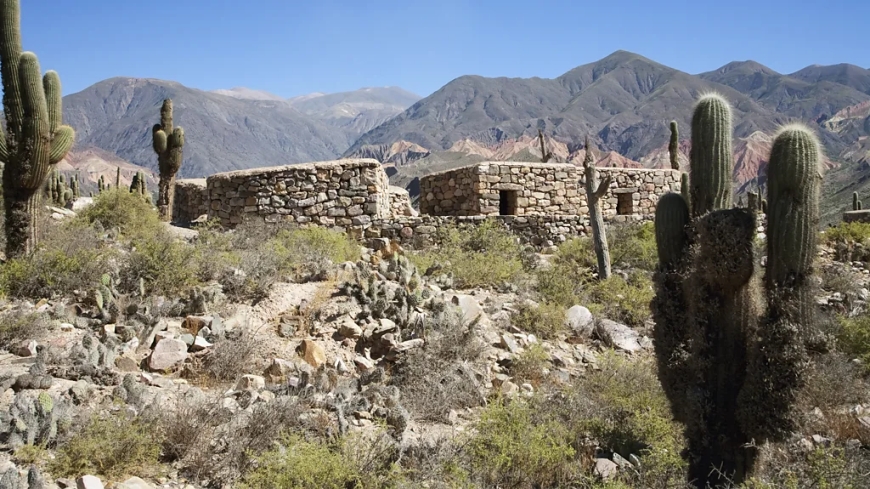
Tilcara is the northern terminus and the cultural heart of the Quebrada. Its star attraction is the Pucará de Tilcara, a partially reconstructed pre-Inca hilltop fortress dating back around 900 years, with commanding views over the valley. Tilcara also has the best concentration of restaurants, museums and guesthouses on the route, making it an ideal place to linger or to stay overnight if you want to break up your journey.
Ridden end to end without disembarking, the full journey takes roughly an hour and a half but the real recommendation is to make stops at the stations and soak up the character of each town.
-
How the Solar Train Actually Works
The engineering behind the train is elegantly simple in concept. The train is 100% sustainable, running on lithium batteries recharged with solar energy. The batteries recharge at the various stations along the route, where solar installations harvest the one resource this high-altitude desert region has in almost limitless supply: sunshine. The Quebrada enjoys some of the clearest skies in Argentina, making it close to an ideal environment for solar-powered transport.
The train runs on the metre-gauge track of the old national railway, reaching operating speeds of around 60 km/h, a deliberately gentle pace that suits both the technology and the landscape. This is not a train for getting somewhere fast. It's a train for watching mountains change colour through oversized windows.
Each service carries up to 140 passengers, and the interiors are modern and comfortable, designed around the panoramic viewing experience. The near-silence of electric propulsion is a genuine part of the experience: without engine noise, the soundscape of the valley wind, birdsong, the murmur of towns as you glide past comes through.
-
The 360° and 180° Experiences Explained
The Solar Train offers two distinct experiences. The 360° Experience covers the full circuit of stations with cultural and gastronomic activities, while the 180° Experience offers a shorter ride from Purmamarca, ideal for enjoying a coffee and the unforgettable landscapes.
The 360° Experience is a complete full-day circuit with a specialised guide on board and at each station. It allows you to travel the route across the whole day, with scheduled stops, cultural, gastronomic and recreational activities in each locality, and free time to explore each destination. If you have a full day to give, this is unquestionably the way to do it the guided element adds real depth, translating the layers of history visible from the window into stories you'll actually remember.
The 180° option suits travellers who are short on time, or who are already basing themselves in Purmamarca and want a taste of the train without committing an entire day.
For visitors coming from further afield, full-day tour packages are available that include transfers from San Salvador de Jujuy, the provincial capital and round-trip transfer packages also operate from Salta, which is where many international travellers to northwest Argentina first arrive.
-
Tickets, Prices and Practical Information
Tickets can be booked through the train's official website (trensolar.com.ar) as well as through authorised tour operators. Pricing is tiered by residency. At the time of writing, the standard fare for foreign visitors is around USD 37, with reduced peso fares for Argentine residents, children under 12, residents of Jujuy province, and retirees and prices can vary depending on the route you choose. Always check the official site for current fares, as prices in Argentina change frequently.
A few practical tips worth knowing before you go:
Altitude matters. The Quebrada sits at roughly 2,000–2,500 metres above sea level, and many visitors arrive from near sea level. Take the first day gently, drink plenty of water, and consider trying coca tea, the traditional local remedy for altitude adjustment.
Book ahead. With limited capacity per departure and the train's growing popularity, advance booking is strongly recommended, especially during Argentine holiday periods (January–February and July) and around regional festivals.
Bring layers. High-desert weather swings dramatically. Mornings and evenings can be sharply cold even when midday is hot, and the sun at this altitude is intense sunscreen and a hat are essential.
Carry some cash. The small towns along the route are wonderful for artisan shopping and street food, but card acceptance can be patchy in smaller establishments.
-
When to Ride: Best Seasons for the Quebrada
The Quebrada de Humahuaca is a year-round destination, but each season offers something different.
April to November (the dry season) brings the most reliable conditions: crisp, sunny days, brilliant blue skies, and the mountain colours at their most vivid. This is the ideal window for photography and for combining the train with hiking.
Summer (December to March) is the rainy season, when afternoon storms can roll through though mornings are often clear, and the valley takes on a rare green tint.
Festival timing is worth considering, too. The Quebrada's Carnival celebrations (usually February) are among the most distinctive in South America, blending Andean and Catholic traditions. Easter week and the Pachamama (Mother Earth) ceremonies of August also fill the valley's towns with colour, music and ritual riding the train during these periods pairs the journey with unforgettable cultural experiences.
-
Beyond the Train: What Else to See in Jujuy
The Solar Train pairs beautifully with the wider wonders of Jujuy province.
Humahuaca town, further north up the valley beyond the current rail terminus, offers cobbled streets, a famous monument to the independence wars, and access to the Serranía de Hornocal the "mountain of fourteen colours," whose jagged, zigzagging bands of colour arguably outdo even Purmamarca's famous hill.
The Salinas Grandes, a blinding-white salt flat reached via a spectacular mountain pass above Purmamarca, is one of Argentina's most surreal landscapes and an easy half-day trip.
San Salvador de Jujuy, the provincial capital, rewards a wander with its plazas and its cathedral, while Salta, a few hours south, is one of Argentina's best-preserved colonial cities and the natural anchor for a longer northwest itinerary.
Combine the train with two or three of these, and you have one of South America's great under-the-radar travel circuits.
-
Why This Train Matters for the Future of Travel
It would be easy to file the Tren Solar under "novelty" a curiosity for train enthusiasts. That would miss the point entirely.
The Solar Train represents a milestone in sustainable tourism, combining technological advances with environmental preservation. It demonstrates something the travel industry urgently needs examples of: that tourism infrastructure can be genuinely low-impact without being austere or joyless. The train brings visitors and their spending directly into small valley towns, distributing tourism income along the route rather than concentrating it in a single hub. It revives heritage railway infrastructure instead of abandoning it. And it does all this in a landscape whose fragility and cultural significance demand exactly this kind of care.
In a UNESCO-listed valley that has hosted human life for ten thousand years, a silent, sun-powered train feels less like an intrusion and more like a continuation the newest chapter in a very long story of people moving thoughtfully through this corridor of mountains.
-
Final Thoughts: A Journey Worth Making
Great travel experiences tend to have one memorable dimension a view, a meal, a moment. The Tren Solar de la Quebrada has three: a landscape of impossible colour, a genuinely pioneering piece of sustainable engineering, and a passage through one of the deepest continuous human histories anywhere on Earth.
It is still new, still relatively uncrowded, and still flying beneath the radar of mainstream international tourism. That won't last forever. If northern Argentina is anywhere on your travel horizon, board this train while it still feels like a secret.
Ten thousand years of history are waiting at the window.
What's Your Reaction?
 Like
0
Like
0
 Dislike
0
Dislike
0
 Love
0
Love
0
 Funny
0
Funny
0
 Wow
0
Wow
0
 Sad
0
Sad
0
 Angry
0
Angry
0

A spirit that pursues sunsets and tales. Entrepreneur at heart, globe-trotter by soul. Founder of an art-worshiping jewelry brand that embodies emotion & individuality — where each piece is a tale of culture, craft, and character. From trails up mountains to gem markets, I'm inspired by all journeys — transforming wanderlust into enduring design. Establishing a brand built on authenticity, refinement & purpose — one work at a time.










Comments (0)