

Inside the Kota Conversion Case: What We Know About the 40,000-Video Network and Pakistan Connection
Inside the Kota conversion case: uncovering a 40,000-video radicalization network, its Pakistan links, and what it reveals about digital threats.
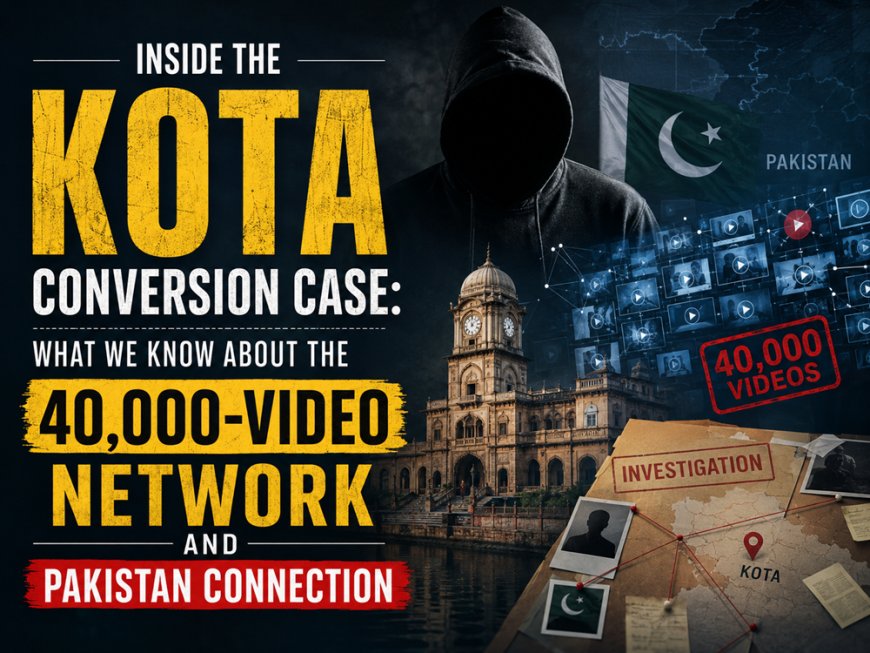
Table of Contents
- Introduction: Why the Kota Case Matters
- What Is the Kota Conversion Case?
- The 40,000-Video Network: Scale and Structure
- The Pakistan Connection: Evidence and Allegations
- How the Radicalization Pipeline Worked
- Key Arrests and Who Was Involved
- Digital Footprint and Platform Exploitation
- Legal Framework and NIA Involvement
- Impact on Kota's Student Population
- What This Case Reveals About Broader Threats
- Conclusion
-
Introduction: Why the Kota Case Matters
Kota, Rajasthan widely recognised as India's coaching capital, attracts hundreds of thousands of students every year from across the country. Young people converge on this city chasing dreams of cracking the IIT-JEE, NEET, and other competitive examinations. It is a city built on ambition, discipline, and aspiration.
That reputation, however, also made it a target.
Investigators have recently uncovered what they describe as a sophisticated and deeply troubling operation: a digital radicalization network allegedly running out of Kota, with alleged operational links stretching across the border into Pakistan. At its core sits a staggering archive of roughly 40,000 videos, content designed not to educate, but to manipulate vulnerable young minds toward religious conversion and, in some cases, extremism.
This case is not just about one city. It is a window into how modern radicalization works: quietly, digitally, and at scale.
-
What Is the Kota Conversion Case?
The Kota conversion case refers to an ongoing investigation into an alleged network that systematically targeted students many of them from non-Muslim backgrounds with curated digital propaganda. The alleged goal was to drive religious conversion, isolate individuals from their families and original belief systems, and in more advanced stages, pull recruits toward radical ideology.
The investigation gained momentum after local intelligence units flagged unusual online activity patterns among certain student groups in the city. Subsequent raids and arrests revealed what officials described as a carefully orchestrated operation not merely the work of a few individuals, but a structured network with roles, resources, and a reach that genuinely alarmed security agencies.
The case quickly drew national attention and prompted the involvement of central investigative agencies, given the international dimension that emerged from the evidence collected.
-
The 40,000-Video Network: Scale and Structure
Perhaps the most striking element of the case is the sheer volume of propaganda content allegedly produced and distributed. Investigators reportedly uncovered a repository of approximately 40,000 videos, a figure that speaks to years of sustained effort and substantial organisational backing.
These videos were reportedly not random or loosely scattered across the internet. According to investigators, they were part of a structured distribution system, with content tailored to specific audiences. Some materials were designed for initial engagement, emotional, relatable content that drew in young people struggling with stress, loneliness, or identity questions. Subsequent content reportedly grew progressively more ideological, nudging viewers toward conversion narratives and, in select cases, toward extremist thought.
The videos were allegedly circulated through encrypted messaging applications, private social media groups, and peer-to-peer sharing chains. This layered approach made tracking significantly harder for authorities and allowed the network to operate for an extended period without detection.
What makes this particularly notable from an investigative standpoint is the degree of curation involved. This was not mass broadcasting, it was targeted grooming at digital scale.
-
The Pakistan Connection: Evidence and Allegations
The alleged Pakistan connection is one of the most sensitive and significant dimensions of the case. Investigators have stated that evidence points to operational coordination between handlers inside India and elements based in Pakistan, though the exact nature and depth of that relationship continues to be established through ongoing proceedings.
According to officials, digital forensics and communications analysis revealed contact between individuals arrested in Kota and accounts or numbers traced to Pakistani territory. The alleged role of these external actors was not passive, investigators suggest they provided ideological content, strategic direction, and potentially financial support to keep the network functioning.
Agencies have pointed to known Pakistani-based organisations with a documented history of running influence operations in India. The modus operandi described in this case, mass content production, targeted distribution, exploitation of vulnerable demographics, aligns with patterns that security researchers and counterterrorism analysts have previously documented.
The Pakistan angle has added a layer of national security seriousness to what might otherwise have been treated as a purely criminal matter, and it explains why the National Investigation Agency moved to take an interest in the proceedings.
It bears noting that Pakistan's government has not publicly responded to the specific allegations tied to this case, and investigations are still active. What has been established is that the digital trail raises serious questions about cross-border coordination.
-
How the Radicalization Pipeline Worked
Understanding the mechanics of the alleged pipeline is critical to appreciating the sophistication of the operation.
According to investigators and reports from those familiar with the case, the process typically followed several distinct stages:
Stage One — Initial Contact: Students, often those dealing with academic pressure, family distance, or a search for meaning, were approached through social media or introduced by already-converted peers. The initial contact was warm, supportive, and entirely non-threatening.
Stage Two — Content Exposure: Once trust was established, individuals were gradually introduced to religious content first general, then increasingly pointed toward specific theological arguments for conversion. The 40,000-video archive is believed to have served as the content backbone for this stage.
Stage Three — Community Integration: Targets were invited into closed groups both virtual and, in some cases, physical where they were surrounded by individuals who reinforced the conversion narrative. Social bonding played a powerful role in cementing the shift in identity.
Stage Four — Isolation and Deepening: As individuals moved further along, they were allegedly encouraged to distance themselves from their original social circles, families, and belief systems. In certain cases, investigators allege that more radical ideology was introduced at this stage.
This pipeline mirrors documented patterns in international radicalization research, which is precisely why investigators have taken it so seriously.
-
Key Arrests and Who Was Involved
Multiple individuals have been arrested in connection with the case. Those taken into custody include local facilitators, people living and operating within Kota who allegedly served as ground-level operators for the network. They are accused of making direct contact with students, managing content distribution, and in some instances, conducting or facilitating conversion ceremonies.
Investigators have also identified figures who allegedly served as coordinators or mid-level handlers, individuals responsible for managing groups of recruits and liaising with higher elements of the network.
The socioeconomic and educational background of those arrested has varied, but investigators note that some had genuine access to the student community through coaching institutions, accommodation services, or social connections, making them effective at infiltrating a population that might otherwise have been harder to reach.
Charges filed have included those related to unlawful conversion, criminal conspiracy, and in some cases, provisions under national security legislation. As the investigation progresses, further arrests have not been ruled out.
-
Digital Footprint and Platform Exploitation
A key takeaway from this case is how effectively the alleged network exploited mainstream and encrypted digital platforms. Investigators found the operation spread across a combination of channels: popular social media platforms were used for initial outreach and soft content, while encrypted apps were deployed for deeper ideological material and coordination.
The use of end-to-end encrypted communication platforms posed a genuine challenge for investigators, a challenge that has become a recurring theme in digital security and counterterrorism discussions globally. The sheer volume of content, those 40,000 videos, meant that even if some material was taken down on one platform, the archive could be redistributed elsewhere.
Platform exploitation also extended to algorithm-driven content discovery. By producing high volumes of content with specific keywords and engagement patterns, the network may have benefited from organic recommendation systems that brought new, unintended viewers toward the material.
This raises serious questions about platform responsibility, content moderation capabilities, and the speed at which authorities can respond when radicalization activity is operating within private digital spaces.
-
Legal Framework and NIA Involvement
The case has drawn in multiple layers of India's law enforcement and investigative machinery. Local Rajasthan Police were initially involved in the arrests and early investigation. Given the alleged cross-border dimensions and national security implications, the National Investigation Agency, India's premier counterterrorism body, has been looped into the proceedings.
The NIA's involvement signals the seriousness with which central authorities are treating the alleged Pakistan connection. The agency has jurisdiction over cases involving threats to national security, terrorist activity, and offences with international linkages, all of which appear to apply here.
Legal provisions invoked reportedly include sections of the Unlawful Activities (Prevention) Act (UAPA), along with provisions related to criminal conspiracy and religious conversion regulations under Rajasthan state law. The application of UAPA provisions reflects the view that this case goes beyond ordinary criminal activity into the territory of organised threats to national security.
The investigation remains active, and legal proceedings are ongoing. Observers will be watching closely to see how the international dimension is handled and whether the evidence trail leads to formal diplomatic or legal action.
-
Impact on Kota's Student Population
The revelation of an alleged radicalization network operating within their city has had a visible impact on Kota's broader student ecosystem. Coaching institutions, hostel operators, and student welfare organisations have all been prompted to review their safeguarding practices.
For families sending children to Kota often from distant states, and sometimes for the first time living away from home, the case has sharpened existing anxieties about student safety. The pressures of competitive exam preparation already make Kota's student population statistically vulnerable to psychological stress. The idea that organised actors may have deliberately targeted that vulnerability has understandably provoked concern and anger.
Local authorities have reportedly increased awareness programmes and asked educational institutions to strengthen monitoring of student welfare. Mental health support, already a topic of active discussion in Kota given the competitive pressures students face, has now taken on an additional dimension relating to ideological vulnerability.
-
What This Case Reveals About Broader Threats
The Kota conversion case is, in many ways, a case study in the evolution of radicalization in the digital age. Several broader lessons emerge from what investigators have uncovered.
First, scale is now achievable without enormous visible infrastructure. A network of 40,000 videos can be assembled, stored, and distributed without a physical broadcasting centre, a printing press, or even a large staff. The barriers to running an influence operation have collapsed.
Second, vulnerability is a target. The deliberate focus on students under academic stress demonstrates that those running such operations understand psychology. They are not broadcasting randomly, they are fishing in specific waters.
Third, borders are largely irrelevant in digital operations. If the alleged Pakistan connection holds up under legal scrutiny, it demonstrates that a foreign actor can run a sustained influence and radicalization operation inside another country's cities without a single operative crossing the border in person.
Fourth, detection is slow and imperfect. The alleged network appears to have operated for an extended period before authorities were able to build a full picture. This is not a failure unique to any one agency, it reflects the structural difficulty of monitoring encrypted, high-volume digital activity at scale.
These lessons have implications well beyond Kota, and well beyond India.
-
Conclusion
The Kota conversion case remains an active investigation, and many questions are still being answered. What is already clear, however, is that it represents a significant and troubling example of organised digital radicalization, one that combined technological sophistication, psychological targeting, and alleged international coordination.
For India's security establishment, it is a reminder that threats to national cohesion and security are increasingly likely to arrive not at border checkpoints, but through smartphone screens in student dormitories.
For parents, educators, and platform companies, it is a call to take seriously the environments both physical and digital in which young people find themselves.
And for investigators and policymakers, it is evidence that the architecture of modern radicalization has fundamentally changed, and that the responses to it must change too.
The 40,000 videos are not just a number. They are a measure of intent and a marker of how much work remains to be done.
What's Your Reaction?
 Like
0
Like
0
 Dislike
0
Dislike
0
 Love
0
Love
0
 Funny
0
Funny
0
 Wow
0
Wow
0
 Sad
0
Sad
0
 Angry
0
Angry
0

A spirit that pursues sunsets and tales. Entrepreneur at heart, globe-trotter by soul. Founder of an art-worshiping jewelry brand that embodies emotion & individuality — where each piece is a tale of culture, craft, and character. From trails up mountains to gem markets, I'm inspired by all journeys — transforming wanderlust into enduring design. Establishing a brand built on authenticity, refinement & purpose — one work at a time.















Comments (0)