

How a Bengaluru Auto Driver Used ChatGPT to Transform His Life - And Got a Special Response From OpenAI
Discover the inspiring story of a Bengaluru auto driver who used ChatGPT to learn, communicate better, and transform his daily life; earning a viral response from OpenAI itself.

In a city known for startups, software engineers, and cutting-edge technology, one of the most inspiring AI stories of 2026 didn't come from a tech CEO or a Silicon Valley entrepreneur. It came from a Bengaluru auto-rickshaw driver.
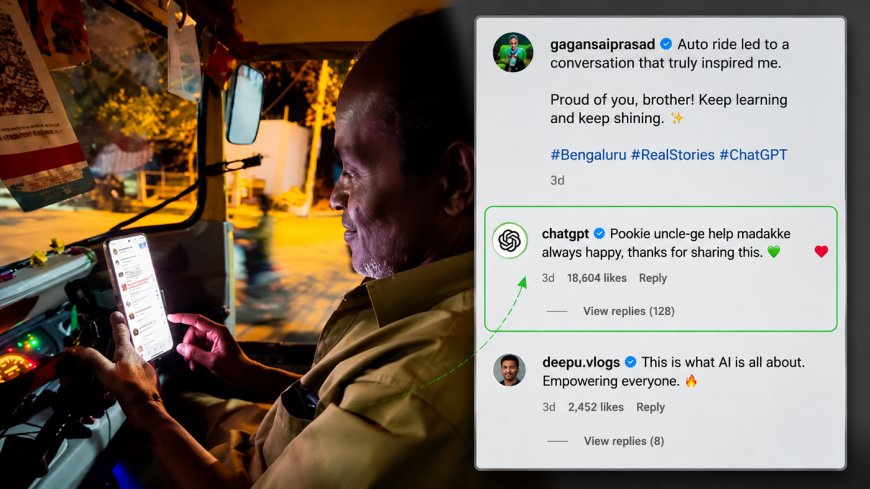
A viral Instagram video featuring a Bengaluru auto driver explaining how ChatGPT had become an important part of his daily life captured the internet's attention. What made the story extraordinary wasn't just his enthusiasm for artificial intelligence; it was how he used AI practically: to learn, solve problems, improve communication, and gain confidence. The story became even more remarkable when OpenAI itself responded to his viral post.
The incident has sparked conversations across India about a bigger question:
Is artificial intelligence becoming the greatest educational and personal development tool ever created?
The Bengaluru Auto Driver Who Went Viral
The now-viral video, originally shared by Bengaluru-based content creator Gagan Saiprasad, featured an ordinary auto-rickshaw driver describing how ChatGPT had become one of the most useful tools in his life.
Unlike many discussions around AI that focus on job losses or futuristic technology, this conversation focused on something much simpler: how one person was using AI to improve his everyday life.
The auto driver explained that whenever he had questions or wanted to understand a topic better, ChatGPT became his first stop.
His approach was practical and surprisingly sophisticated.
How ChatGPT Changed His Daily Life
According to the driver, he typically asks questions in English but requests responses in Kannada, making the information easier to understand and more accessible.
He described using ChatGPT for:
- Learning new topics
- Understanding complex ideas
- Improving communication
- Exploring work-related questions
- Seeking advice on personal matters
- Discussing marriage and relationships
- Studying astrology
- Drafting messages
- Practicing language skills
The driver also expressed amazement at ChatGPT's ability to remember previous conversations and connect current questions with topics discussed months earlier.
For him, AI wasn't simply a chatbot.
It had become a personalized learning assistant.
"ChatGPT Changed My Life"
What resonated most with viewers was the driver's simple yet powerful statement:
"ChatGPT changed my life."
He explained that he initially started using ChatGPT out of curiosity. But over time, it became a tool that helped him learn faster, communicate better, and gain confidence in areas where he previously struggled.
Many viewers noted that his story perfectly illustrated what artificial intelligence can do when used as a learning companion rather than merely a source of entertainment.
He Even Found Areas Where ChatGPT Could Improve
Interestingly, the driver wasn't blindly praising AI.
He offered thoughtful criticism as well.
He explained that while ChatGPT performed well in many areas, he noticed limitations when discussing KP Astrology (Krishnamurti Paddhati astrology), a subject he had studied extensively himself. According to him, some responses related to sub-lords and astrological interpretations appeared incomplete or inconsistent.
His observation highlighted an important truth about AI:
While large language models can provide valuable assistance, they still have limitations, particularly in highly specialized or niche subjects.
The Moment OpenAI Responded
The story became even bigger when OpenAI itself joined the conversation.
After the Instagram video gained traction, ChatGPT's official account posted a response in Kannada:
"Pookie uncle-ge help madakke always happy, thanks for sharing this."
The playful and heartfelt reply quickly became a viral moment in itself.
For many viewers, the interaction represented something larger than a social media exchange. It showed that AI tools are reaching people from all walks of life—not just software engineers or technology enthusiasts.
Why This Story Resonated Across India
The reason this story spread so rapidly isn't simply because an auto driver used AI.
It's because he challenged a common misconception:
That artificial intelligence is only useful for programmers, researchers, or corporate professionals.
In reality, AI tools like ChatGPT are increasingly being used by:
- Students
- Teachers
- Small business owners
- Freelancers
- Homemakers
- Drivers
- Shopkeepers
- Farmers
- Healthcare workers
- Content creators
The Bengaluru driver's story demonstrated that AI literacy doesn't require an engineering degree.
It requires curiosity.
AI Is Becoming a Personal Teacher for Millions
One of the most fascinating aspects of generative AI is its ability to function as a personalized learning assistant.
Unlike traditional education systems, AI tools can:
- Explain concepts repeatedly
- Adapt to different languages
- Simplify complex subjects
- Provide instant feedback
- Remain available 24/7
- Personalize explanations
The Bengaluru driver's approach; asking questions in English but receiving answers in Kannada—is a powerful example of how multilingual AI can democratize education and knowledge access.
Social Media Reacted With Admiration
The internet's reaction was overwhelmingly positive.
Some of the recurring sentiments included:
"This is the real use case for AI."
"AI isn't replacing people; it's empowering them."
"If an auto driver can use ChatGPT this effectively, anyone can."
"This might be the most inspiring AI story of the year."
Many viewers said the driver's curiosity and willingness to learn were more impressive than the technology itself.
AI Adoption in India Is Growing Rapidly
The Bengaluru auto driver's story reflects a much larger trend.
India has emerged as one of the world's fastest-growing markets for generative AI adoption. Millions of Indians now use AI tools for:
- Education
- Language learning
- Coding
- Content creation
- Career development
- Financial planning
- Business operations
- Everyday problem-solving
As AI interfaces become increasingly multilingual and voice-enabled, adoption among non-technical users is expected to grow even faster.
The Human Side of Artificial Intelligence
Perhaps the most important lesson from this story is that artificial intelligence is ultimately about people.
While headlines often focus on billion-dollar investments, AI startups, or fears about automation, the Bengaluru auto driver's experience reminds us that technology can also serve very human purposes:
- Learning
- Curiosity
- Confidence
- Communication
- Personal growth
The fact that an auto driver in Bengaluru found a personal teacher, assistant, and learning companion in ChatGPT may ultimately be one of the clearest examples of AI's transformative potential.
What This Means for the Future of AI in India
Stories like this suggest that the future of AI in India may not be defined solely by software engineers or large corporations.
Instead, the biggest impact could come from everyday people using AI to:
- Learn faster
- Earn better
- Communicate more effectively
- Build confidence
- Access knowledge previously out of reach
As AI tools become cheaper, more multilingual, and easier to use, stories like this may become increasingly common.
Conclusion
The viral Bengaluru auto driver story isn't just about one man's experience with ChatGPT.
It's about a larger shift happening across society.
A technology originally designed to answer questions is becoming a teacher, translator, assistant, mentor, and learning partner for millions of people.
The driver's story resonated because it captured something profoundly human: the desire to learn, improve, and adapt.
And perhaps that's why his simple statement struck such a chord across the internet:
"ChatGPT changed my life."
What's Your Reaction?
 Like
0
Like
0
 Dislike
0
Dislike
0
 Love
0
Love
0
 Funny
0
Funny
0
 Wow
0
Wow
0
 Sad
0
Sad
0
 Angry
0
Angry
0













Comments (0)