

Best Plagiarism Checkers for Bloggers and Content Marketers
Discover the best plagiarism checkers for bloggers and content marketers in 2026, with real pricing, standout features, and honest trade-offs to help you protect your content.
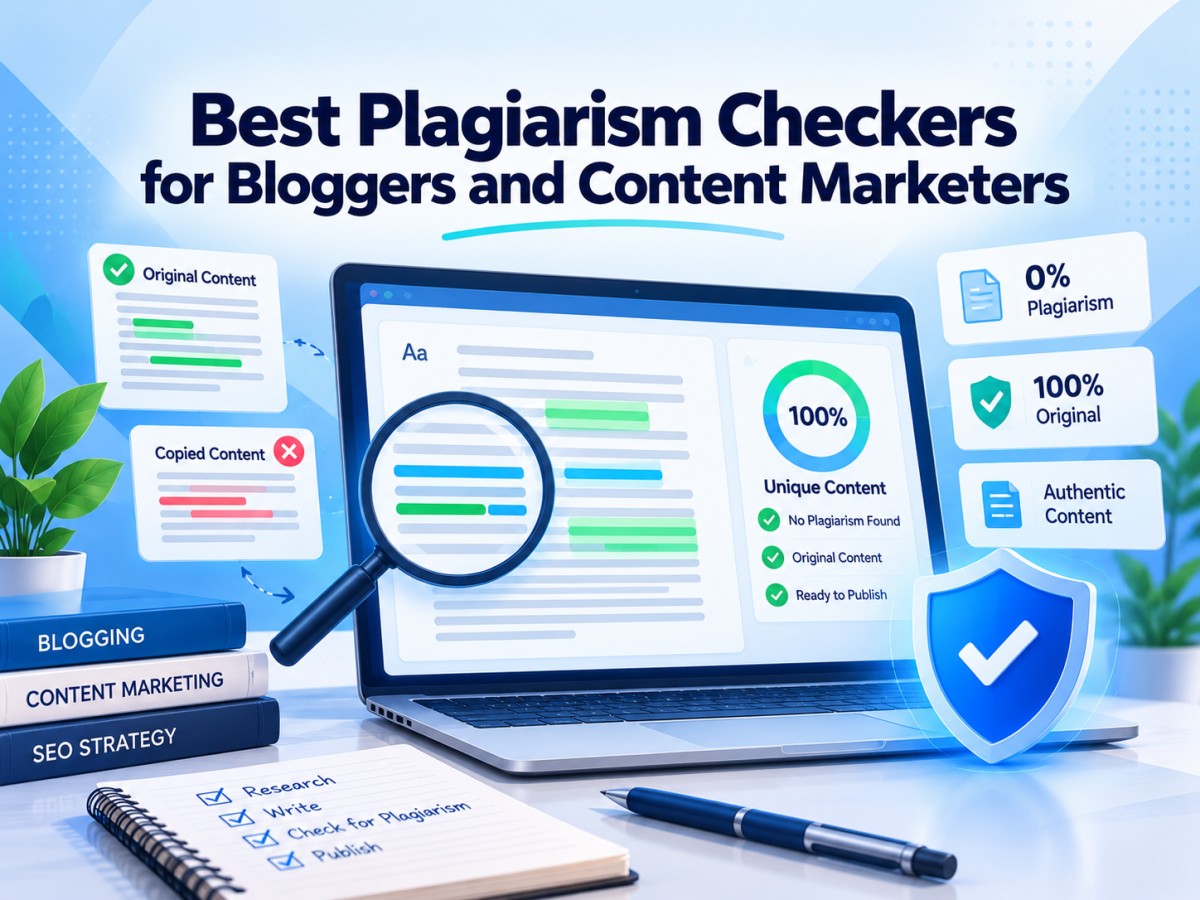
Table of Contents
- 1. Introduction: Why Plagiarism Checking Isn't Optional Anymore
- 2. What a Good Plagiarism Checker Actually Needs to Do
- 3. How We're Comparing These Tools
- 4. The Best Plagiarism Checkers in 2026 (With Pricing)
- 5. Quick Price Comparison Table
- 6. Plagiarism Checker vs. AI Content Detector: What's the Difference?
- 7. How to Choose the Right Tool for Your Situation
- 8. Final Thoughts
-
1. Introduction: Why Plagiarism Checking Isn't Optional Anymore
If you publish content for a living, you already know the stakes have changed. Google's search quality systems are built to reward original, helpful content and quietly bury pages that duplicate what's already out there. Clients increasingly ask for an originality report before they pay an invoice. And with AI writing tools now part of nearly every content workflow, the line between "inspired by research" and "copied without realising it" has gotten blurrier than it used to be.
A plagiarism checker isn't just a tool for catching cheating students anymore. For bloggers, it's quality control. For content marketers and agencies, it's a credibility safeguard — proof to clients and search engines alike that what you're publishing is genuinely yours. And increasingly, it's also the first line of defence against accidentally publishing AI-generated text that echoes its training data too closely.
The challenge is that "plagiarism checker" now covers a surprisingly wide range of tools, from simple word-matching scanners to sophisticated platforms that also flag AI-generated content. This guide breaks down the strongest options on the market, what each one actually does well, and critically what they cost, so you can pick the right one without overpaying for features you'll never use.
-
2. What a Good Plagiarism Checker Actually Needs to Do
Before comparing specific tools, it helps to know what actually separates a useful plagiarism checker from a gimmick:
- Depth of index. The tool is only as good as what it's checking against. Does it scan the live web, academic databases, or just its own internal archive of previously submitted documents?
- Accuracy of matching. A good checker distinguishes between a genuinely copied passage and a common phrase, a properly cited quote, or a coincidental overlap in simple language.
- Source reporting. It should show you exactly which source it matched, not just a vague percentage score. A "12% similarity" score means nothing without the receipts.
- AI content detection. Increasingly relevant as more writers use AI tools in their workflow — several platforms now flag both plagiarism and AI-generated text in one pass.
- Workflow fit. Does it integrate into your writing tool (like a Google Docs or WordPress plugin), or does it require copying and pasting your draft into a separate dashboard every time?
-
3. How We're Comparing These Tools
Each tool below is assessed against the criteria above, alongside its current, verified pricing as of October 2026. Pricing in this category varies a lot by use case, per-word, per-document, and per-month models all coexist, so the comparison table later in this guide converts things into a format you can actually use to budget. As always, confirm live pricing on each provider's own site before subscribing, since plans shift periodically.
-
4. The Best Plagiarism Checkers in 2026 (With Pricing)
-
1. Copyscape
Copyscape remains the industry standard for website owners who need to check whether their published content has been copied elsewhere — or whether their own draft unintentionally overlaps with existing web pages. It scans the live web directly, which makes it particularly strong for catching content scraping and duplicate publishing.
Price: Pay-per-use at $0.03 per search for the first 200 words, plus $0.01 per additional 100 words. Copysentry, its automated monitoring add-on that alerts you when your content is copied elsewhere, costs around $4.95/month per site. Strengths: Excellent for checking published URLs against the live web; the monitoring feature is genuinely useful for protecting your own content from scrapers. Weaknesses: No dedicated AI detection; the pay-per-search model can add up if you're checking large volumes of drafts rather than published pages. Best for: Bloggers and site owners who mainly want to protect already-published content from being copied, rather than screen drafts before publishing.
-
2. Grammarly
Most people know Grammarly for grammar and style suggestions, but its plagiarism checker is bundled into the Premium plan and scans against a large database of web pages and academic papers. It's convenient if you're already using Grammarly for editing, since there's no separate tool to manage.
Price: Premium starts at around $12/month billed annually (roughly $30/month billed monthly). Strengths: Seamless if you're already writing inside Grammarly's editor or browser extension; one subscription covers both editing and originality checking. Weaknesses: The free version only tells you whether plagiarism was detected, not where, you need Premium to see actual source matches. Best for: Writers who want plagiarism checking folded into a broader editing subscription rather than a standalone tool.
-
3. Quetext
Quetext is built specifically around plagiarism detection and uses a proprietary matching algorithm (it calls this DeepSearch) designed to catch paraphrased content, not just exact copy-paste matches. It also includes AI content detection on its paid tiers.
Price: Free for up to 500–1,000 words per month depending on current promotions; Essential plan around $19.99/month (100,000 words, AI detection, API access). Strengths: Strong at catching paraphrased plagiarism, not just verbatim copying; API access makes it usable inside a larger content pipeline. Weaknesses: The free tier's word limit is tight for anyone checking full-length blog posts regularly. Best for: Content marketers who want dedicated plagiarism detection with added AI-content screening in one subscription.
-
4. Originality.ai
Originality.ai has become one of the most widely used tools among SEO agencies and content teams specifically because it combines plagiarism detection with AI content detection in a single scan, a combination that's become essential now that so much web content involves at least some AI assistance.
Price: Pro plan around $12.95–$14.95/month billed annually (roughly 2,000 credits, covering around 200,000 words); pay-as-you-go credit packs are also available with no subscription required. Strengths: One of the most trusted AI-detection engines in the industry alongside solid plagiarism scanning; credit-based pricing suits irregular publishing schedules. Weaknesses: No meaningful free trial, you need to buy credits to test it properly. Best for: Agencies and content teams who need both plagiarism and AI-detection in one report, especially when managing freelance writers.
-
5. Copyleaks
Copyleaks offers one of the more generous entry points in this category, with a free trial covering a couple thousand words before you need to pay. Its plagiarism engine checks against a broad web and academic index, and it also offers AI content detection and an API for teams that want to build checking into their own CMS workflow.
Price: Personal plan around $13.99–$16.99/month (billed yearly vs. monthly), covering up to 25,000 words; Enterprise pricing is custom for larger teams. Strengths: Generous free trial relative to competitors; strong API support for teams building custom workflows. Weaknesses: The free trial's word allowance disappears fast if you're checking long-form content regularly. Best for: Teams that want API-level integration into a CMS or publishing pipeline, not just a one-off manual check.
-
6. Scribbr
Scribbr leans toward the academic and long-form side of plagiarism checking, with detailed, well-formatted reports that clearly cite each matched source. It prices per document rather than per subscription, which suits people who only need occasional checks rather than a recurring tool.
Price: Pay-per-document: around $19.95 for up to 7,499 words, $29.95 for 7,500–49,999 words, and $39.95 for 50,000+ words. Strengths: Very clear, well-organised similarity reports; no ongoing subscription commitment. Weaknesses: Expensive if you're checking content regularly, since every document resets the cost. Best for: Writers and marketers who only need occasional, high-detail checks rather than a tool they'll use daily.
-
7. Turnitin
Turnitin is the name most associated with plagiarism detection, but it's worth noting upfront: it's built for educational institutions, not individual bloggers or marketing teams. It's licensed to schools and universities rather than sold as a personal subscription, so most content marketers won't actually be able to buy direct access.
Price: Institutional licensing only, typically $2–$8 per student per year — there's no individual consumer plan. Strengths: Extremely thorough database, particularly for academic sources. Weaknesses: Not available as a standalone purchase for bloggers or businesses. Best for: Academic institutions, generally not a realistic option for independent content creators.
-
8. Semrush SEO Content Checker
If you're already using Semrush for keyword research or SEO auditing, its content checker includes a plagiarism scan as part of the broader writing assistant toolset, which can save you from juggling a separate subscription purely for originality checks.
Price: Plagiarism checks are billed per use within a Semrush subscription roughly $5 for every 10 checks, on top of the base Semrush plan cost. Strengths: Convenient if plagiarism checking is a secondary need alongside SEO content optimisation you're already paying for. Weaknesses: Not worth subscribing to Semrush for this feature alone, it only makes sense as an add-on to an existing subscription. Best for: SEO teams already inside the Semrush ecosystem who want originality checks without adding another separate tool.
-
-
5. Quick Price Comparison Table
Tool Starting Price Free Option Copyscape $0.03/search + $0.01 per 100 words 1 free URL check Originality.ai ~$12.95–$14.95/month (~2,000 credits) No free trial; pay-as-you-go available Grammarly ~$12/month (billed annually) Free plan flags plagiarism but not sources Copyleaks ~$13.99–$16.99/month (25,000 words) 2,500-word free trial Quetext ~$19.99/month (100,000 words) Free up to 500–1,000 words/month Scribbr $19.95–$39.95 per document Preview only Semrush Content Checker ~$5 per 10 checks (add-on) Requires Pro subscription Turnitin $2–$8/student/year (institutional only) None Prices are accurate at the time of writing and may change, always confirm current rates on each provider's official pricing page before subscribing.
-
6. Plagiarism Checker vs. AI Content Detector: What's the Difference?
These two tool categories get lumped together constantly, but they solve different problems. A plagiarism checker compares your text against existing published content web pages, academic papers, other documents and flags overlapping passages. An AI content detector instead analyses the statistical patterns of the writing itself to estimate the likelihood that it was generated by a language model, regardless of whether that text matches anything previously published.
The reason this matters for bloggers and content marketers specifically: AI-assisted writing can be completely free of plagiarism (it's not copying any single source) while still reading as generic or formulaic in a way that both search engines and human editors notice. Tools like Originality.ai, Quetext, and Copyleaks have responded by bundling both checks into one scan, which is genuinely useful if your workflow involves any AI drafting at all, even just for outlines or research summaries.
-
7. How to Choose the Right Tool for Your Situation
Solo blogger checking occasional posts: Grammarly Premium or Quetext's free tier covers light, infrequent use without a big commitment.
Content marketer managing freelance writers: Originality.ai or Copyleaks, since both combine plagiarism and AI-detection — essential when you don't control exactly how a freelancer produced their draft.
Agency protecting published content from scraping: Copyscape with Copysentry monitoring is the most direct way to get alerted when your content turns up elsewhere without permission.
Teams already paying for an SEO suite: Check whether Semrush's content checker (or a similar bundled feature in your existing platform) already covers your needs before adding another subscription.
Occasional, high-stakes documents (a book manuscript, a long report): Scribbr's pay-per-document model avoids paying for a subscription you'd barely use.
-
8. Final Thoughts
There's no single "best" plagiarism checker for everyone, the right choice depends on whether you're protecting published content from scrapers, screening drafts before they go live, or managing freelance writers whose process you can't fully see. Copyscape wins for monitoring your own published work; Originality.ai and Copyleaks win when AI-content screening matters as much as plagiarism; Grammarly and Quetext win for convenience and lighter budgets.
Whichever tool you choose, treat the originality score as a starting point for review, not a final verdict. The real value comes from reading the flagged passages yourself and deciding whether they're a genuine problem or just the normal overlap that happens when multiple writers cover the same topic.
Frequently Asked Questions
What's Your Reaction?
 Like
0
Like
0
 Dislike
0
Dislike
0
 Love
0
Love
0
 Funny
0
Funny
0
 Wow
0
Wow
0
 Sad
0
Sad
0
 Angry
0
Angry
0

A spirit that pursues sunsets and tales. Entrepreneur at heart, globe-trotter by soul. Founder of an art-worshiping jewelry brand that embodies emotion & individuality — where each piece is a tale of culture, craft, and character. From trails up mountains to gem markets, I'm inspired by all journeys — transforming wanderlust into enduring design. Establishing a brand built on authenticity, refinement & purpose — one work at a time.












Comments (0)