

Breaking Barriers at 200 MPH: Diana Pundole Becomes First Indian Woman to Race a Ferrari
Diana Pundole from Pune has made history as the first Indian woman to race a Ferrari on the international stage. Discover her inspiring journey from national circuits to the Ferrari Challenge Middle East in this in-depth story.
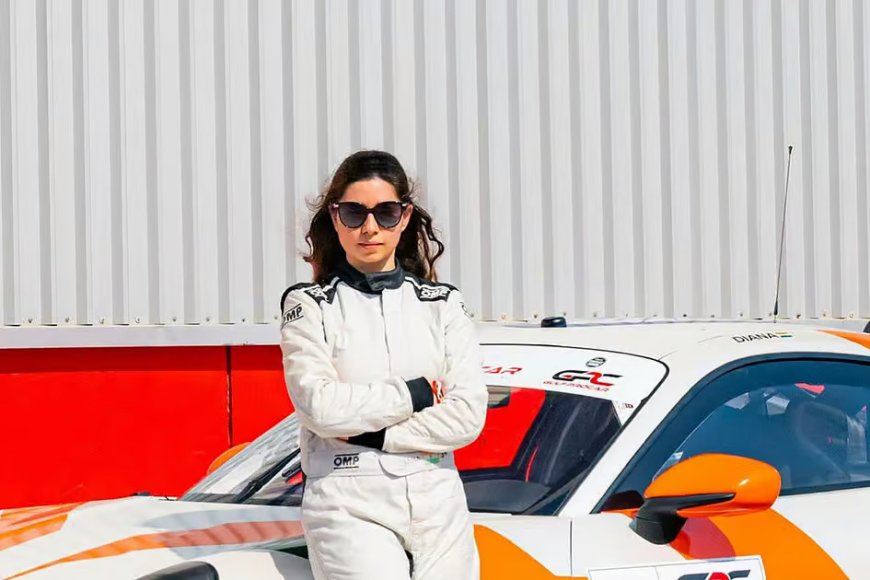
Table of Contents
- Introduction: A Prancing Horse With an Indian Heartbeat
- Who Is Diana Pundole?
- The Beginning: From Pune to the Racetrack
- Racing Against Doubt: Fighting Stereotypes in a Male-Dominated Sport
- The 2024 Breakthrough: A National Championship Like No Other
- The Ferrari Call: How the Historic Opportunity Came About
- Inside the Machine: The Ferrari 296 Challenge
- The Ferrari Challenge Middle East: Racing on F1 Circuits
- A Stunning International Debut
- More Than a Milestone: What This Means for Indian Motorsport
- What's Next for Diana Pundole?
- Final Thoughts: The Road Ahead
-
Introduction: A Prancing Horse With an Indian Heartbeat
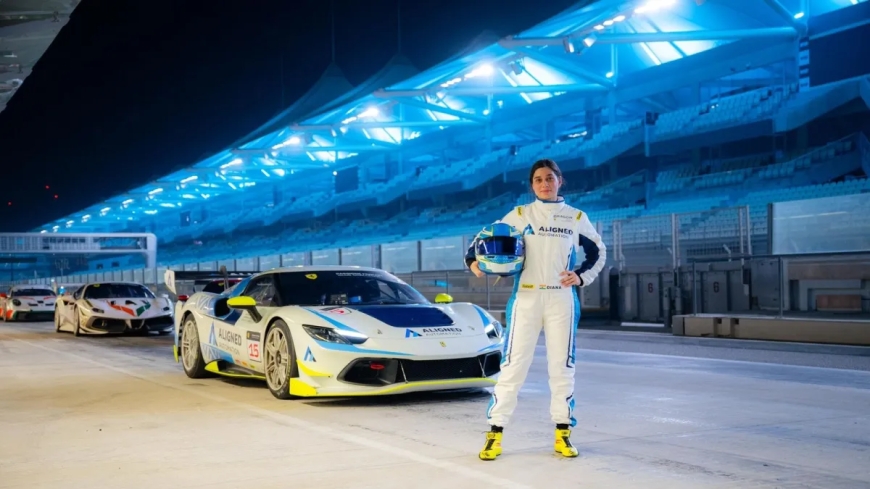
There are few sounds in the world as instantly recognisable as a Ferrari engine at full throttle. For decades, that sound has belonged to a select club of drivers, overwhelmingly male, overwhelmingly Western. But in November 2025, on the floodlit tarmac of the Yas Marina Circuit in Abu Dhabi, that sound carried something new: an Indian woman at the wheel, writing her name into motorsport history.
Diana Pundole, a racer from Pune, became the first Indian woman to compete in a Ferrari on the international championship stage. It was not a publicity stunt, not a ceremonial lap, but a genuine seat on a competitive grid in the Ferrari Challenge Middle East, one of the most demanding one-make racing series in the world.
Her story is not simply about speed. It is about persistence in the face of ridicule, about a woman who was told she did not belong on a racetrack and answered with lap times instead of arguments. This is the story of how she got there and why her achievement matters far beyond the finish line.
-
Who Is Diana Pundole?
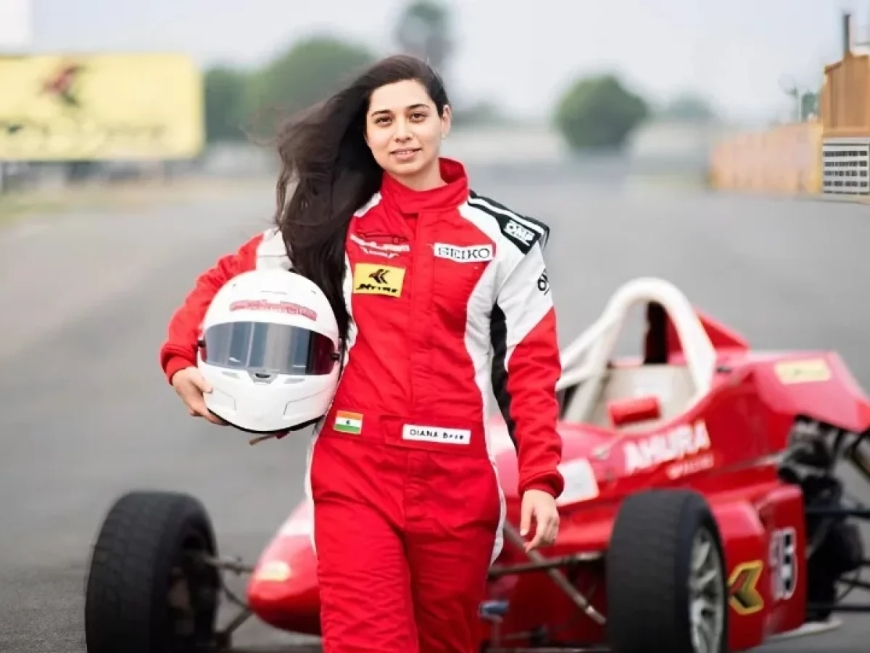
Diana Pundole is a 32-year-old racing driver from Pune, Maharashtra, and a mother of two. On paper, her profile defies almost every stereotype of what a professional racer is "supposed" to look like in India. She did not come from a family of motorsport insiders, nor did she have a fast track into the sport through wealth or connections.
What she did have was an inherited passion. Diana has often credited her late father, a devoted racing fan, with lighting the spark that would eventually define her life. Though he is no longer around to watch her race, his love for motorsport became the foundation of her ambition, a legacy she carries onto every grid she lines up on.
Away from the circuit, Diana leads a strikingly ordinary life. But the moment she pulls on a helmet, that ordinariness disappears. As she has described it herself, inside the cockpit there is no outside world, no noise, no expectations. Just instinct and the track.
-
The Beginning: From Pune to the Racetrack
Diana's formal racing journey began in 2018, when she joined the JK Tyre Women in Motorsport programme, an initiative created specifically to bring more Indian women into competitive racing. For a country where motorsport itself remains a niche pursuit, and where female participation is rarer still, the programme offered something invaluable: a legitimate entry point.
From there, Diana worked her way through the ranks of Indian national racing. She competed in categories such as the Indian Touring Cars and the Volkswagen Polo Cup, steadily collecting podium finishes and, more importantly, seat time. In motorsport, there is no substitute for experience, every race teaches a driver something about tyre behaviour, braking points, racecraft, and the mental discipline required to perform under pressure.
From 2022 onwards, her progress attracted the backing of RaceTech India, a Bangalore-based sports car tuning company, giving her the technical support to keep climbing. Race by race, season by season, she was building a résumé that would eventually become impossible to ignore.
-
Racing Against Doubt: Fighting Stereotypes in a Male-Dominated Sport
To understand the scale of Diana's achievement, you have to understand what she was up against and much of it had nothing to do with machinery.
Motorsport in India, as in much of the world, remains overwhelmingly male. When Diana began racing, she was frequently the only woman on the grid. She has spoken openly about the doubts, the ridicule, and the societal stereotypes she encountered, including criticism for choosing racing over a conventional, stable career path. Some people told her, in so many words, that she simply did not belong there.
Her response was characteristically understated. Rather than engaging in debates, she let her driving do the talking. "I never wanted my journey to be framed by gender. I wanted to be judged by my lap times," she has said, a statement that captures her entire philosophy.
That approach demanded a thicker skin and a stronger work ethic than most of her competitors would ever need. By her own account, she knew she had to work twice as hard to prove herself. She endured crashes, lost races, and finishes at the back of the field. What she never did was stop.
-
The 2024 Breakthrough: A National Championship Like No Other
Every barrier-breaking career has a turning point, and for Diana Pundole, it came in 2024.
That year, she made history by becoming the first Indian woman to win the MRF National Racing Championship in the Saloon Car category. The significance of this cannot be overstated: it made her the only Indian woman ever to win a four-wheeler national championship competing on completely equal footing with men.
This was not a women-only category or a special classification. It was an open championship, contested against the best saloon car racers in the country and she beat them.
The victory did more than deliver a trophy. It changed how the motorsport world perceived her. Sponsors, teams, and industry insiders who might once have dismissed her now had incontrovertible proof of her ability. In a sport where results are the only currency that truly matters, Diana was suddenly rich.
-
The Ferrari Call: How the Historic Opportunity Came About
After her championship win, Diana continued testing different racing machinery in the UAE, sharpening her skills on international circuits and quietly preparing for a bigger stage. That preparation, combined with her 2024 title, caught the attention of Aligned Automation, a technology services company that decided to back her through a corporate sponsorship programme.
With additional support from Ferrari New Delhi, the pieces fell into place for something no Indian woman had ever done: a full entry into the Ferrari Challenge Middle East, one of the Prancing Horse's official one-make championship series.
For Diana, the moment was surreal. She described being part of the series as "truly an incredible honour" not just a personal milestone, but a proud moment for women in Indian motorsport as a whole. After years of being questioned, she was now being handed the keys to one of the most iconic racing brands on the planet.
-
Inside the Machine: The Ferrari 296 Challenge
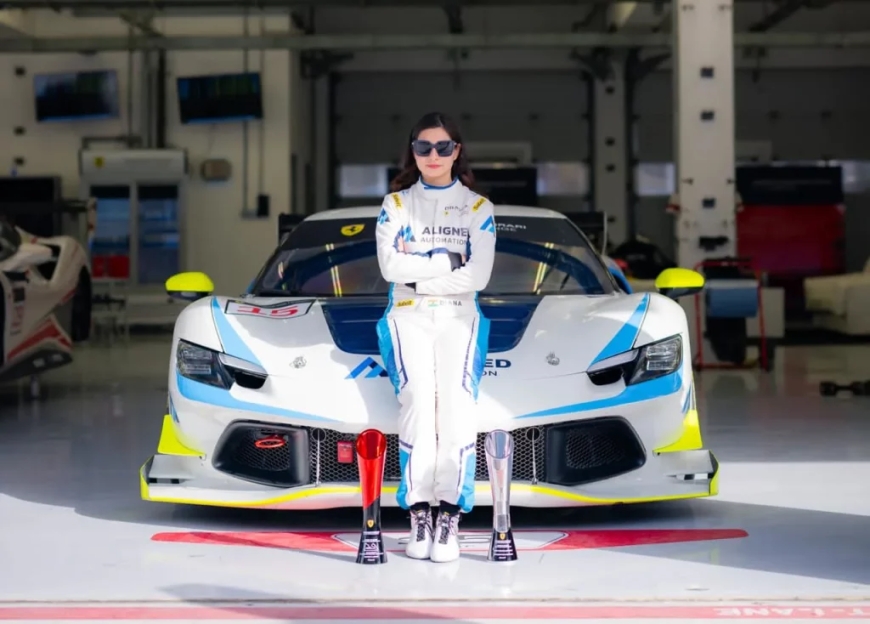
The car Diana races is no ordinary Ferrari. The Ferrari 296 Challenge is a purpose-built, track-only racing machine, the competition version of Ferrari's acclaimed 296 platform, stripped of every comfort and engineered purely for speed.
The numbers tell their own story. The car produces around 700 horsepower from its turbocharged V6 engine while weighing just 1,330 kilograms, giving it a power-to-weight ratio that would embarrass most supercars on the road. Advanced aerodynamics generate enormous downforce, allowing cornering speeds that push the human body to its limits. Out on the long straights of Formula One circuits, these machines reach staggering velocities, the kind of speed where a driver's reactions are measured in fractions of a second.
Diana has described the step up from her previous cars as a leap into an entirely different level of sophistication, speed, and control. Handling a machine like this requires far more than bravery. It demands intensive physical conditioning the neck, core, and cardiovascular strength to withstand sustained g-forces, as well as mental training, data analysis, and hundreds of hours of preparation that spectators never see.
-
The Ferrari Challenge Middle East: Racing on F1 Circuits
The Ferrari Challenge Middle East is not a regional side-show. Running from November 2025 to April 2026, the championship takes drivers to some of the most prestigious Formula One-certified circuits in the world, Yas Marina in Abu Dhabi, the Dubai Autodrome, the Bahrain International Circuit, and tracks in Qatar and Saudi Arabia.
These are the same venues where Formula One world champions do battle, with the same demanding layouts, the same unforgiving run-off zones, and the same world-class technical standards. The grid Diana joined featured experienced drivers from across the globe, each bringing their own racing pedigree and style.
Diana has spoken about the intensity of the competition and the charged, international atmosphere of the paddock, an environment where professionalism, technology, and speed operate at levels far beyond anything in domestic racing. For a driver whose journey began just seven years earlier on Indian national circuits, it represented the steepest possible learning curve.
She embraced it. In her own words, she treats every new track like a classroom, a place that teaches through repetition and humility.
-
A Stunning International Debut
If anyone expected Diana Pundole to be overwhelmed by the occasion, her debut race put that idea to rest emphatically.
On 9 November 2025, at the iconic Yas Marina Circuit, the venue that hosts the Formula One season finale, Diana lined up for her first-ever international championship race, surrounded by a field of twenty world-class drivers. It was her first taste of top-level global competition, in an unfamiliar car, on one of the most technical circuits in the calendar.
She finished fourth.
For a debutant, in a debut season, against seasoned international competition, it was a remarkable result, one Diana has said she will cherish forever. It also delivered a pointed message to every person who had ever doubted her: the first Indian woman on a Ferrari grid was not there to make up the numbers. She was there to compete.
Her campaign continued across Abu Dhabi and Bahrain, each round adding to her experience and confirming that her national success translated to the world stage.
-
More Than a Milestone: What This Means for Indian Motorsport
Diana Pundole's achievement lands at a fascinating moment for Indian sport. Across disciplines, Indian women are dismantling long-standing assumptions about which arenas belong to them and motorsport, perhaps the most stubbornly male-coded of them all, is now part of that story.
The significance operates on several levels. For Indian motorsport as an industry, having a driver on an official Ferrari championship grid raises the country's profile in a sport where India has historically been a peripheral player. For sponsors and manufacturers, it demonstrates that investing in Indian talent and specifically in female Indian talent, can deliver world-stage results.
But the deepest impact is cultural. Somewhere in India right now, a young girl watching Diana race is recalibrating her own sense of what is possible. Diana herself has framed it with typical modesty: if someone sees her race and thinks "if she can do it, I can too," then that is enough.
She never set out to be a symbol. She set out to race. Yet every time she lines up on a grid, another stereotype quietly falls away.
-
What's Next for Diana Pundole?
Far from treating the Ferrari Challenge as a career summit, Diana is already mapping an even more ambitious road ahead. Her upcoming plans include a six-hour endurance race in Abu Dhabi, the legendary 24 Hours of Dubai endurance event, and a move into European competition through the Porsche Swiss Cup.
Endurance racing represents a new discipline altogether one that tests consistency, stamina, and teamwork over hours rather than sprint distances. That she is willing to take it on speaks to the same restless ambition that carried her from a Pune novice programme to a Ferrari cockpit in just seven years.
Her guiding philosophy remains unchanged: expect the worst, prepare relentlessly, stay adaptable. It is an approach forged through crashes, setbacks, and last-place finishes and it has never failed her yet.
-
Final Thoughts: The Road Ahead
Diana Pundole's story resists easy packaging. It is tempting to reduce it to a headline, first Indian woman to race a Ferrari, but the headline only captures the destination, not the journey. The journey involved years of being underestimated, of self-funding a dream that many around her called foolish, of losing before winning and getting up before anyone noticed she had fallen.
What makes her achievement resonate is precisely that it was earned the hard way, on merit, against open competition. She did not ask for a special category or a softer standard. She asked only to be judged by her lap times and by that measure, she now stands alone in Indian motorsport history.
The barriers she has broken will not rebuild themselves. The next Indian woman who dreams of racing a Ferrari will no longer be dreaming of the impossible only of following a path that Diana Pundole has already driven, at full throttle, with the whole world finally watching.
What's Your Reaction?
 Like
0
Like
0
 Dislike
0
Dislike
0
 Love
0
Love
0
 Funny
0
Funny
0
 Wow
0
Wow
0
 Sad
0
Sad
0
 Angry
0
Angry
0

A spirit that pursues sunsets and tales. Entrepreneur at heart, globe-trotter by soul. Founder of an art-worshiping jewelry brand that embodies emotion & individuality — where each piece is a tale of culture, craft, and character. From trails up mountains to gem markets, I'm inspired by all journeys — transforming wanderlust into enduring design. Establishing a brand built on authenticity, refinement & purpose — one work at a time.















Comments (0)