

The Hidden Edo-Era Bathhouse That Captures Tokyo's Soul
Tucked down a Ginza side street, Konparu-yu is a working bathhouse from 1863 that has survived earthquakes, war and skyscrapers. Discover the hidden Edo-era sento that captures the true soul of Tokyo and how to visit it yourself.
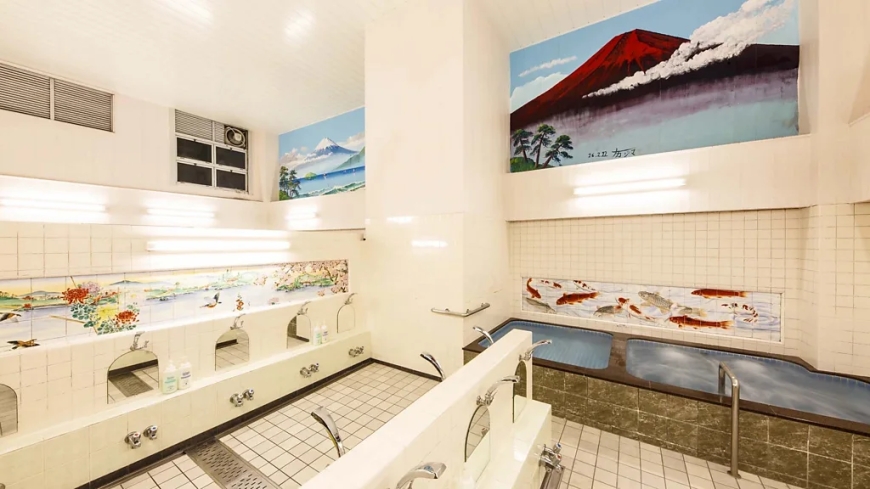
Table of Contents
- Introduction: A Doorway to Old Edo in the Middle of Ginza
- What Exactly Is a Sento and Why It Matters
- The Story of Konparu-yu: Born in 1863, Still Steaming
- A Name Borrowed from the Noh Stage
- Surviving the Impossible: Fire, War and Real Estate
- Stepping Inside: What the Experience Is Actually Like
- The Art on the Walls: Murals, Carp and Mount Fuji
- Why Locals Still Come and Why That's the Point
- How to Visit Konparu-yu: Practical Guide
- Sento Etiquette: The Unwritten Rules Made Simple
- The Bigger Picture: Tokyo's Vanishing Bathhouses
- Final Thoughts: Why This Small Bathhouse Captures Tokyo's Soul
-
Introduction: A Doorway to Old Edo in the Middle of Ginza
Ginza is the last place in Tokyo you'd expect to find the past hiding in plain sight. This is the city's most polished district, a grid of flagship boutiques, marble showrooms, Michelin-starred restaurants and glass towers, built on some of the most valuable land in Japan. Tour buses release waves of shoppers onto Chuo-dori every hour. Everything here shines.
And yet, a few steps off the main avenue, down a narrow side street you'd walk past a hundred times without noticing, hangs a faded noren curtain and a small blue sign marked with the ♨ symbol. Push through it, and you leave the twenty-first century entirely.
This is Konparu-yu, a neighbourhood bathhouse that first opened its doors in 1863, in the final years of the Edo period when Tokyo was still called Edo, samurai still walked its streets, and the Shinsengumi had only just been formed. More than 160 years later, the taps are still running, the water is still hot, and locals still soak here after work as their great-great-grandparents might have done.
Plenty of places in Tokyo perform history for visitors. Konparu-yu simply lives it. That's what makes it, quietly and without any fuss, one of the most soulful experiences the city has to offer.
-
What Exactly Is a Sento and Why It Matters
Before going further, it helps to understand what kind of place this is. A sento is a public bathhouse not to be confused with an onsen, which draws on natural hot spring water. Sento use heated tap water, and historically they existed for a very practical reason: most Japanese homes, well into the twentieth century, had no private bath.
For centuries, the sento was where daily life happened. Neighbours caught up on gossip, business was discussed, children learned to behave in shared spaces, and the day's stresses dissolved into the steam. Bathing together, in Japan, has never only been about getting clean. It's a social ritual, a great equaliser where everyone, stripped of clothing and status, sits on the same low stools and soaks in the same water.
As private bathrooms became universal, sento began disappearing at a startling pace. Tokyo once had thousands; today only a few hundred remain, and the number shrinks each year. Every surviving bathhouse is therefore something more than a business. It's a fragment of a communal way of life that modern Tokyo has largely left behind which is exactly why finding one that dates back to the Edo period itself feels close to miraculous.
-
The Story of Konparu-yu: Born in 1863, Still Steaming
Konparu-yu opened in 1863 in what was then the heart of feudal Edo. To put that date in perspective: the United States was in the middle of its Civil War, Japan's borders had only just been forced open to the West, and the shogunate that had ruled the country for two and a half centuries had barely five years left to live.
The bathhouse has naturally changed form over the decades. The original wooden structure is long gone; in 1957, the building was rebuilt so that the bathhouse now occupies the lower floor of a modern building an unusual arrangement at the time. But the location has never moved, and neither has the purpose. Through every reconstruction, the same plot of Ginza land has been dedicated to the same simple service: hot water, offered to anyone, for the price of pocket change.
Inside, the sense of continuity is immediate. There's a traditional bandai, the raised wooden reception counter from which the attendant oversees the premises vintage shoe lockers near the entrance, and a strikingly high latticed ceiling that instantly evokes the atmosphere of old Tokyo. The bathing area itself is intimate: two compact tubs, one comfortably warm and one heated to a bracing 42°C or so. There is no sauna, no jet-lag recovery menu, no wellness branding. It's a bathhouse in the oldest, plainest sense of the word and that plainness is precisely its charm.
-
A Name Borrowed from the Noh Stage
Even the name carries history. "Konparu" is said to come from the Konparu school of Noh theatre one of the classical schools of Japan's ancient masked drama because a residence connected to Noh actors once stood on this land. In a single word, the bathhouse ties itself to a performing art that predates it by centuries.
It's a small detail, but a telling one. In Ginza, where buildings are demolished and rebuilt in cycles measured in decades, Konparu-yu's name preserves a memory of what the neighbourhood was before the department stores arrived. The land remembers, even when the skyline doesn't.
-
Surviving the Impossible: Fire, War and Real Estate
The most remarkable thing about Konparu-yu isn't its age it's everything that age implies. Consider what this single plot of land has lived through.
The Great Kanto Earthquake of 1923 flattened and burned enormous swathes of Tokyo. The firebombing raids of 1945 devastated the city again, wiping out the majority of its bathhouses; of the roughly 2,900 sento operating in Tokyo before the war, only around 400 were left standing by its end. Then came perhaps the strangest threat of all: the 1980s bubble economy, when Ginza real estate became, by some measures, the most expensive land on Earth. A modest bathhouse charging a few hundred yen per customer, sitting on ground worth a fortune, should not by any commercial logic still exist.
And yet it does. While its neighbours became boutiques and office towers, Konparu-yu kept filling its tubs. At one point Ginza had eight public bathhouses; today, Konparu-yu is one of only two that remain in the district. Its survival isn't an accident of neglect. It's the result of generations of owners choosing, again and again, to keep something alive that the market gave every reason to abandon.
That stubbornness is a very Tokyo trait. This is a city that reinvents itself relentlessly, yet tucks small acts of preservation into its side streets, a shrine wedged between skyscrapers, a family noodle shop under a railway arch, a bathhouse behind a cosmetics showroom.
-
Stepping Inside: What the Experience Is Actually Like
Visiting Konparu-yu is refreshingly unceremonious. You slide your shoes into a wooden locker, pay a small entry fee at the counter (around ¥520 for adults likely the cheapest thing you'll buy in Ginza all day), and pass into gender-separated changing rooms.
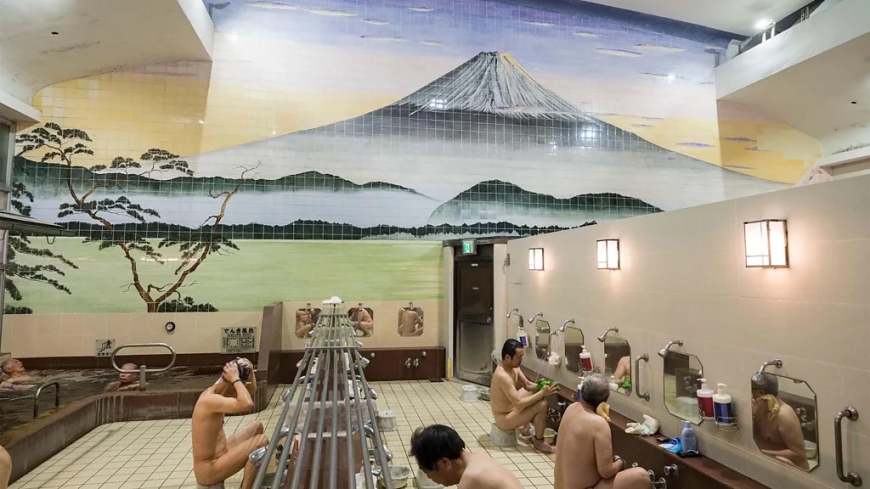
The bathing room is compact and honest. Rows of low stools and hand showers line the walls for the all-important pre-soak wash in Japan, you scrub thoroughly before entering the tub, never in it. Then comes the choice: the nurui (warm) bath or the atatakai (hot) one, though first-timers should know that "warm" by sento standards is still plenty hot for most people.
Then you simply sit. Steam rises. The murmur of water echoes off tiles. An office worker soaks with his eyes closed; an elderly regular exchanges a few words with the attendant. Outside, one of the busiest luxury districts on the planet hums along, and none of it reaches you.
Evenings can get genuinely busy this is a working bathhouse serving its neighbourhood, and it's not unusual for the tubs to be full by early evening. That crowding, honestly, is part of the experience. You haven't wandered into a museum reconstruction. You've joined a living routine.
-
The Art on the Walls: Murals, Carp and Mount Fuji
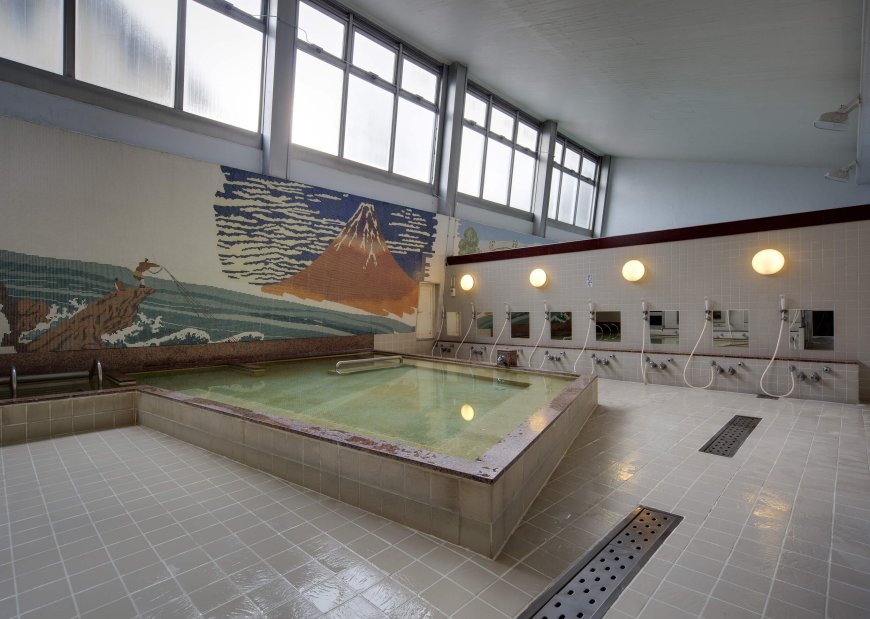
No traditional sento is complete without bath art, and Konparu-yu delivers beautifully. The bathing area features a mural of Mount Fuji the classic sento motif painted by a professional bathhouse artist, a genuine and dwindling craft in Japan where only a handful of dedicated sento painters still work.
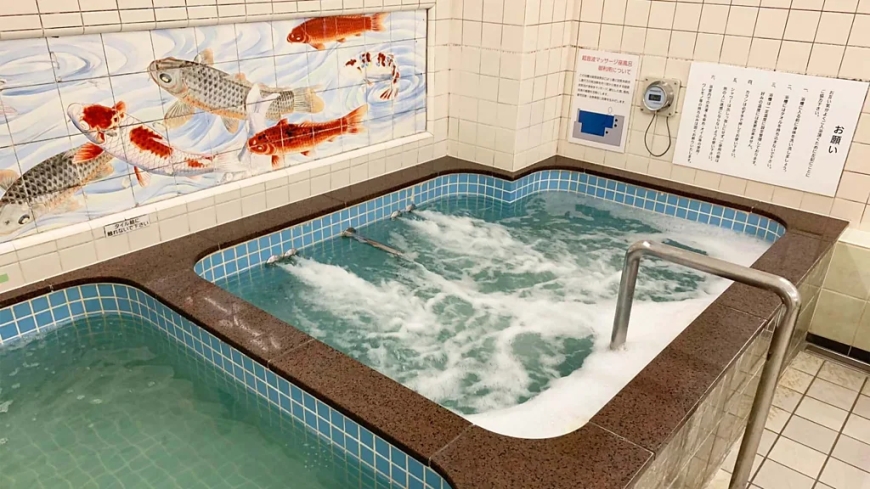
Even more distinctive are the Kutani porcelain tile panels depicting carp gliding among seasonal flowers and birds. Soaking in hot water while gazing at hand-crafted images of koi and spring blossoms is the kind of small aesthetic pleasure that Japanese design does better than anywhere else beauty placed exactly where daily life happens, not roped off behind glass.
And in a lovely seasonal touch, the bathhouse periodically floats real flowers in its tubs on special days worth checking their schedule if you'd like your soak with an extra flourish.
-
Why Locals Still Come and Why That's the Point
It would be easy to frame Konparu-yu as a tourist curiosity, but that would miss what makes it special. The people in the water beside you are mostly locals: shopkeepers, office workers, longtime residents of Chuo ward. Some come out of habit, some for the ritual, some simply because a deep hot soak at day's end is one of life's reliable pleasures.
This is what separates a genuine cultural experience from a staged one. At Konparu-yu, nothing is being performed for you. The bathhouse would run exactly the same way if no traveller ever found it. As a visitor, you're not the audience, you're a temporary participant in a neighbourhood ritual that has repeated itself daily since the age of the samurai.
If you want to understand Tokyo, a city so often described as futuristic this is the counterweight: an institution built on trust, routine, community and the radical idea that some things don't need upgrading.
-
How to Visit Konparu-yu: Practical Guide
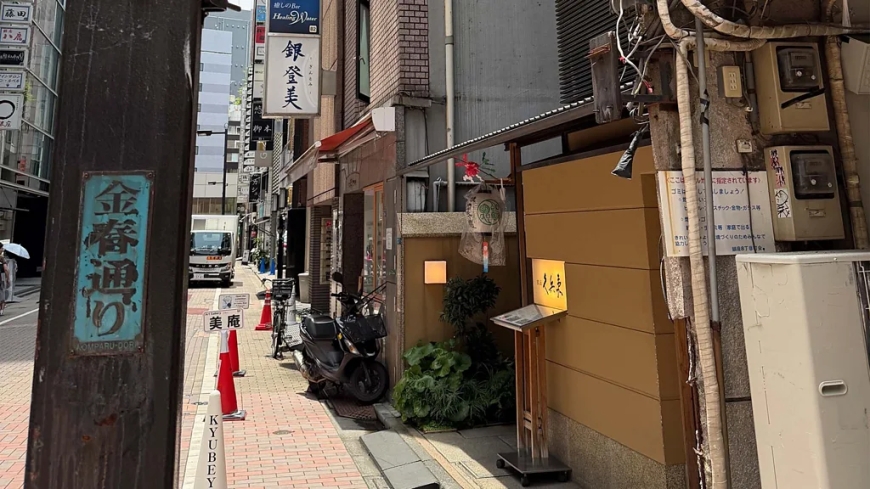
Location: 8-7-5 Ginza, Chuo City, Tokyo on a small street parallel to Chuo-dori, in the Ginza 8-chome area.
Nearest stations: Shinbashi Station and Ginza Station are both a short walk away, making the bathhouse easy to combine with a day of exploring central Tokyo.
Hours: Generally open from 2pm to 10pm on weekdays (shorter hours on Saturdays), and closed on Sundays and public holidays, plan around this, as it catches many visitors out.
Price: Around ¥520 for adults, with discounted rates for children, extraordinary value in a district where a coffee can cost triple that.
What to bring: A small towel and basic toiletries if you have them; simple amenities can usually be purchased on site for a small fee. Tattoo policies at small sento tend to be more relaxed than at onsen resorts, but discretion and courtesy always help.
Best time to go: Mid-afternoon on a weekday is your quietest window. Evenings fill up fast with the after-work crowd.
-
Sento Etiquette: The Unwritten Rules Made Simple
First-time bathers sometimes feel nervous, but the rules are simple and forgiving:
Wash and rinse yourself completely at the shower stations before entering any tub. Bathe fully unclothed swimwear is not worn in a sento. Keep your small towel out of the bathwater (folding it on your head is the time-honoured solution). Tie up long hair, keep conversation gentle, and rinse your stool and station when you finish. That's genuinely all there is to it. Follow these basics and you'll be welcomed like anyone else.
-
The Bigger Picture: Tokyo's Vanishing Bathhouses
Konparu-yu's story carries a bittersweet edge. Tokyo's sento are closing at a steady rate squeezed by ageing owners, rising fuel costs, redevelopment pressure and homes that no longer need them. Wards that once held dozens of bathhouses now count them on one hand, and beloved institutions elsewhere in the city have been demolished in recent years despite passionate preservation campaigns.
Every visit to a surviving bathhouse is, in a modest way, a vote for its future. The few hundred yen you spend at Konparu-yu does more real cultural preservation than most souvenir purchases ever will. You're not just having an experience you're helping ensure the next traveller can have it too.
-
Final Thoughts: Why This Small Bathhouse Captures Tokyo's Soul
Tokyo's soul isn't found in its observation decks or its robot-themed attractions. It lives in the tension the city holds so gracefully: relentless reinvention on the surface, deep continuity underneath.
Konparu-yu embodies that tension in a single small room. A bathhouse born under the shogunate, wearing a Noh theatre name, wrapped inside a modern Ginza building, painted with Mount Fuji, filled each evening with ordinary Tokyoites doing what their ancestors did, while some of the most expensive real estate on Earth glitters a few metres away.
You can see all of Tokyo's famous sights and still miss the city entirely. Or you can spend an hour and a few hundred yen down a Ginza back street, sink into hot water beneath a painted mountain, and feel genuinely, the thread that connects modern Tokyo to old Edo. That thread is still warm. Go and hold it while you can.
What's Your Reaction?
 Like
0
Like
0
 Dislike
0
Dislike
0
 Love
0
Love
0
 Funny
0
Funny
0
 Wow
0
Wow
0
 Sad
0
Sad
0
 Angry
0
Angry
0

A spirit that pursues sunsets and tales. Entrepreneur at heart, globe-trotter by soul. Founder of an art-worshiping jewelry brand that embodies emotion & individuality — where each piece is a tale of culture, craft, and character. From trails up mountains to gem markets, I'm inspired by all journeys — transforming wanderlust into enduring design. Establishing a brand built on authenticity, refinement & purpose — one work at a time.













Comments (0)