

Beyond Keukenhof: Where Locals Go to See the Netherlands' Most Stunning Tulips
Skip the crowds at Keukenhof and discover where Dutch locals actually go for tulip season. From the Noordoostpolder to hidden flower routes in Noord-Holland, here's your insider guide to the Netherlands' most stunning tulip fields.
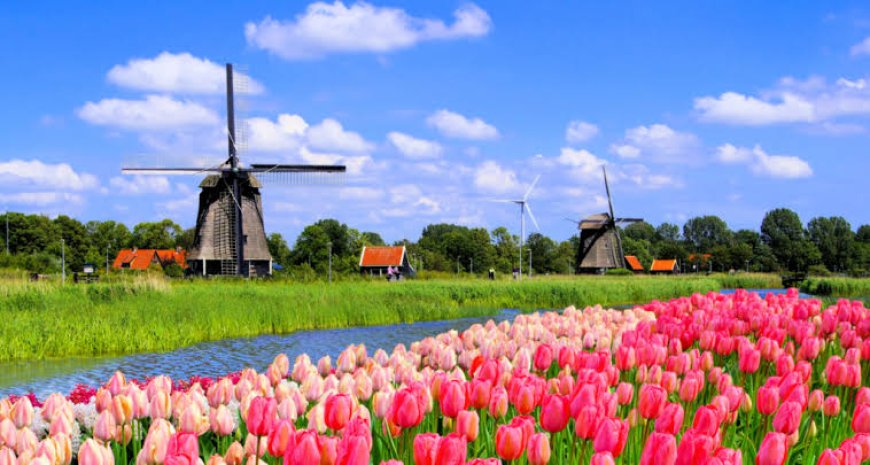
Table of Contents
- Introduction: The Tulip Experience Most Tourists Never See
- Why Look Beyond Keukenhof?
- Understanding Dutch Tulip Season: Timing Is Everything
- The Noordoostpolder: The Largest Tulip Region in the Netherlands
- The Bollenstreek: Cycling the Flower Strip Like a Local
- Noord-Holland: Tulips Between the Dunes and the Dijk
- The Kop van Noord-Holland and the Flower Days of Anna Paulowna
- Flevoland's Tulip Route: A Drive Through a Sea of Colour
- How to Visit Tulip Fields Respectfully
- Practical Tips: Getting There, Bikes, and What to Bring
- Final Thoughts: The Real Tulip Country
-
Introduction: The Tulip Experience Most Tourists Never See
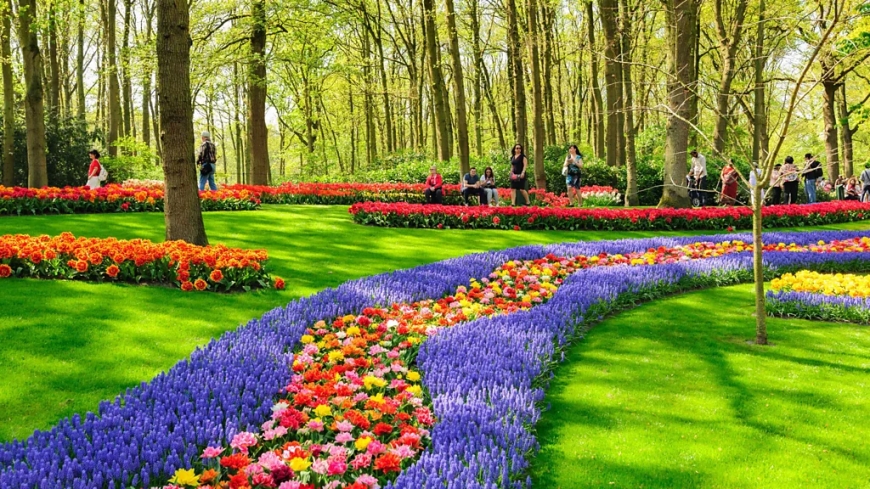
Every spring, over a million visitors funnel through the gates of Keukenhof, the world-famous garden in Lisse where seven million bulbs bloom in carefully curated displays. It's beautiful nobody disputes that. But ask a Dutch person where they go to see tulips, and Keukenhof is rarely the answer.
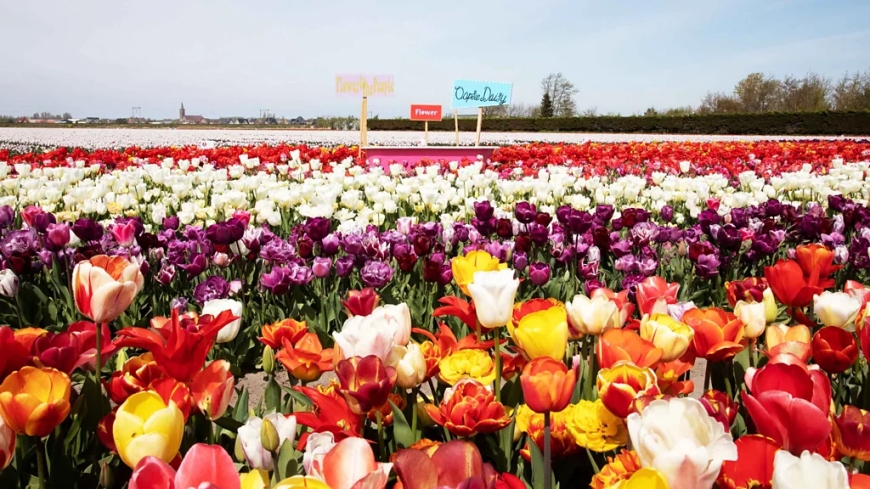
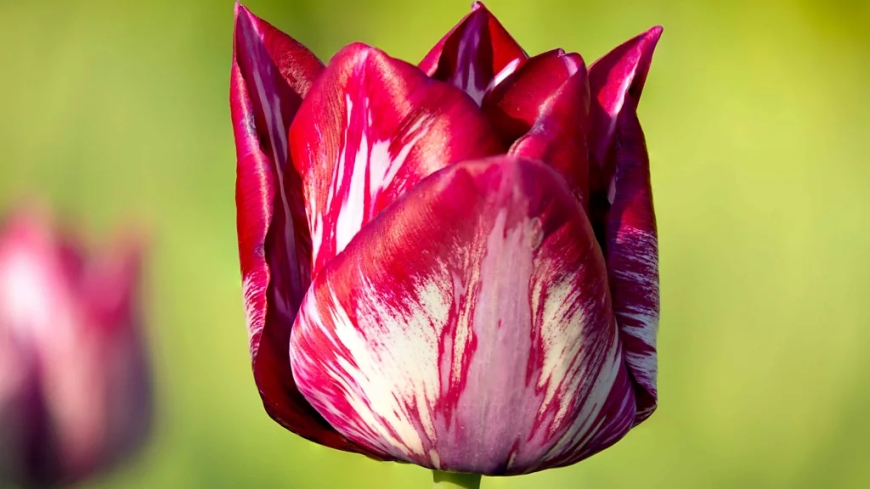
The Netherlands grows tulips on a scale that most visitors never grasp. Thousands of hectares of working farmland erupt into stripes of red, yellow, pink, purple, and orange each April, and the vast majority of these fields lie far from any ticket booth or tour bus. They stretch across reclaimed polders in Flevoland, hug the dunes of Noord-Holland, and blanket the countryside around small farming villages where the loudest sound in April is the wind and the occasional passing bicycle.
This is the tulip landscape locals know: free to see, endlessly photogenic, and blissfully uncrowded. This guide takes you there, to the regions, routes, and villages where the Netherlands' real tulip country reveals itself.
-
Why Look Beyond Keukenhof?
Let's be fair to Keukenhof first. As a showcase of horticultural artistry, it's world-class. If you've never seen it and you're in the area, it's worth a visit.
But Keukenhof comes with real drawbacks. It's open only for roughly eight weeks a year, tickets must often be booked in advance, and on peak weekends the paths can feel more like a queue than a garden. Crucially, Keukenhof is a garden, a designed display. It's not the agricultural tulip landscape that made the Netherlands famous.
The working tulip fields offer something fundamentally different:
- Scale. A single commercial field can cover more ground than several Keukenhof display gardens combined, and regions like the Noordoostpolder contain thousands of hectares of blooms.
- Authenticity. These are working farms. The tulips are grown for their bulbs, tended by families who have often farmed the same land for generations.
- Freedom. No opening hours, no entrance fees, no crowds. You can cycle past fields at 7am with golden light spilling across the colour bands and not see another soul.
- Variety of landscape. Tulips against dunes, tulips beside windmills, tulips stretching to a dead-flat polder horizon, each region frames the flowers differently.
The trade-off is that you need to know where to go and when. That's what the rest of this guide is for.
-
Understanding Dutch Tulip Season: Timing Is Everything
Tulip season in the Netherlands generally runs from late March to mid-May, but the true peak for field colour is usually mid-April to early May. A few things every visitor should understand:
The season moves with the weather. A warm early spring can push peak bloom into the first half of April; a cold one can delay it towards May. Locals watch the fields, not the calendar.
Crocuses and daffodils come first. From late March, the bulb regions glow yellow and white before the tulips take over. If you visit early, you'll still find colour just a different palette.
Topping happens fast. Because commercial growers cultivate tulips for bulbs rather than blooms, the flower heads are mechanically removed ("topped") shortly after full bloom to send energy back into the bulb. A field that's a blaze of red one weekend can be green stubble the next. This is why timing matters more here than at Keukenhof, where displays are managed for continuous show.
Regional differences help you. The Bollenstreek (near the coast, south of Haarlem) tends to bloom slightly earlier, while the Noordoostpolder and the Kop van Noord-Holland often peak a week or so later. If you miss peak bloom in one region, you may still catch it in another.
-
The Noordoostpolder: The Largest Tulip Region in the Netherlands
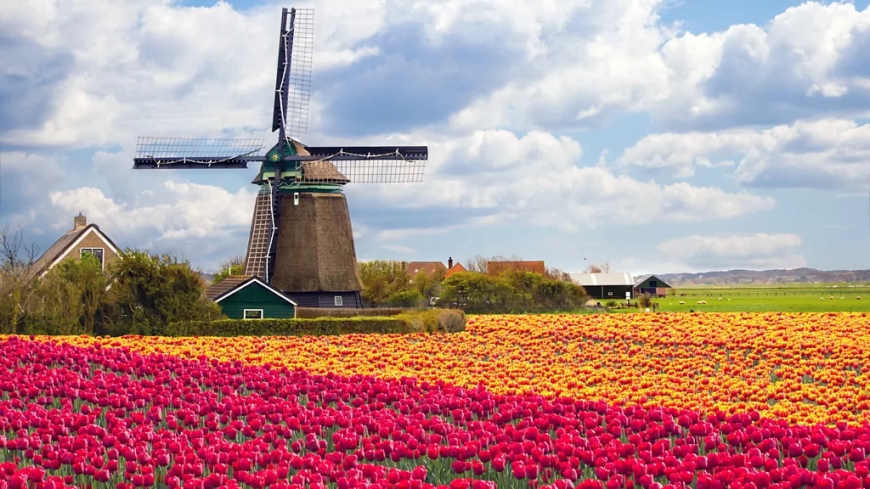
Here's the fact that surprises almost everyone: the biggest tulip-growing area in the Netherlands isn't near Keukenhof at all. It's the Noordoostpolder in Flevoland, land that didn't even exist a century ago, reclaimed from the Zuiderzee in the 1940s.
The polder's young, fertile clay soil turned out to be superb for bulb cultivation, and today the region hosts well over a thousand hectares of tulips, significantly more than the famous Bollenstreek. Because the polder was designed from scratch, the fields are vast, geometric, and uninterrupted, creating colour bands that run to the horizon in a way you simply don't see in the older bulb regions.
Each spring, the area celebrates with the Tulip Festival Noordoostpolder, typically running from mid-April to early May. A signposted tulip route of around 100 kilometres winds through the fields and can be driven, cycled in sections, or explored via shorter marked loops. Along the way you'll find show gardens, viewing points, pick-your-own tulip stands, and farms that open their doors to visitors.
The town of Emmeloord makes a practical base, and villages like Creil and Espel sit right among the most concentrated blooms. Despite the festival's growing reputation among Dutch day-trippers, international tourists remain rare here. If you want the "endless tulip field" photograph without a single stranger in the frame, this is where you'll get it.
-
The Bollenstreek: Cycling the Flower Strip Like a Local
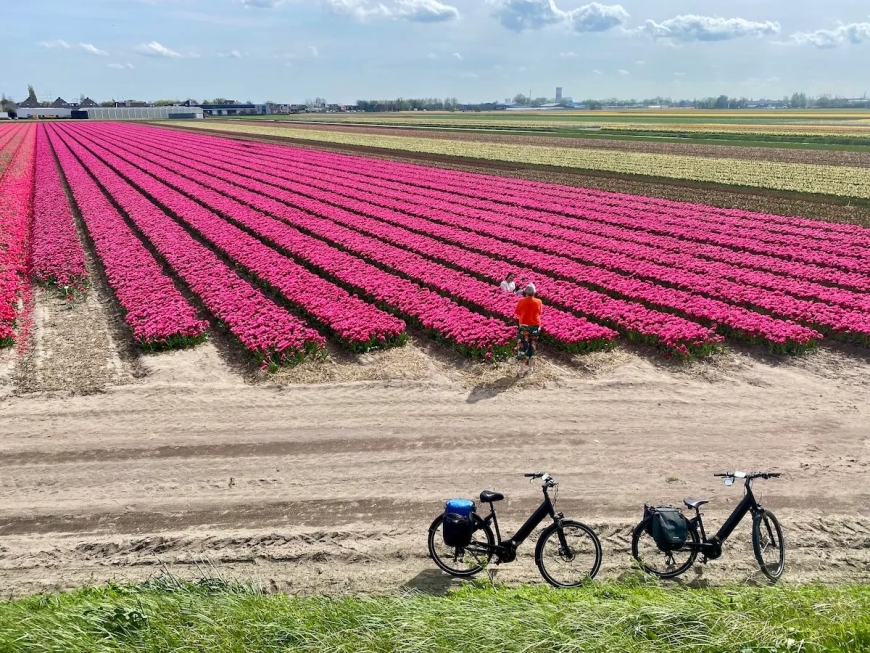
The Bollenstreek, literally "bulb strip" is the classic tulip region between Haarlem and Leiden, and it's where Keukenhof itself sits. But here's the local secret: you don't need a Keukenhof ticket to enjoy it. The fields around the garden are free, and the best way to experience them is exactly how the Dutch do by bicycle.
The sandy soil behind the coastal dunes here has supported bulb growing since the 17th century, and villages like Lisse, Hillegom, Sassenheim, Voorhout, and Noordwijkerhout are surrounded by working fields every spring.
A few favourite approaches:
- The Bollenstreek cycling routes. Well-marked paths connect the bulb villages, weaving directly between the fields. Rent a bike in Haarlem, Leiden, or Lisse and follow the junction-numbered knooppunten network to build your own loop of 20–40 km.
- The dune-and-flower combination. Ride towards Noordwijk and you can combine tulip fields with North Sea beaches and dunes in a single afternoon, a pairing few first-time visitors realise is possible.
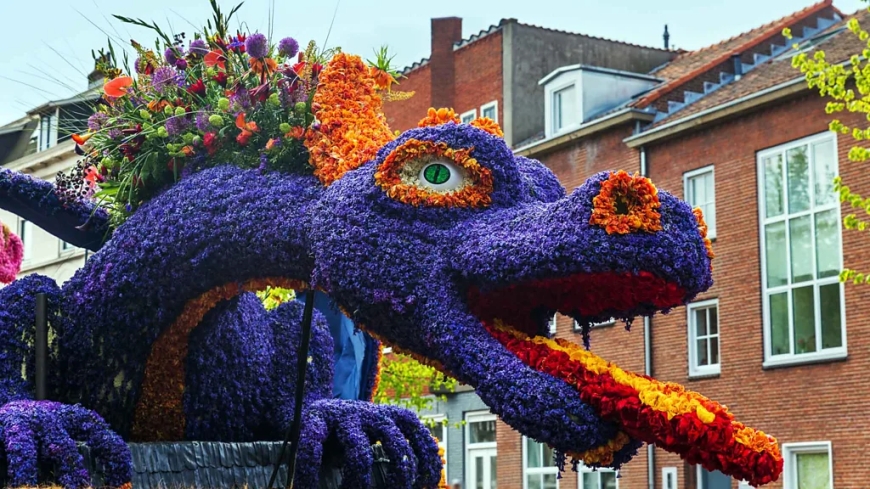
- The Flower Parade (Bloemencorso). One Saturday each April, an extraordinary procession of floats built entirely from flowers travels roughly 40 km from Noordwijk to Haarlem, passing through the bulb villages. Locals line the route with picnics; it's festive, free, and gloriously Dutch.
Visit on a weekday morning and even this famous region feels surprisingly calm. The crowds are inside Keukenhof; the fields outside belong to the cyclists.
-
Noord-Holland: Tulips Between the Dunes and the Dijk
North of Amsterdam, the province of Noord-Holland hides some of the country's most atmospheric bulb landscapes and some of its least-visited.
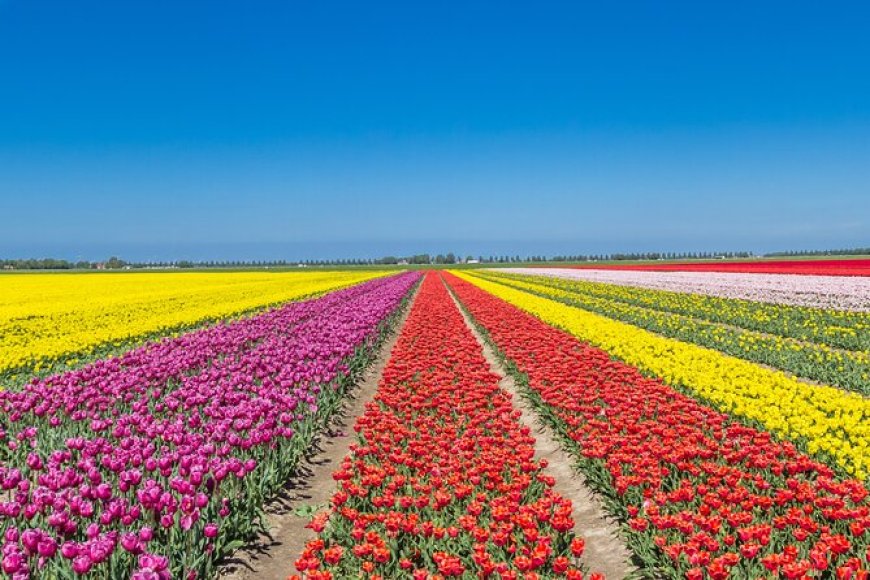
Around the towns of Schagen, Petten, and along the coastal strip near Julianadorp, tulip fields press right up against the dunes. The village of Julianadorp proudly styles itself as being at the heart of one of the largest connected bulb areas in the world, and in late April the drive or ride along the coast here is a ribbon of colour with the sea just over the dune ridge.
Further inland, the area around De Rijp and the Beemster polder, a UNESCO World Heritage landscape of 17th-century land reclamation, mixes tulip fields with historic wooden villages, stolp farmhouses, and windmills. It's the picture-postcard Netherlands, minus the tour groups.
This region rewards slow travel. There's no single famous festival to anchor a visit; instead, you wander, follow the colour, stop at farm stalls selling bunches of fresh tulips for a few euros, and enjoy having the landscape almost to yourself.
-
The Kop van Noord-Holland and the Flower Days of Anna Paulowna
At the very top of the province the "head" of Noord-Holland lies a bulb region that even many Dutch people outside the area don't know well. Around the villages of Anna Paulowna and Breezand, the flat land between the Wadden coast and the North Holland Canal turns into a patchwork of colour each spring.
The local highlight is the Bloemendagen (Flower Days) of Anna Paulowna, usually held in late April or early May. During this community festival, residents create enormous mosaics, intricate pictures made entirely from hyacinth and tulip petals displayed in front gardens throughout the villages. Entire neighbourhoods take part, and a marked route lets you walk or cycle from mosaic to mosaic, surrounded all the while by blooming fields.
It's the kind of event that captures what tulip season means to the people who actually live in bulb country: not a tourist spectacle, but a village tradition. Visitors are welcomed warmly precisely because there aren't many of them.
Nearby, ferries from Den Helder cross to the island of Texel, which grows its own tulip fields, meaning you can, with a little planning, combine island beaches, seals, and tulips in one long spring day.
-
Flevoland's Tulip Route: A Drive Through a Sea of Colour
Beyond the Noordoostpolder, the rest of Flevoland, the world's largest artificial island, reclaimed in the mid-20th century, offers its own signposted spring driving routes through eastern and southern Flevoland, around towns like Dronten, Lelystad, and Zeewolde.
Because Flevoland's roads are modern and its fields enormous, this is the most car-friendly tulip experience in the country ideal if you're travelling with limited time, small children, or mobility constraints and can't manage a long cycle. Pull-in viewing points along the routes let you photograph the fields safely without trampling anyone's crop.
Flevoland also adds a striking modern contrast: wind turbines rising out of the colour bands, land art installations on the polder, and the knowledge that everything you're looking at soil, road, and flower sits on what was seabed within living memory. It's the Netherlands' engineering story and its floral story told in a single view.
-
How to Visit Tulip Fields Respectfully
This matters enough to deserve its own section. The fields are not public parks they're the livelihood of farming families, and in recent years careless visitors have caused real damage. A few walked-on rows can destroy thousands of euros' worth of bulbs, and growers have increasingly had to fence fields or post pleading signs.
The local code is simple:
- Never enter a field without explicit permission. Photograph from roads, paths, and field edges.
- Don't walk between the rows. even the strips of bare soil hide bulbs and roots.
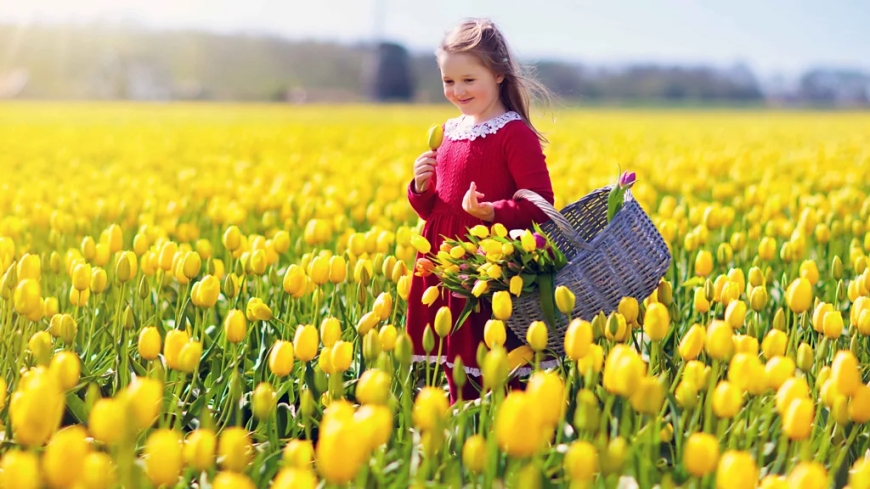
- Don't pick flowers. Buy a bunch from a farm stall instead; they're inexpensive and fresher than anything at home.
- Look for official photo spots. During festival periods, many farms set up designated areas, picking gardens, and even flower "selfie spots" precisely so visitors can get their photos without harming the crop.
- Park considerately on rural roads; leave passage for tractors and residents.
Follow these basics and you'll be welcomed everywhere. The growers are, on the whole, proud of their fields and happy to see people enjoying them respectfully.
-
Practical Tips: Getting There, Bikes, and What to Bring
Getting around. The Bollenstreek is easily reached by train (Haarlem, Leiden, or Hillegom stations) plus a rental bike. The Noordoostpolder, Flevoland routes, and Kop van Noord-Holland are far easier with a car, though buses do serve the main towns.
Bike rental. Available in virtually every Dutch town; expect to pay a modest daily rate. E-bikes are widely available and worth it if headwinds worry you — the polders are flat but famously breezy.
Best time of day. Early morning and the golden hour before sunset give the richest colours and the emptiest roads. Midday light flattens the fields.
Weather. Dutch spring is changeable. Bring layers, a windproof jacket, and accept that a passing shower is part of the experience — the light after rain is often the best of the day.
Photography. A polarising filter deepens the colour contrast; a step-ladder or raised roadside verge helps you shoot across the colour bands rather than along them.
Combine regions. With a car and two days, you can comfortably pair the Bollenstreek with the Noordoostpolder, hedging your bets on bloom timing across both.
-
Final Thoughts: The Real Tulip Country
Keukenhof will always be the postcard. But the Netherlands' true tulip story is written across its farmland, in the geometric colour fields of a polder that used to be sea, in village flower mosaics assembled by hand, in a farmer's honesty-box stall selling twenty stems for pocket change.
Go where the locals go, and tulip season stops being an attraction you visit and becomes a landscape you're briefly, wonderfully inside. Rent the bike. Take the quiet road north. Follow the colour.
The fields are waiting and there's no queue.
What's Your Reaction?
 Like
0
Like
0
 Dislike
0
Dislike
0
 Love
0
Love
0
 Funny
0
Funny
0
 Wow
0
Wow
0
 Sad
0
Sad
0
 Angry
0
Angry
0

A spirit that pursues sunsets and tales. Entrepreneur at heart, globe-trotter by soul. Founder of an art-worshiping jewelry brand that embodies emotion & individuality — where each piece is a tale of culture, craft, and character. From trails up mountains to gem markets, I'm inspired by all journeys — transforming wanderlust into enduring design. Establishing a brand built on authenticity, refinement & purpose — one work at a time.













Comments (0)