

Theyyam: When Men Become Gods in Kerala's Ancient Trance Ritual
Discover Theyyam, the ancient trance ritual of North Kerala where ordinary men transform into living gods. Explore its history, costumes, types, and where to witness this sacred art form.
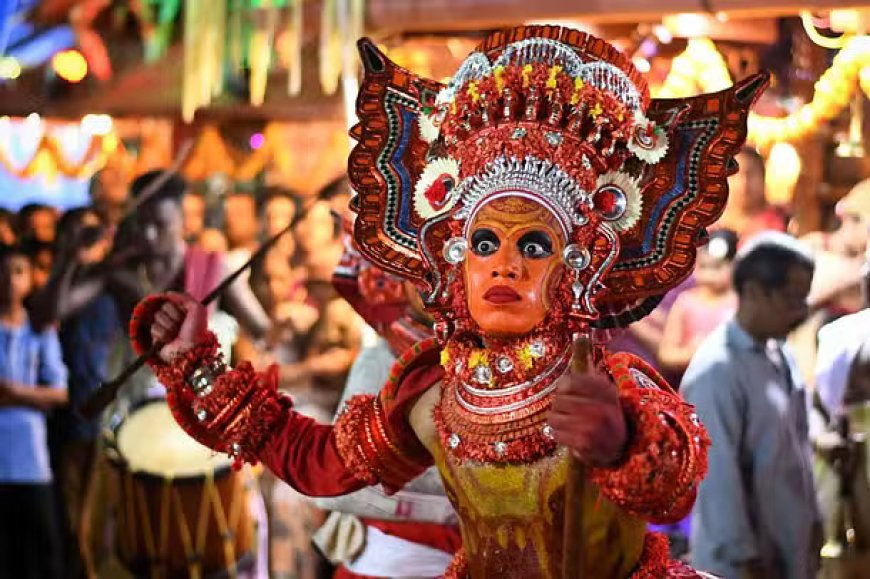
Table of Contents
- What Is Theyyam?
- The Meaning Behind the Name
- The Ancient Origins of Theyyam
- The Sacred Transformation: How Men Become Gods
- The Art of Costume and Makeup
- Music, Movement, and the Descent Into Trance
- Popular Types of Theyyam
- Theyyam and the Question of Caste
- When and Where to Witness Theyyam
- Theyyam in the Modern World
- Frequently Asked Questions
- Final Thoughts
-
What Is Theyyam?
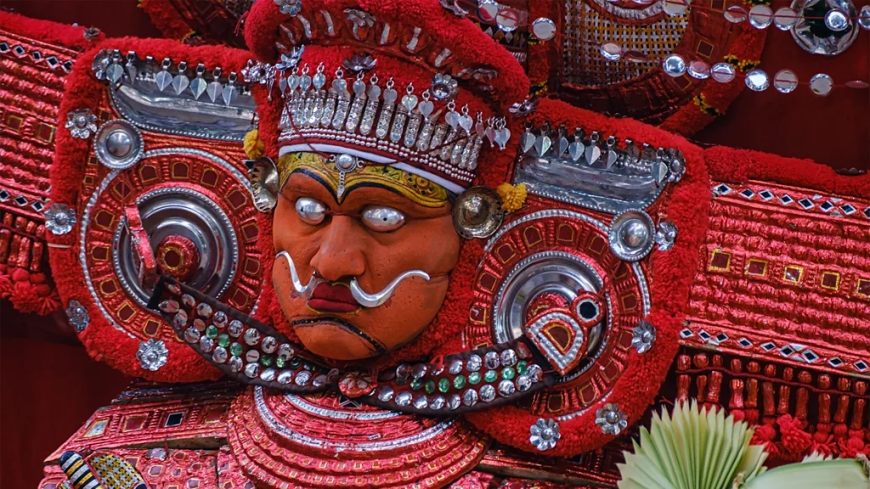
Theyyam is a ritual art form native to the northern districts of Kerala, primarily Kannur and Kasaragod, the region historically known as Malabar. It blends dance, mime, music, elaborate costume, and devotional worship into a single overwhelming experience. But calling it a "dance" or "performance" only scratches the surface, because the heart of Theyyam is not entertainment. It is invocation.
During a Theyyam ritual, a trained performer embodies a deity, a deified ancestor, a heroic spirit, or a goddess. Devotees do not watch the way an audience watches a play. They come to seek blessings, ask questions about their lives, settle disputes, and receive a personal word from the divine. The performer, once fully transformed, becomes a vessel through which the deity is believed to speak directly to the community.
There are said to be more than four hundred distinct forms of Theyyam, each with its own myth, costume, song, and personality. Some are fierce and warlike, some maternal and gentle, some mischievous, and some carry stories of injustice that still sting centuries later.
-
The Meaning Behind the Name
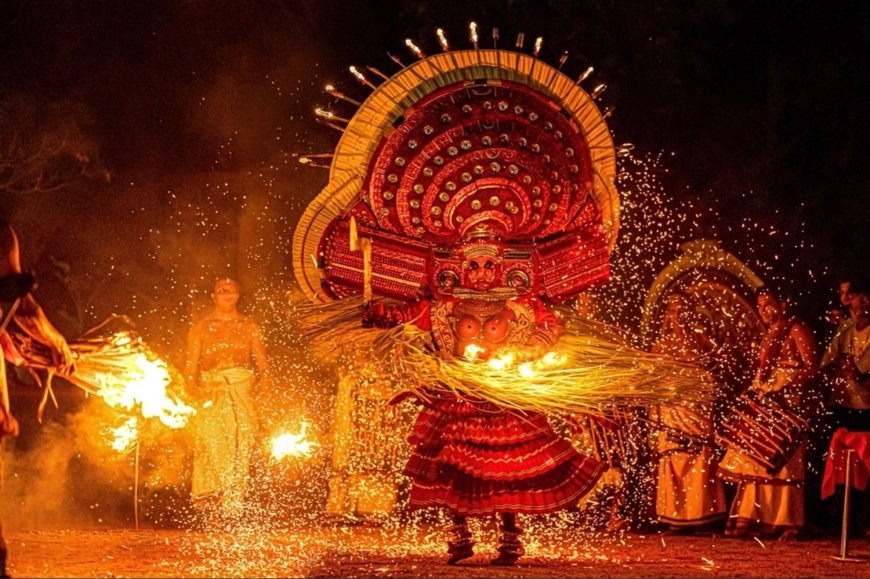
The word Theyyam is widely understood to be a colloquial form of Daivam, the Malayalam and Sanskrit word for "god." The ritual is also called Kaliyattam or Thira in certain areas, with subtle regional variations in how it is staged and named.
That linguistic root tells you everything about the intent. This is not a representation of god in the way a painting or a sculpture represents the divine. The very name insists that what stands before you, in flesh and paint and palm-frond, is the deity for the duration of the ritual.
-
The Ancient Origins of Theyyam
Theyyam's roots stretch back many centuries, by most accounts well over a thousand years - into the pre-Brahminical, folk-religious world of ancient Malabar. Long before the grand temples of organized Hinduism dominated the region, ordinary communities worshipped a vivid pantheon of local deities: mother goddesses tied to the land, serpent spirits, the ghosts of brave warriors, ancestors who had died unjust deaths, and forces of nature.
Theyyam grew out of this older substrate of ancestor worship, hero worship, and goddess worship. Many Theyyam myths commemorate real or legendary individuals - a fearless hunter, a wronged woman, a martyr killed by the powerful, who were elevated to divine status by the communities that remembered them. Over generations, these stories crystallized into ritual, and the ritual was entrusted to specific families who passed the knowledge down from father to son.
What makes this history so remarkable is its continuity. While much of India's folk heritage has faded or been absorbed into mainstream temple practice, Theyyam has survived largely intact, performed in the same sacred groves (kavus) and ancestral shrines (tharavadu and kottam) that have hosted it for centuries.
-
The Sacred Transformation: How Men Become Gods
The most spellbinding aspect of Theyyam is the transformation itself, and it does not happen all at once. It is a gradual, deliberate journey from human to divine that unfolds over many hours.
It often begins the night before with a preliminary ritual called thottam, in which the performer, dressed simply and without his full regalia, sings the sacred song that recounts the deity's origin myth. Through this song he summons the spirit and prepares his own body and mind to receive it.
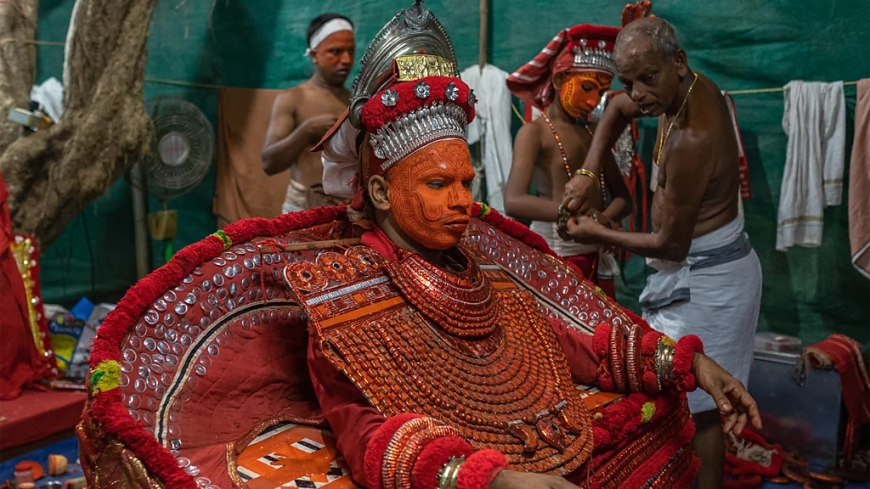
By the time the full costume is donned the next day, the performer has fasted, abstained, and immersed himself in the deity's story. The drums build relentlessly. The crowd presses in. And then comes the moment of aavesham, the descent of the divine. The performer's body begins to tremble and shake, his movements grow uncontrollable, and the people around him recognize the unmistakable sign that the god has arrived.
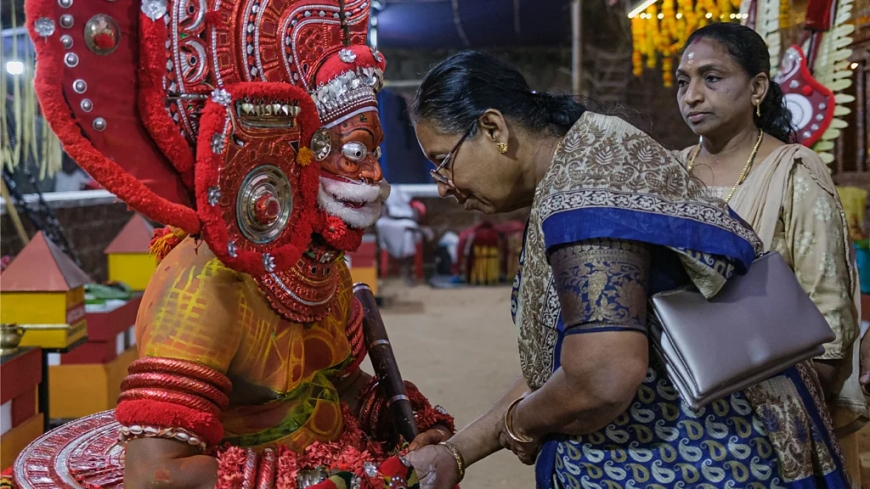
From that moment, the man is treated as the deity. Even priests and patrons of higher social standing bow before him. He blesses children, hands rice and turmeric to the faithful, listens to their troubles, and offers prophecies and reassurances. When the ritual finally ends, the deity departs, and the exhausted performer returns to being an ordinary human, often a farm labourer or daily-wage worker who, just hours earlier, was worshipped as a god.
-
The Art of Costume and Makeup
You cannot speak of Theyyam without dwelling on its staggering visual power. The transformation is as much an act of craftsmanship as it is of spirit.
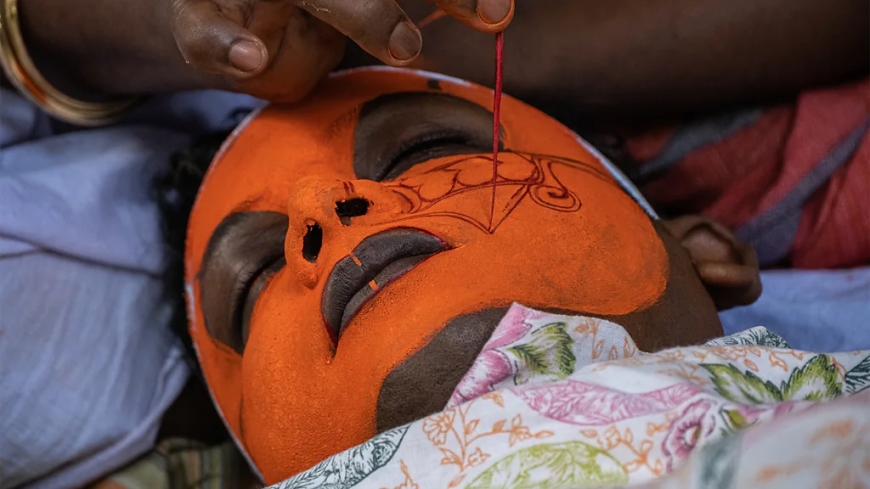
The face painting, known as mukhathezhuthu, is a painstaking art in itself. Using natural pigments - rice paste, turmeric, and the brilliant red of mineral and plant-based colours, artists draw intricate symmetrical patterns across the performer's face. Each Theyyam has its own prescribed design, some so complex they take several hours to complete.
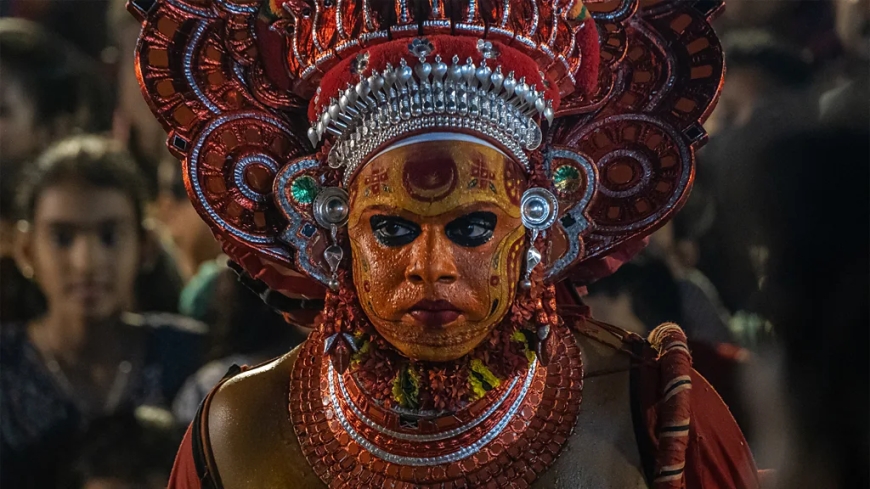
The costumes are equally astonishing. Skirts and ornaments are fashioned from split and dyed coconut palm fronds, layered into vast bristling shapes that make the performer seem larger than human. Then there is the mudi, the headdress - sometimes a modest crown, sometimes a colossal tower of bamboo, cloth, and ornament that rises many feet into the air and must be balanced through hours of vigorous movement.
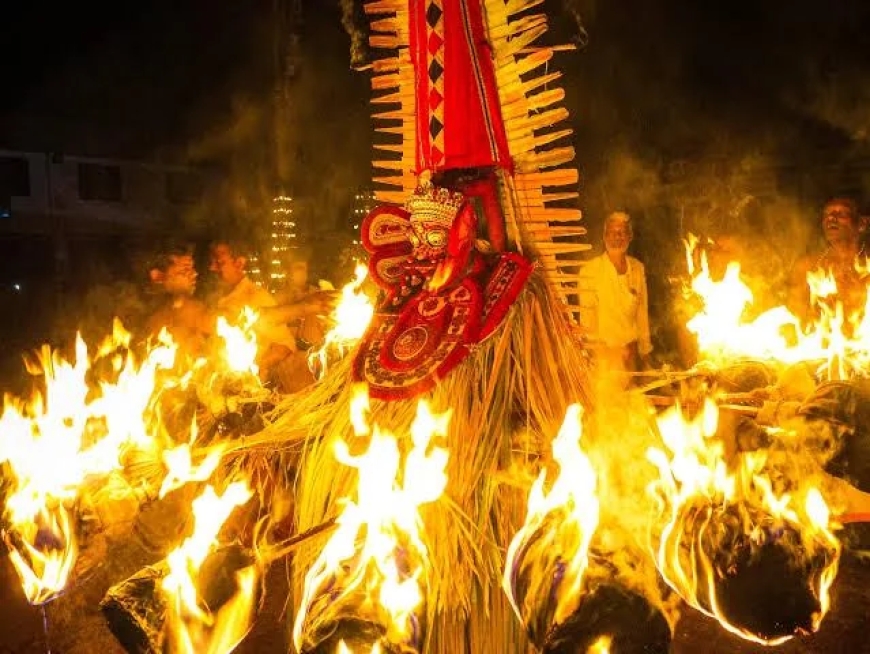
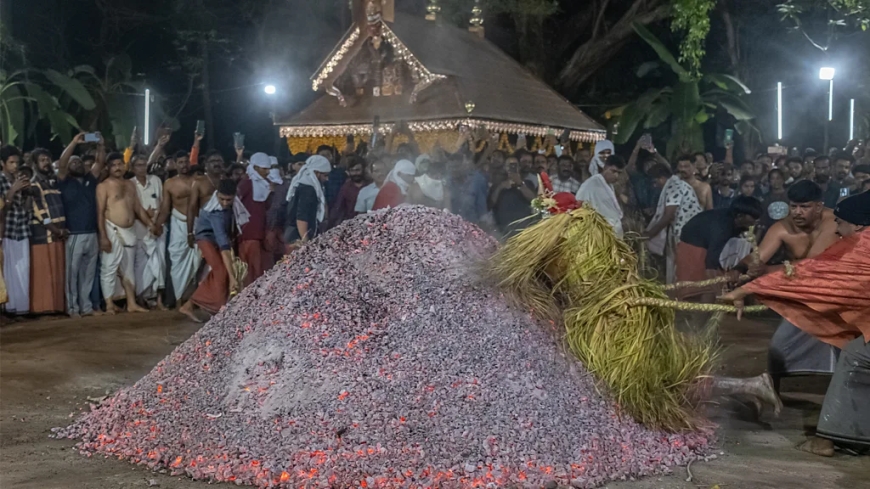
Some forms add an element that defies belief entirely: fire. In Theyyams such as Theechamundi and certain Ottakkolam rituals, the performer hurls himself repeatedly into and across enormous heaps of burning embers, emerging unharmed, the flames seeming to part around the deity he has become.
-
Music, Movement, and the Descent Into Trance
The pulse of Theyyam is its percussion. The chenda, a powerful cylindrical drum, drives the ritual with thunderous, accelerating rhythms, joined by other traditional instruments such as the elathalam (cymbals) and the kuzhal (a wind instrument). The music is not background; it is the engine of the trance, an unbroken wall of sound that loosens the boundary between the human and the divine.
The performer's movements range from slow, weighted, deliberate steps to frenzied spinning and leaping. As the rhythm intensifies, so does his motion, until the line between choreography and possession dissolves. To witness it in person is to feel the air itself thicken with intensity, the heat of the torches, the smell of camphor and burning wicks, the chant of the thottam, and the relentless drums all converging on a single, electrifying point.
-
Popular Types of Theyyam
With hundreds of forms in existence, no single list can do justice to the variety. But a few are especially well known and frequently performed:
Muchilottu Bhagavathi — One of the most revered goddess Theyyams, associated with a tragic legend of a wise and chaste young woman who was wronged and later deified. Her shrines draw enormous devotion across the region.
Vishnumoorthi — A fierce form linked to the Narasimha avatar of Vishnu, famous for its dramatic fire-leaping sequences and intense energy.
Pottan Theyyam — Perhaps the most socially powerful of all. Its myth confronts caste discrimination head-on, voicing the searing question of how the blood of a so-called "low-caste" person differs from that of the privileged. It remains a haunting cry against injustice.
Gulikan — A guardian and underworld deity, often portrayed with a wild, otherworldly intensity.
Kandanar Kelan — A hero Theyyam recounting the story of a young man who died in a forest fire and was restored, performed with spectacular fire rituals.
Raktha Chamundi — A ferocious blood-goddess form, embodying raw, protective power.
-
Theyyam and the Question of Caste
Here lies one of Theyyam's most profound and quietly subversive truths. The performers who become gods are drawn almost entirely from communities that were historically placed at the bottom of the caste hierarchy, groups such as the Vannan, Malayan, Velan, and Pulayan.
For most of the year, these performers occupied the margins of a deeply stratified society. But during the Theyyam ritual, that order is dramatically inverted. The man from the oppressed community becomes the deity before whom landlords and upper-caste patrons must bow, seeking his blessing and his word. For a few sacred hours, the lowest becomes the highest.
This inversion is not accidental, and forms like Pottan Theyyam make the critique explicit. In a society long divided by birth, Theyyam carved out a ritual space where the divine spoke through the very people that society had pushed aside. It is impossible to fully understand Theyyam without appreciating this layer of meaning, at once spiritual, social, and quietly revolutionary.
-
When and Where to Witness Theyyam
Theyyam is seasonal. The ritual calendar, known broadly as the Kaliyattam season, traditionally runs from around October to May, avoiding the heavy monsoon months. The exact timing of any given Theyyam depends on the festival cycle of its particular shrine.
To see it, you must travel to North Kerala. The districts of Kannur and Kasaragod are the undisputed heartland, with countless small kavus and family shrines hosting rituals throughout the season. The town of Parassinikadavu, home to the Muthappan temple, is notable because Theyyam (in the form of Muthappan Theyyam) is performed there almost daily through much of the year, making it one of the more accessible places for visitors.
A few respectful tips for travellers: most authentic Theyyams happen in village shrines rather than tourist venues, so a local guide or host is invaluable for finding genuine performances. Dress modestly, ask before photographing, and remember that you are a guest at a sacred ritual, not a spectator at a show. Many rituals begin late at night and continue until dawn, so come prepared for a long, immersive experience.
-
Theyyam in the Modern World
Like all living traditions, Theyyam faces the pressures of the present. Younger generations from performing families sometimes seek more stable livelihoods, the physical demands and risks are immense, and the cost of staging an elaborate Theyyam continues to rise. There is also the delicate tension between preservation and commercialization, as growing tourist interest brings both attention and the risk of diluting the ritual's sacred core.
Yet there is reason for optimism. Awareness of Theyyam's cultural value has grown well beyond Kerala, documentary filmmakers and photographers have brought its imagery to global audiences, and many communities remain fiercely committed to keeping the tradition alive in its proper sacred context. The devotion that sustains Theyyam is, after all, the same devotion that has carried it through a thousand years of change.
-
Frequently Asked Questions
Is Theyyam a dance or a religious ritual?
It is fundamentally a religious ritual that incorporates dance, music, and dramatic performance. The performer is believed to become a living deity, so it is far more than artistic entertainment.
Where can tourists watch Theyyam?
The best places are the village shrines of Kannur and Kasaragod districts in North Kerala. The Parassinikadavu Muthappan Temple near Kannur stages Theyyam almost daily and is one of the most accessible options.
What is the best time of year to see Theyyam?
The traditional season runs from roughly October to May, with the precise dates varying by shrine.
Why do the performers come from particular communities?
Theyyam has historically been performed by communities once placed low in the caste hierarchy. During the ritual their status is dramatically elevated, with even high-caste patrons bowing before the deified performer.
Is the fire in Theyyam real?
Yes. In fire-based forms such as Theechamundi, performers genuinely leap into and across heaps of burning embers, an act regarded as proof of the deity's presence within them.
-
Final Thoughts
Theyyam is not a relic kept behind glass. It is a breathing, burning, drumming testament to a worldview in which the divine is not distant but can step into a human body and speak, here and now, in a village courtyard at dawn. It is at once a work of breathtaking artistry, a profound act of faith, and a quiet rebellion against a social order that tried to decide who mattered and who did not.
To witness a man become a god in the red light of a North Kerala morning is to brush against something very old and very alive. And long after the drums fall silent and the paint is washed away, the memory of that transformation tends to stay with you, a reminder of how thin, in the right hands, the line between the human and the holy can become.
What's Your Reaction?
 Like
0
Like
0
 Dislike
0
Dislike
0
 Love
0
Love
0
 Funny
0
Funny
0
 Wow
0
Wow
0
 Sad
0
Sad
0
 Angry
0
Angry
0

A spirit that pursues sunsets and tales. Entrepreneur at heart, globe-trotter by soul. Founder of an art-worshiping jewelry brand that embodies emotion & individuality — where each piece is a tale of culture, craft, and character. From trails up mountains to gem markets, I'm inspired by all journeys — transforming wanderlust into enduring design. Establishing a brand built on authenticity, refinement & purpose — one work at a time.










Comments (0)