

Umaid Bhawan of Jodhpur: History, Architecture & Royal Legacy Explained
Explore the history, architecture, and royal legacy of Umaid Bhawan of Jodhpur, from its famine relief roots to being the world’s largest private residence.
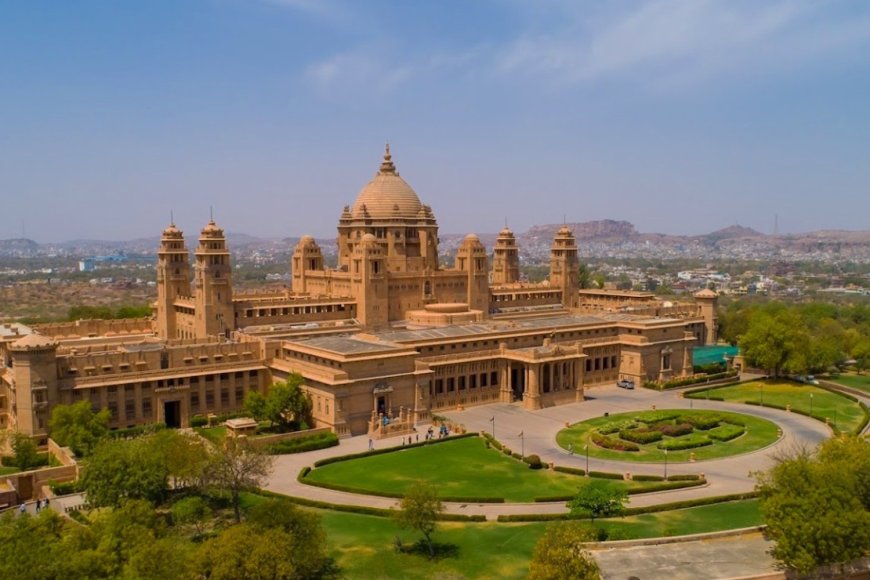
Table of Contents
- Why Umaid Bhawan Still Captivates the World
- The Origin Story: A Palace Built to Fight Famine
- The Visionary Behind It: Maharaja Umaid Singh of Jodhpur
- Creating a Dream Team: The Role of Architect Henry Vaughan Lanchester
- The Grand Design: A Unique Blend of Indo-Deco and Renaissance
- Golden-Yellow Sandstone: The Soul of the Palace
- A Home, A Museum, A Hotel: Three Faces of Umaid Bhawan
- The Palace and the Royal Family of Jodhpur
- Fun Facts You’ll Love
- Why Umaid Bhawan Is a Crown Jewel of Rajasthan
-
Why Umaid Bhawan Still Captivates the World
The Umaid Bhawan of Jodhpur is not just another palace sitting on a hill. It is a story carved in stone. A symbol of kindness during hard times. And one of the last great palaces ever built in India. Rising proudly above the Blue City, this palace feels less like a monument and more like a living chapter from history.
People visit because it’s beautiful. They leave because the story stays with them. When you walk through its grand halls or admire the golden glow of its walls at sunset, you realize this palace is not just about royalty. It’s about responsibility, vision, and compassion.
-
The Origin Story: A Palace Built to Fight Famine
Here’s the thing most people don’t know: the palace wasn’t originally built to show off luxury. It was built to fight hunger.
In the late 1920s, the region was hit by a severe famine. People had no work, no food, and no hope. Instead of offering short-term help, the king decided on something radical. He ordered the construction of a massive palace. Not to celebrate wealth, but to provide jobs for thousands of struggling families.
The building of the palace continued for over 14 years. For villagers, it meant daily wages, meals, and dignity. This humanitarian beginning makes the Umaid Bhawan Palace's history truly different from any other Indian palace.
What this really means is simple: this palace stands on a foundation of empathy, not ego.
-
The Visionary Behind It: Maharaja Umaid Singh of Jodhpur
The man responsible for this extraordinary decision was Maharaja Umaid Singh of Jodhpur. Unlike many rulers who focused on comforts inside palace walls, he looked beyond them.
He believed a king’s role was to protect his people in their weakest moments. The famine tested his leadership, and he responded by turning crisis into opportunity.
Even today, locals remember him not just as a ruler, but as a protector. His decision to commission the palace changed lives and created a landmark that the city remains proud of.
-
Creating a Dream Team: The Role of Architect Henry Vaughan Lanchester
A vision is only as strong as the hands that shape it. The king’s dream was brought to life by British architect Henry Vaughan Lanchester.
Lanchester was known for blending modern design with traditional forms. For this project, he studied Indian architecture deeply. Instead of trying to “import” a Western palace style, he let Indian culture lead the design. His work didn’t overpower the land. It respected it.
Let’s break it down: this wasn’t a foreign design dropped in Rajasthan. It was a global idea shaped by Indian roots.
-
The Grand Design: A Unique Blend of Indo-Deco and Renaissance
The Umaid Bhawan architecture is one of a kind. It blends Indo-Deco with Renaissance design in a way you won’t find anywhere else.
Here’s what makes it special:
1. Wide domes inspired by Rajput and Mughal design
2. Tall pillars and clean lines from Art Deco
3. European balance and symmetry from the Renaissance style
Surprisingly, the style feels timeless. It doesn’t look old-fashioned. It looks powerful. And artistic. And confident.
When the sun hits the stone, the entire palace turns golden. Not “Instagram golden” but real, glowing, almost unreal golden.
-
Golden-Yellow Sandstone: The Soul of the Palace
Every block of this palace is built from golden-yellow sandstone, mined locally. No cement was used in the early construction. Instead, lime mortar and hand-cut stone formed the massive structure.
Over time, the sandstone changes color with the sky. Morning brings soft yellow. Evening creates deep gold. Monsoon adds drama.
This natural material gives the palace life. It ages beautifully, just like the stories inside it.
Inside the Palace: 347 Rooms of Royal Wonder
Now let’s talk scale. The palace has 347 rooms.
Inside you’ll find:
1. Ballroom halls with high ceilings
2. Libraries filled with rare books
3. Secret corridors
4. Indoor gardens
5. Vast courtyards
6. Marble staircases
Each room has its own mood. Some feel royal and grand. Others feel peaceful and private.
It’s also considered the world’s largest private residence. Even today, a part of it is still home to the royal family.
-
A Home, A Museum, A Hotel: Three Faces of Umaid Bhawan
The Umaid Bhawan of Jodhpur continues to evolve.
The palace has three sections:
1. Royal Residence: Home to the Jodhpur royal family
2. Luxury Hotel: Where visitors can stay and taste royal living
3. Museum: With clocks, vintage cars, weapons, photographs, and more
Each section tells a different story. Together, they complete the picture of a palace that still lives and breathes.
-
The Palace and the Royal Family of Jodhpur
For the royal family, this palace is not just history. It is home.
Generations have lived here. Celebrations, weddings, decisions about the kingdom, and private moments all happened within these walls.
For locals, the palace remains a symbol of the Jodhpur royal palace culture. A reminder that royalty isn’t only about crowns and thrones. It’s about duty.
-
Fun Facts You’ll Love
Here’s the lighter side of this majestic place:
1. It took over 15,000 workers and 14 years to build
2. Uses locally sourced stone only
3. Designed to be earthquake-resistant
4. Has underground tunnels for safety
5. One wing still hosts royal weddings
6. From the air, the palace looks like a flying bird
7. It is the world’s largest private residence.
-
Why Umaid Bhawan Is a Crown Jewel of Rajasthan
Of all the heritage palaces of Rajasthan, this one stands out. Not because it’s the biggest. But because it’s bold in purpose.
It wasn’t built for comfort. It was built during a crisis.
It wasn’t built for show. It was built for survival.
That’s what makes it unforgettable.
What's Your Reaction?
 Like
0
Like
0
 Dislike
0
Dislike
0
 Love
0
Love
0
 Funny
0
Funny
0
 Wow
0
Wow
0
 Sad
0
Sad
0
 Angry
0
Angry
0

I’m Ryan Rehan, Business Development Executive and a passionate blogger dedicated to sharing insights, tips, and experiences that inspire and inform. Through my blogs, I explore topics that matter, spark curiosity, and encourage thoughtful conversations. Whether I’m breaking down complex ideas, offering practical advice, or simply sharing stories, my goal is to create content that adds real value to a growing community of curious minds and passionate readers.













Comments (0)