

Earth’s Core Is Leaking Gold – New Scientific Discovery
A new study reveals Earth’s core may be leaking gold and rare metals through volcanic activity. Discover what scientists found in Hawaiian lava rocks.
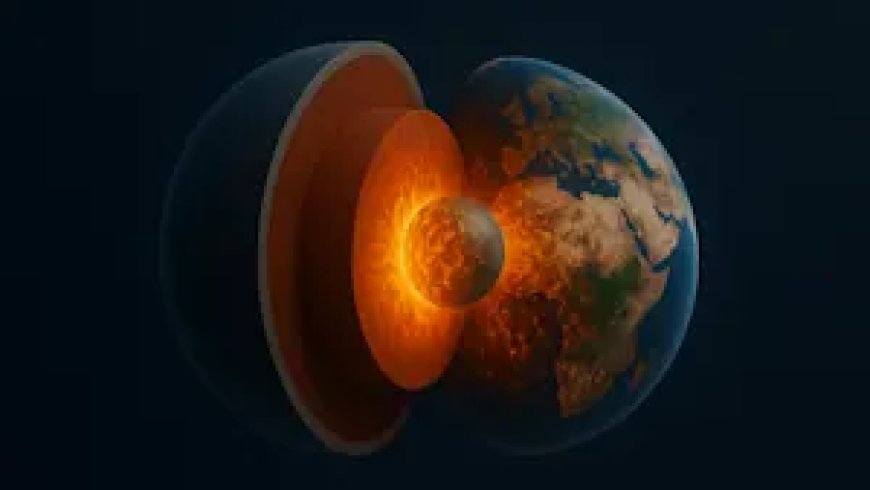
You’re standing near a Hawaiian volcano, watching molten lava bubble and flow, unaware that what’s rising to the surface might have come from one of the deepest, most mysterious places on Earth — the core. Now, imagine that this lava contains not just molten rock, but traces of gold and other rare elements that have been hidden since Earth’s earliest days.
Sounds unreal? Science just made it very real.
A Golden Discovery Deep Below Our Feet
We’ve always believed Earth’s core — the scorching, metallic heart of our planet — was sealed off, far too deep to ever influence what we see on the surface. After all, it's buried under around 3,000 kilometers of solid rock. Scientists have long considered it unreachable, especially when it comes to valuable materials like gold, platinum, and ruthenium — most of which sank into the core during Earth’s violent formation over 4.5 billion years ago.
But a recent study by researchers from the University of Göttingen in Germany is turning that belief on its head.
Their research focused on volcanic rocks from Hawaii. Why Hawaii? Because the islands were formed by deep mantle plumes — super-hot material that punches up through the Earth’s layers and erupts at the surface. If there were ever clues about what’s happening deep inside the planet, this is where you’d find them.
The Ruthenium Clue: A Tiny Isotope with a Big Story
When scientists began analyzing these volcanic rocks, they weren’t expecting much. But what they found was fascinating — unusually high levels of a particular isotope of ruthenium, an ultra-rare metal often found in the same class as gold and platinum.
What makes this isotope special is that it's typically found in Earth's core, not in the mantle or crust. This told researchers one thing loud and clear: the material that created these rocks must have originated from very close to the core.
As one of the study’s lead geochemists, Nils Messling, explained, the moment they saw the data, they realized they had stumbled upon something groundbreaking. Not just scientifically, but literally — a direct connection between Earth's core and its surface.
So... Is the Earth Really Leaking Gold?
Yes — in a sense. The study shows that small amounts of precious metals, like gold and ruthenium, are escaping from the core region and making their way to the surface through volcanic activity. While we’re not talking about gold nuggets spilling out of lava flows (sorry, treasure hunters!), the presence of these elements confirms that the Earth’s core is not as sealed off as once thought.
It’s a slow, complex process — but over billions of years, it means that some of the gold we mine today might have originated from the deepest parts of our planet.
Why This Changes Everything We Thought We Knew
This isn’t just about finding gold. It’s about understanding the inner mechanics of our planet. For years, the core was viewed as a static, unreachable zone. Now, this discovery hints at interaction between the core and mantle, meaning the layers of the Earth are more connected and dynamic than previously believed.
Professor Matthias Willbold, who co-authored the study, emphasized how massive this discovery is. According to him, these findings offer strong evidence that hundreds of quadrillions of tons of hot rock — yes, that much — could be rising from the boundary between the core and mantle to form volcanic islands like Hawaii.
It’s like discovering a hidden highway that links the center of the Earth to its surface — and that highway carries microscopic hints of gold.
What This Means for the Future of Science
Beyond the shiny metals, what excites scientists most is the potential for new research tools. The specific ruthenium isotope identified in the study could serve as a “tracer,” helping scientists map the journey of materials moving from the core to the mantle, and ultimately to the surface.
It opens the door to studying core-mantle interactions, a field that could redefine our understanding of planetary evolution, natural resources, and even volcanic behavior.
And while we may not be mining the core anytime soon, knowing that Earth's inner layers are leaking elements like gold adds an entirely new dimension to geology and Earth science.
So, Can We Strike It Rich?
Not quite. The precious metals coming from the core are found in incredibly tiny amounts — more like a chemical fingerprint than a gold rush. Still, it’s astonishing to realize that the gold in your ring, or the platinum in your phone, could have been formed deep in the Earth’s core and carried up through volcanic processes over millions of years.
It’s humbling to think that something so small can carry such a huge story — a story of fiery beginnings, planetary collisions, and molten secrets rising slowly through time.
Final Thoughts: Earth, the Living Machine
The idea that Earth’s core is leaking precious metals might sound poetic — and in a way, it is. It reminds us that our planet isn’t just a static rock floating in space. It’s a living, breathing machine, constantly shifting, changing, and even sharing pieces of its oldest self.
So the next time you admire a piece of gold, think about where it might have come from. Not just from a mine, or a riverbed — but from the center of the Earth itself, carried upward through fire and time, until it reached the light.
What's Your Reaction?
 Like
0
Like
0
 Dislike
0
Dislike
0
 Love
0
Love
0
 Funny
0
Funny
0
 Wow
0
Wow
0
 Sad
0
Sad
0
 Angry
0
Angry
0

Hi, I'm Tripti, a passionate SEO expert with extensive experience in optimizing websites for search engines, driving organic growth, and crafting data-driven content strategies. Currently, I work as a Senior SEO Manager at a Social IT Company, where I help brands enhance their online visibility and achieve sustainable digital success. I love discussing SEO trends, content marketing, social media strategies, and digital analytics. Always open to knowledge-sharing, industry insights, and networking with fellow marketers!














Comments (0)