

Bajau People: The Sea Nomads Who Live Their Entire Lives on Water
Discover the Bajau people, legendary sea nomads who live on water, dive without oxygen, and survive entirely from the ocean for centuries.

Most of us treat the ocean as an escape. A place to visit, photograph, admire, and then leave behind. For the Bajau people, the sea is not an escape at all. It’s home in the most literal sense.
For more than a thousand years, the Bajau have lived almost entirely on water, moving freely across the seas of Southeast Asia. Long before passports, coast guards, or GPS, they navigated the waters between present-day Indonesia, Malaysia, and the Philippines using memory, stars, tides, and instinct.
Their lives challenge what we think is normal, possible, or even humanly sustainable.
A Life Without Land
The Bajau are often described as Sea Nomads, and the name fits. Traditionally, they did not belong to any single country or coastline. They belonged to the sea itself.
Entire families lived aboard wooden boats called lepa-lepa. These boats weren’t temporary shelters. They were permanent homes. Cooking, sleeping, raising children, repairing nets, and even celebrating milestones all happened on gently rocking water.
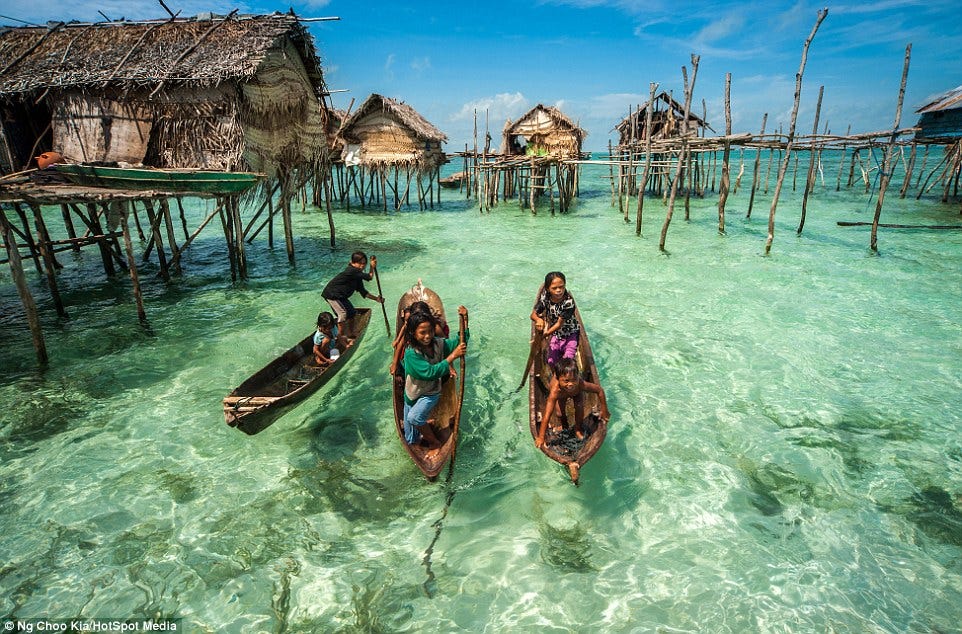 Image Credit: Medium
In recent decades, some Bajau communities have moved into stilt houses built directly over shallow coastal seas. Even then, land remains optional. The water stays central. Boats are still used daily, and fishing routes still guide movement.
The idea of settling inland permanently feels foreign to many elders. For them, stillness means danger. Movement means survival.
Growing Up Underwater
Bajau children are introduced to the sea almost as soon as they can stand. Swimming comes before walking. Diving comes before schooling.
While children elsewhere learn playground games, Bajau children learn how currents behave, how fish react to shadows, and how breath feels when stretched to its limits. The ocean becomes muscle memory.
By adulthood, many Bajau divers spend more than half their working hours underwater. They dive not for sport or records, but for food.
And they do it without oxygen tanks.
The Science Behind Their Diving Ability
The freediving ability of the Bajau has fascinated scientists for years. Regular dives of 20 to 70 meters on a single breath are common. Staying underwater for several minutes is routine.
What’s remarkable is that this isn’t just training.
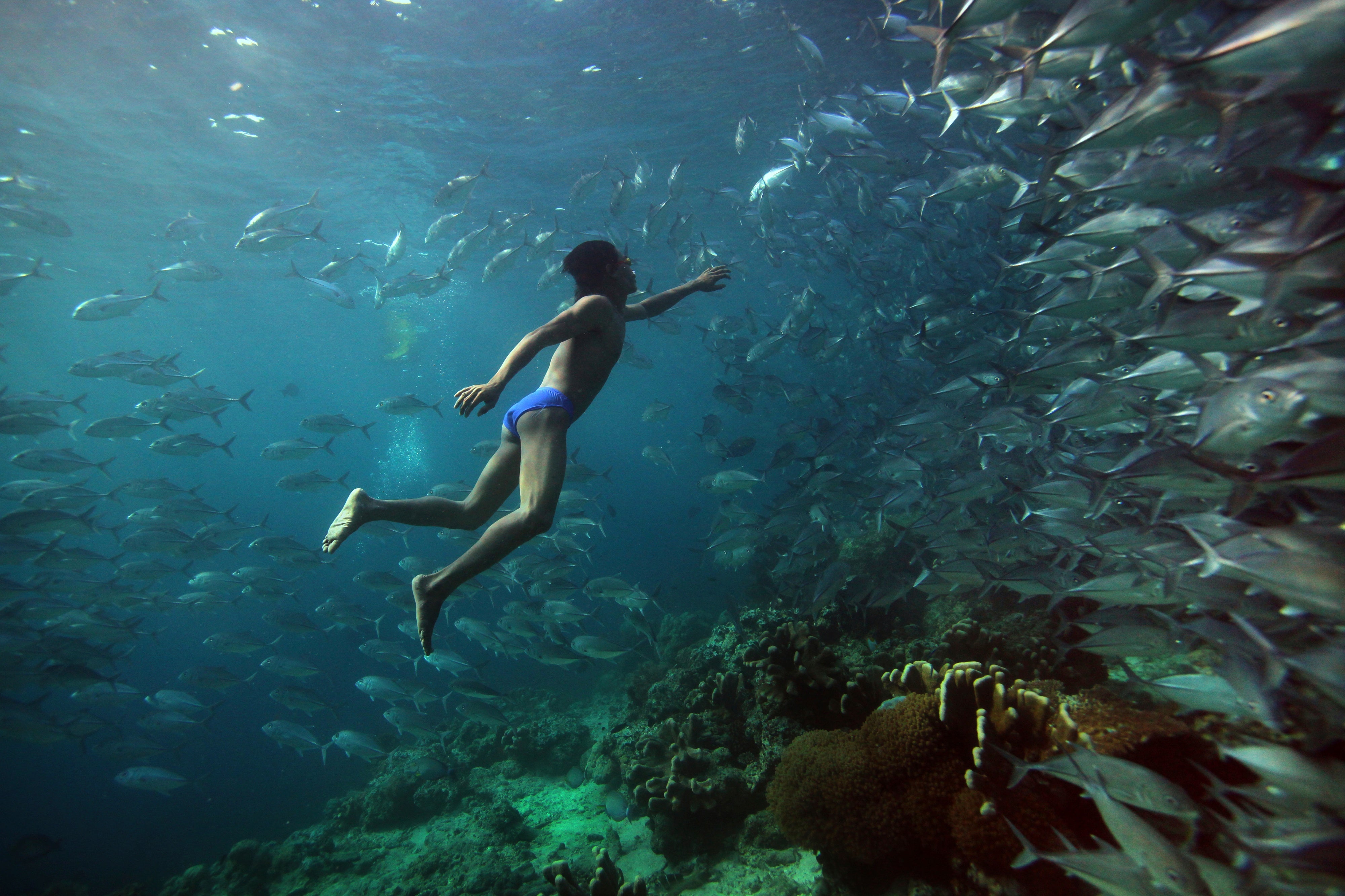 Image Credit: Scientific American
Genetic research has shown that the Bajau have unusually large spleens. The spleen stores oxygen-rich red blood cells. When the body dives, and oxygen becomes limited, the spleen contracts and releases extra oxygen into circulation.
This natural advantage allows Bajau divers to stay underwater longer without panic or damage.
In simple terms, generations of diving shaped their bodies. Evolution met lifestyle and adapted.
Fishing as a Way of Knowing
The Bajau don’t fish the way modern industries do. There are no trawlers, no massive nets, no rush to extract everything at once.
Fishing is personal.
They hunt reef fish, octopus, shellfish, crabs, and sea cucumbers using spears, traps, and deep dives. Every action is guided by an understanding of seasons, breeding cycles, and reef health.
 Image Credit: The Times
This knowledge isn’t written down. It’s passed through observation, repetition, and quiet correction. A wrong move doesn’t just cost a catch. It can damage a reef that feeds generations.
Because of this, Bajau fishing practices have historically been sustainable, allowing communities to survive for centuries without collapsing their own food sources.
Food From the Sea, Trade From the Shore
Almost everything the Bajau eat comes from the ocean. Fish and seafood dominate their diet, often cooked simply over small onboard fires.
Occasionally, they trade with coastal communities. Dried fish or sea cucumbers are exchanged for rice, cassava, or basic supplies. One traditional dish, Kasaba Panggykayu, uses cassava obtained through such trade.
Even these interactions are limited. Permanent settlement has never been the goal. The sea always calls them back.
When Borders Entered the Water
For most of their history, the Bajau moved freely. The sea had no borders.
Modern politics changed that.
Today, Bajau communities find themselves split across national lines. Many lack formal citizenship documents because their ancestors never needed them. This creates serious problems, from restricted movement to limited access to healthcare and education.
Laws designed for land-based populations don’t translate well to nomadic sea life. Fishing zones, marine parks, and national boundaries often cut directly through traditional Bajau routes.
What was once freedom is now paperwork.
Pressures of the Modern World
Beyond legal challenges, the Bajau face environmental and economic threats.
Tourism has altered coastal ecosystems. Coral damage and boat traffic disrupt fishing grounds. Destructive practices like dynamite fishing, often carried out by outsiders, devastate reefs that Bajau families depend on.
Climate change adds further instability. Rising sea levels, unpredictable weather, and declining fish populations make traditional knowledge harder to rely on.
As a result, many younger Bajau are being pushed toward land-based jobs and schooling. While adaptation can offer opportunities, it also risks breaking the chain of knowledge passed down for generations.
Holding Onto the Sea
Some Bajau leaders are working to protect their culture without rejecting the modern world entirely. Efforts focus on legal recognition, marine conservation rights, and education that respects their maritime identity.
The goal isn’t isolation. It’s a choice.
Preserving the Bajau way of life means allowing them to decide how they evolve, instead of forcing them to abandon the sea in the name of progress.
Why the Bajau Story Matters
The Bajau remind us that humans are far more adaptable than we assume.
They prove that:
1. The human body can evolve in response to lifestyle
2. Sustainable living is possible without modern systems
3. Culture doesn’t require cities or land ownership to thrive
Their lives offer a rare perspective in a world obsessed with speed and permanence. The Bajau live lightly, move constantly, and leave little behind except knowledge.
If their way of life disappears, we lose more than a community. We lose evidence that humans can live in deep harmony with nature, not by controlling it, but by understanding it.
And that might be the most valuable lesson of all.
What's Your Reaction?
 Like
0
Like
0
 Dislike
0
Dislike
0
 Love
0
Love
0
 Funny
0
Funny
0
 Wow
0
Wow
0
 Sad
0
Sad
0
 Angry
0
Angry
0

I’m Ryan Rehan, Business Development Executive and a passionate blogger dedicated to sharing insights, tips, and experiences that inspire and inform. Through my blogs, I explore topics that matter, spark curiosity, and encourage thoughtful conversations. Whether I’m breaking down complex ideas, offering practical advice, or simply sharing stories, my goal is to create content that adds real value to a growing community of curious minds and passionate readers.















Comments (0)