

Top Website Crawlers Every SEO Professional Should Use
Compare the best website crawlers for SEO in 2026, Screaming Frog, Sitebulb, Ahrefs, Semrush, Lumar, OnCrawl & more, with up-to-date pricing and feature breakdowns.
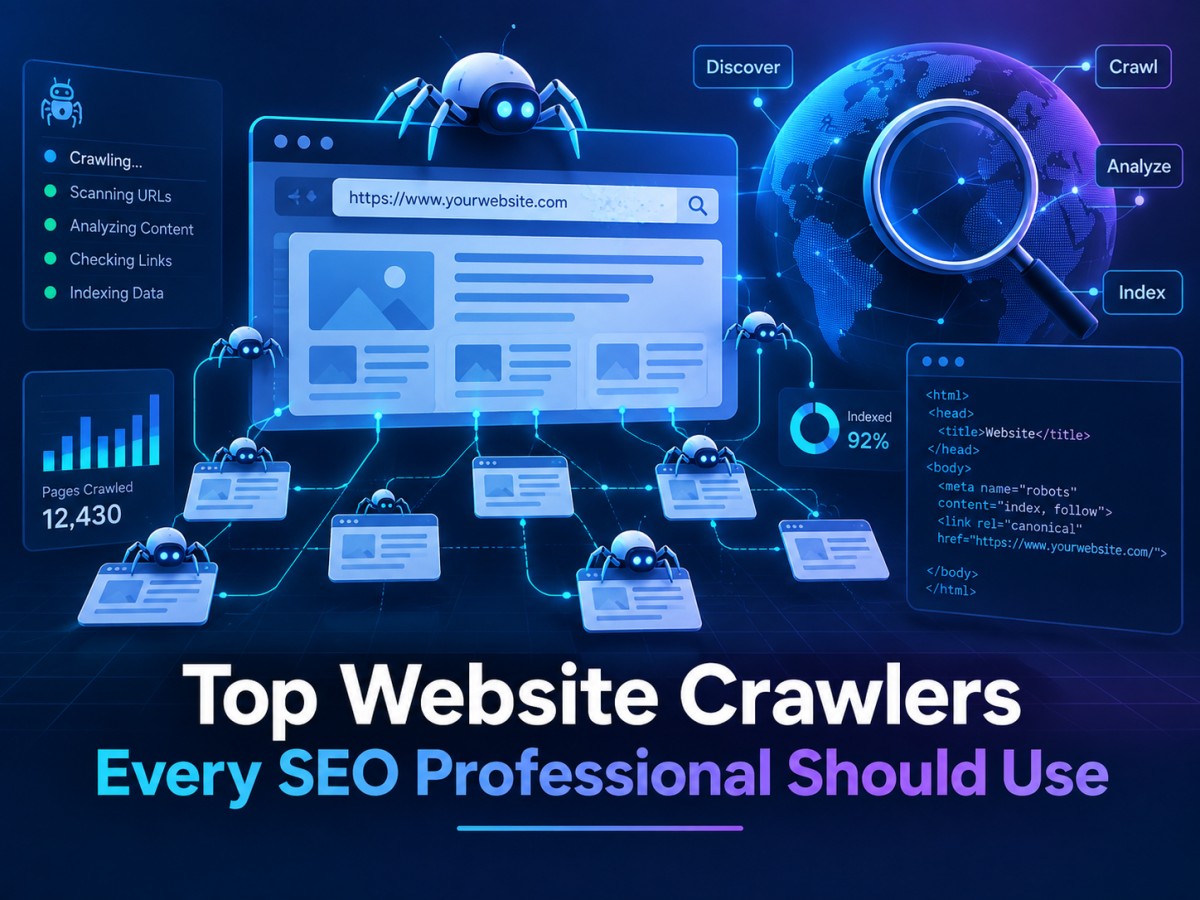
Table of Contents
- 1. Introduction: Why Every SEO Strategy Starts With a Crawl
- 2. What Exactly Is a Website Crawler, and Why Does It Matter?
- 3. Screaming Frog SEO Spider
- 4. Sitebulb
- 5. Ahrefs Site Audit
- 6. Semrush Site Audit
- 7. Lumar (formerly DeepCrawl)
- 8. OnCrawl
- 9. JetOctopus
- 10. Google Search Console (The Free Baseline)
- 11. Pricing Comparison Table
- 12. How to Choose the Right Crawler for Your Needs
- 13. Final Thoughts
-
1. Introduction: Why Every SEO Strategy Starts With a Crawl
Before you can optimise a website, you need to actually understand it, every broken link, every duplicate title tag, every orphaned page buried four clicks deep. That's the job of a website crawler. It's the unglamorous, foundational layer of technical SEO that most ranking improvements are built on top of.
Content strategy, backlinks, and keyword targeting all matter enormously. But none of it performs the way it should if search engines can't properly crawl and index your site in the first place. A crawler simulates exactly what Googlebot does, it moves through your site link by link, page by page, cataloguing structure, content, metadata, redirects, and errors along the way.
The challenge for SEO professionals isn't whether to use a crawler, it's which one. The market has matured considerably, and today's options range from lightweight desktop tools built for freelancers to enterprise-grade cloud platforms crawling tens of millions of URLs a month. This guide breaks down the crawlers that actually matter in 2026, what each one is genuinely good at, and crucially, what they cost, so you can budget with confidence rather than guesswork.
-
2. What Exactly Is a Website Crawler, and Why Does It Matter?
A website crawler (sometimes called a spider) is a piece of software that systematically browses a website the way a search engine bot would. It follows internal links, records response codes, extracts on-page elements like titles, meta descriptions, and headers, and flags technical issues such as broken links, redirect chains, duplicate content, missing alt text, and crawl depth problems.
For an SEO professional, this data is diagnostic gold. It answers questions that are almost impossible to assess manually on any site beyond a handful of pages: Which pages return a 404? Where are the redirect loops? Is the XML sitemap accurate? Are canonical tags pointing where they should? Is the site architecture creating orphan pages that never get discovered?
Without this visibility, technical debt accumulates silently. A crawler turns that invisible debt into a prioritised, actionable list, which is exactly why it belongs at the centre of any serious SEO workflow, whether you're auditing a five-page brochure site or a million-URL ecommerce catalogue.
-
3. Screaming Frog SEO Spider
Screaming Frog is the closest thing the SEO industry has to a universal standard. It's a desktop application (Windows, Mac, Linux) that has been the default technical audit tool for well over a decade, and it remains the benchmark against which most newer crawlers are measured.
What makes it so enduring is the sheer depth of raw data it exposes. It handles JavaScript rendering, custom extraction via CSS Path, XPath, or regex, scheduled crawls, and integrations with Google Analytics, Search Console, and PageSpeed Insights. It's not the prettiest interface in the category, but for anyone who wants granular control over exactly what gets crawled and how, it's hard to beat.
Best for: Freelancers, in-house SEOs, and agencies who want deep, customisable data without a steep monthly commitment.
Pricing: Free for crawls up to 500 URLs. The paid licence, which unlocks unlimited crawling and advanced features, costs $279 per year (roughly $23/month), with volume discounts available for teams of five or more licences.
-
4. Sitebulb
Sitebulb was built with a different philosophy to Screaming Frog: instead of handing you a spreadsheet of raw data, it interprets that data for you. It generates over 300 prioritised "hints" — plain-language explanations of what's wrong and why it matters — along with visual crawl maps that make site architecture and internal linking issues immediately obvious, even to non-technical stakeholders.
This makes Sitebulb particularly popular with agencies that need to explain audit findings to clients who don't live and breathe technical SEO. It's available as both a desktop application and a cloud-hosted version for teams that need centralised, browser-based access.
Best for: Agencies and consultants who need audit reports that are easy to explain and visually persuasive.
Pricing: Desktop plans start at $18/month for Lite (10,000 URLs per audit, 100+ hints), rising to $42/month for Pro (500,000 URLs, 300+ hints, scheduled audits). Sitebulb Cloud starts at roughly $125/month and scales up to $495/month and beyond for larger teams.
-
5. Ahrefs Site Audit
Ahrefs isn't a standalone crawler — it's a full SEO suite — but its Site Audit module is powerful enough that many professionals use Ahrefs primarily for this feature alone. It crawls your site on a schedule, tracks site health scores over time, and flags issues across more than 100 predefined SEO checks, all tied into Ahrefs' broader backlink and keyword data.
The advantage of a bundled tool like this is context: you're not just seeing that a page is thin on content, you're seeing it alongside the keywords it ranks for and the backlinks pointing to it. That makes prioritisation considerably easier.
Best for: Teams that want technical audit data integrated with backlink, keyword, and competitor analysis in one platform.
Pricing: Ahrefs runs on five tiers — Starter at $29/month, Lite at $129/month, Standard at $249/month, Advanced at $449/month, and Enterprise from $1,499/month. Annual billing saves roughly 17% across most tiers. Site Audit crawl credits scale with the plan, and a free Ahrefs Webmaster Tools option exists for auditing sites you personally own.
-
6. Semrush Site Audit
Semrush's Site Audit tool works in much the same spirit as Ahrefs' — a crawler embedded inside a broader marketing platform — but it leans slightly more toward actionable, prioritised fixes and integrates tightly with Semrush's content and on-page SEO checker tools. It's especially strong for teams already using Semrush for keyword tracking or PPC, since the audit data lives in the same dashboard as the rest of the marketing workflow.
Best for: Marketing teams and agencies who want site audits alongside keyword tracking, competitor research, and content tools in a single subscription.
Pricing: Semrush offers three primary tiers — Pro at $139.95/month, Guru at $249.95/month, and Business at $499.95/month — with annual billing bringing the effective monthly cost down by roughly 16–17%. The Guru plan (around $208/month annually) is generally the sweet spot for agencies managing multiple client sites, offering up to 300,000 crawled pages per month.
-
7. Lumar (formerly DeepCrawl)
Lumar sits firmly at the enterprise end of the market. It's built for organisations with very large, complex sites — think major ecommerce catalogues, publishers, or marketplaces — where crawling needs to happen at genuine scale (Lumar advertises crawl speeds of up to 450 URLs per second) and where technical issues need to be caught before they ever reach production, thanks to its pre-launch testing environments.
It also goes beyond traditional SEO crawling into site speed, accessibility compliance, and log file analysis, making it more of a website intelligence platform than a simple crawler.
Best for: Large enterprises and organisations managing sites with hundreds of thousands to millions of URLs.
Pricing: Lumar does not publish self-serve pricing. Quotes are arranged directly with their sales team, and reported entry-level contracts start in the region of $1,000–$1,500 per month, with full enterprise deployments often running well into five figures annually depending on crawl volume and feature requirements.
-
8. OnCrawl
OnCrawl, now part of BrightEdge, pairs crawl data with real server log files — a combination that's particularly valuable for understanding exactly how search engine bots are actually behaving on your site, rather than just how your site is theoretically structured. This log file analysis capability is one of OnCrawl's strongest differentiators, helping teams spot crawl budget waste and orphan pages that a standard crawl alone might miss.
Best for: Large or complex sites where log file analysis and crawl budget optimisation are priorities.
Pricing: OnCrawl does not publish self-serve pricing and typically requires a demo or sales conversation. Third-party sources suggest entry-level plans in the range of €49–€99/month for smaller crawl volumes, with mid-tier plans around €199–€299/month, and custom enterprise pricing for larger deployments.
-
9. JetOctopus
JetOctopus is a cloud-based crawler that's gained traction as a faster, more transparently priced alternative to some of the bigger enterprise platforms. It combines crawling, log analysis, and JavaScript rendering, with a particular emphasis on speed — it's built to handle large sites without the multi-hour crawl times that can bog down desktop tools.
Best for: Mid-sized to large sites that want enterprise-style log file and crawl analysis without committing to the highest-end enterprise contracts.
Pricing: Plans start at approximately €379/month for the Standard tier aimed at medium-sized websites, with higher tiers available for larger crawl volumes.
-
10. Google Search Console (The Free Baseline)
It's not a crawler in the traditional sense — it doesn't simulate a crawl of your site the way the tools above do — but no list of technical SEO tools is complete without mentioning it. Search Console shows you how Google itself is actually crawling and indexing your site: coverage issues, crawl stats, mobile usability, Core Web Vitals, and manual actions. Every SEO professional should have it connected, regardless of which paid crawler they also use, because it's the closest thing to ground truth on how Google sees your site.
Best for: Every website, without exception.
Pricing: Free.
-
11. Pricing Comparison Table
Tool Entry-Level Price Top Paid Tier Free Option Screaming Frog SEO Spider $279/year (~$23/mo) Same (per-licence, volume discounts apply) Yes, up to 500 URLs Sitebulb $18/month (Lite) $495/month (Cloud Medium) No (14-day trial) Ahrefs (Site Audit incl.) $29/month (Starter) $1,499/month (Enterprise) Limited (Webmaster Tools) Semrush (Site Audit incl.) $139.95/month (Pro) $499.95/month (Business) No (trial only) Lumar (DeepCrawl) ~$1,000+/month (custom quote) Custom enterprise pricing No OnCrawl ~€49–€99/month (reported) Custom enterprise pricing Demo/trial only JetOctopus ~€379/month Custom for high-volume tiers Trial available Google Search Console Free Free Fully free Prices reflect published or verified rates as of 2026 and are subject to change; always confirm current pricing directly with each vendor before purchasing.
-
12. How to Choose the Right Crawler for Your Needs
The "best" crawler genuinely depends on the size of the site you're working with and how your team operates:
If you're a freelancer or work on smaller sites, Screaming Frog's free tier or low-cost licence will cover the vast majority of what you need, and Sitebulb's Lite plan is a strong alternative if you want more digestible reporting.
If you're an agency managing multiple clients, Sitebulb Pro or Cloud, or Ahrefs/Semrush's mid-tier plans, offer the reporting polish and multi-project management that client work demands.
If you're working in-house at an enterprise with a large, complex site, Lumar, OnCrawl, or JetOctopus are built to handle crawl volumes and log file analysis that desktop tools simply can't manage efficiently.
Regardless of which paid tool you choose, Google Search Console should always be connected and checked regularly — it's the only source that tells you exactly how Google itself is treating your site.
Many experienced SEO professionals don't rely on just one tool. It's common to run Screaming Frog for hands-on, ad-hoc audits, while using Ahrefs or Semrush for ongoing scheduled monitoring, and reserving something like Lumar or OnCrawl only once a site crosses a genuine enterprise threshold.
-
13. Final Thoughts
Website crawlers aren't the most exciting part of SEO — there's no glamour in a spreadsheet of 404 errors — but they're arguably the most important. Every content strategy, every link-building campaign, every carefully researched keyword target is undermined if the underlying site can't be properly crawled and indexed.
The good news is that the market now offers genuinely excellent options at every budget level, from Screaming Frog's free tier through to enterprise platforms built for sites with millions of pages. The right move isn't necessarily to pick the most expensive tool — it's to match the tool to the actual scale and complexity of the site in front of you, and to make sure whichever one you choose becomes a regular habit rather than a one-off audit.
Frequently Asked Questions
What's Your Reaction?
 Like
0
Like
0
 Dislike
0
Dislike
0
 Love
0
Love
0
 Funny
0
Funny
0
 Wow
0
Wow
0
 Sad
0
Sad
0
 Angry
0
Angry
0

A spirit that pursues sunsets and tales. Entrepreneur at heart, globe-trotter by soul. Founder of an art-worshiping jewelry brand that embodies emotion & individuality — where each piece is a tale of culture, craft, and character. From trails up mountains to gem markets, I'm inspired by all journeys — transforming wanderlust into enduring design. Establishing a brand built on authenticity, refinement & purpose — one work at a time.














Comments (0)