

Best SERP Tracking Tools for Accurate Keyword Monitoring
Compare the best SERP tracking tools of 2026 for accurate keyword monitoring, including pricing, features, and who each tool is really built for, from free options to enterprise-grade trackers.
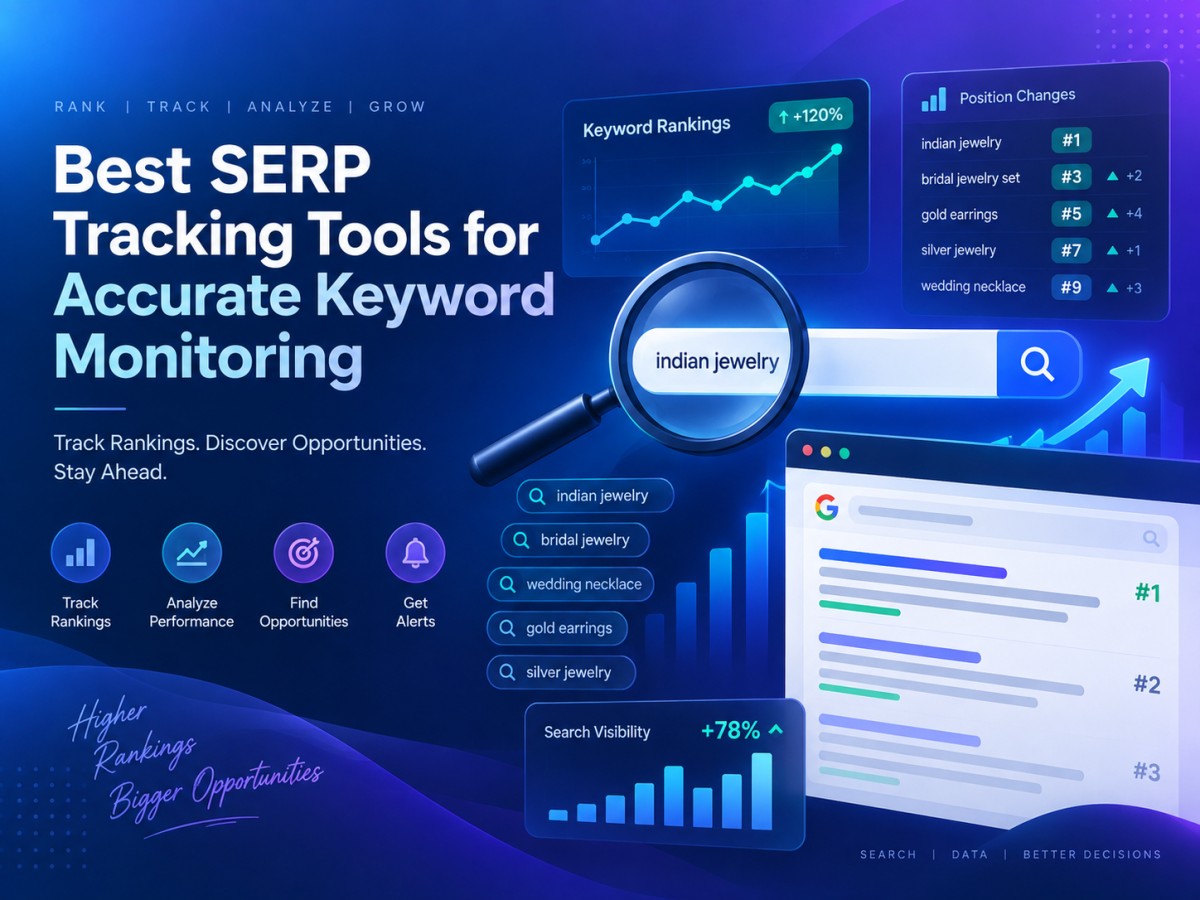
Table of Contents
-
1. Introduction: Why Keyword Monitoring Still Matters
Search results don't sit still. A page can hold position three on Monday and drop to position nine by Friday because of a core update, a competitor's content refresh, or simply Google testing a new SERP layout. Without a system that checks positions regularly, most of that movement goes unnoticed until it shows up as a traffic dip in your analytics — by which point you've already lost the clicks.
That's the entire job of a SERP (Search Engine Results Page) tracking tool: it checks, on a schedule, where your target pages rank for the keywords you care about, and it keeps a history so you can see the trend rather than a single snapshot. In 2026, the best tools go further, tracking not just blue-link positions but featured snippets, People Also Ask boxes, local packs, and increasingly, whether your brand is being cited inside AI Overviews, ChatGPT, or Perplexity responses.
Picking the right one isn't about finding the tool with the longest feature list. It's about matching the tool to how many keywords you're tracking, how often you need updates, and whether you need agency-grade reporting or just an honest answer to "are we moving up or down."
This guide breaks down the strongest options on the market right now, with real, current pricing, so you can compare them properly before committing a budget line to any of them.
-
2. What Is a SERP Tracking Tool, Exactly?
A SERP tracker works by running automated searches for a defined list of keywords, on a defined schedule, from a defined location and device type, and recording exactly where your URL appears. Unlike Google Search Console, which reports your average position based on real user impressions, a rank tracker simulates the search itself, meaning it can also tell you where competitors rank for the same terms, something Search Console will never show you because it only has visibility into your own site.
Most modern tools also capture the wider SERP layout: whether a featured snippet exists for that query, who owns it, whether there's a local map pack, an image carousel, or increasingly relevant in 2026, whether an AI Overview appears above the organic results and whether your content is cited within it.
-
3. What to Look For Before You Buy
A few things separate a genuinely useful tracker from a tool that looks good in a sales demo but frustrates you a month in:
- Update frequency. Daily tracking catches problems while they're still small. Weekly tracking is fine for stable, low-competition niches but risky for anything volatile.
- Location and device granularity. If you serve local customers, you need city- or postcode-level tracking, not just national averages.
- SERP feature visibility. Featured snippets, People Also Ask, and local packs often carry more click share than the organic listings beneath them.
- AI search visibility. As AI Overviews and chat-based search assistants reshape discovery, several trackers now report whether your brand is being cited in these answers.
- Honest pricing at scale. Many tools look cheap at the entry tier and become expensive fast once you add keywords, competitors, or locations. Always check the cost per 1,000 keywords, not just the headline price.
- Reporting and integrations. Agencies in particular should check for white-label reports and integrations with Looker Studio, Google Sheets, or Slack.
-
4. The Best SERP Tracking Tools in 2026 (With Pricing)
1. Semrush Position Tracking {#semrush}
Semrush's rank tracker is bundled inside its broader SEO suite rather than sold as a standalone product, which makes it a strong pick if you're already using Semrush for keyword research, site audits, or backlink analysis. It offers daily updates and now includes AI Overview and AI-answer visibility tracking alongside standard Google rankings.
Price: From $139.95/month (Pro plan), with AI Visibility tracking available as an add-on or through the newer Semrush One bundle. Best for: Teams that want rank tracking as part of a full SEO toolkit, not a standalone line item.
2. Ahrefs Rank Tracker {#ahrefs}
Ahrefs is widely regarded as having some of the cleanest, most reliable ranking data in the industry, largely because it's built on the same crawling infrastructure that powers its backlink index. Like Semrush, it's only available inside the full Ahrefs platform.
Price: Lite – $99/month (750 keywords); Standard – $199/month (2,000 keywords); Advanced – $399/month (5,000 keywords); Enterprise – $999/month (10,000 keywords). Best for: Teams that want rank tracking tied to deep backlink and content data.
3. SE Ranking {#se-ranking}
SE Ranking has built a reputation as the best value option for teams that want most of what Semrush or Ahrefs offer without the enterprise price tag. It covers daily tracking, local and mobile positions, competitor comparison, and AI search visibility reporting.
Price: Essential plan from $52/month (250 keywords); Pro plan around $119/month, which unlocks AI visibility tracking. Best for: Small-to-mid SEO teams and agencies wanting daily tracking without enterprise pricing.
4. AccuRanker {#accuranker}
AccuRanker's defining feature is speed — rather than waiting for a scheduled daily refresh, you can trigger an on-demand ranking check, which is genuinely useful for agencies that need to confirm a ranking change before a client call. SERP feature tracking covers featured snippets, People Also Ask, image packs, and local packs, and white-label reporting is available across all tiers.
Price: From $224/month for 2,000 keywords. Best for: Agencies managing high keyword volume who need fast, on-demand reporting turnaround.
5. Moz Pro {#moz-pro}
Moz Pro pairs rank tracking with the metrics it made famous — Domain Authority and Page Authority — inside an interface designed to be approachable for newer SEO practitioners. Tracking covers Google, Bing, Yahoo, and Google Mobile, with both daily updates and on-demand checks available.
Price: Starter – $49/month ($39/month billed annually) for 50 keywords; Standard – $99/month ($79 annually); Medium – $179/month ($143 annually); Large – $299/month ($239 annually). Best for: Beginners and small in-house teams who want rank tracking alongside site audits and keyword research in one approachable platform.
6. Mangools SERPWatcher {#mangools}
SERPWatcher is consistently rated one of the best value trackers on the market, with a clean interface that keeps the learning curve low. Daily updates are available at its higher tier, and it integrates neatly with the rest of the Mangools toolkit (KWFinder, SERPChecker).
Price: From roughly $29.90/month, dropping to approximately $18/month with annual billing on entry tiers. Best for: Freelancers and small businesses that want dependable tracking without a steep learning curve.
7. Nightwatch {#nightwatch}
Nightwatch tracks rankings across an unusually wide range of locations and devices, with segmentation options that let you break performance down by page type, search intent, or region — a genuine advantage for multi-location businesses. It also tracks AI search visibility alongside traditional Google rankings.
Price: From $32/month. Best for: Multi-location businesses and agencies that need granular, ZIP-code-level local tracking.
8. Wincher {#wincher}
Wincher keeps things simple: daily rank tracking at one of the lowest costs per keyword in this list, plus a WordPress plugin that surfaces live ranking data directly inside your editor while you write.
Price: From $24/month for 500 keywords. Best for: Small sites and bloggers who want daily tracking without paying for features they won't use.
9. SpySERP {#spyserp}
SpySERP tracks your own rankings alongside up to 100 competitor domains, making side-by-side SERP comparisons quick to run, including differences between desktop and mobile results or across multiple locations.
Price: Free plan for 5 keywords; paid plans from $7.20/month for 10,000 keyword checks, with an Enterprise tier for larger needs. Best for: Budget-conscious users and competitor-focused tracking.
10. SerpRobot {#serprobot}
A genuinely free option worth mentioning: SerpRobot checks Google rankings from multiple countries, shows the top 100 results, and provides basic reporting — a reasonable sanity check for smaller sites not ready to pay for a full platform.
Price: Free tier includes 50 keyword checks. Best for: Hobby sites or anyone wanting a free, fast rank check before committing to a paid tool.
11. Google Search Console {#gsc}
It's worth stating plainly: before paying for anything, check Google Search Console. It's free, and it reports your actual average position for every query you already rank for, based on real search data rather than a simulated check. What it won't show you is competitor positions or keywords you don't yet rank for, that's where a paid tracker earns its cost.
Price: Free. Best for: Anyone who simply wants to know whether their own site is trending up or down, with zero budget required.
-
5. Quick Price Comparison Table
Tool Starting Price Keywords Included Google Search Console Free Unlimited (own site only) SerpRobot Free 50 keyword checks SpySERP $7.20/month 10,000 keyword checks Wincher $24/month 500 keywords Mangools SERPWatcher ~$18–$29.90/month Varies by plan Nightwatch $32/month Varies by plan Moz Pro (Starter) $49/month ($39 annually) 50 keywords SE Ranking (Essential) $52/month 250 keywords Ahrefs (Lite) $99/month 750 keywords Semrush (Pro) $139.95/month Suite-based AccuRanker $224/month 2,000 keywords Prices are accurate at the time of writing and may change, always confirm current rates on the provider's official pricing page before purchasing.
-
6. How to Choose the Right Tool for Your Situation
If you're a solo blogger or small business tracking a handful of keywords, start with Google Search Console for free, and only add Wincher, Mangools, or SpySERP if you need competitor visibility.
If you're an in-house SEO team at a growing company, SE Ranking or Moz Pro strike a solid balance between cost and capability, especially if you also need keyword research and site audits in the same platform.
If you're an agency managing multiple clients, AccuRanker's on-demand checks and white-label reporting justify the higher price, while Nightwatch is worth a look if local, multi-location tracking is central to your work.
If you're already paying for Semrush or Ahrefs for keyword research or backlink analysis, their built-in rank trackers are usually the most efficient choice simply because the data lives in one place.
-
7. Final Thoughts
There's no single "best" SERP tracking tool only the tool that fits your keyword volume, your reporting needs, and your budget. Start with Google Search Console if you're not tracking anything yet; it costs nothing and answers the most basic question honestly. Once you need competitor data, local granularity, or AI search visibility, the paid tools above each solve a slightly different problem, from Wincher's simplicity at the low end to AccuRanker's speed and polish at the top.
Whatever you choose, the real value isn't in the dashboard, it's in actually checking it regularly and acting on what it tells you.
Frequently Asked Questions
What's Your Reaction?
 Like
0
Like
0
 Dislike
0
Dislike
0
 Love
0
Love
0
 Funny
0
Funny
0
 Wow
0
Wow
0
 Sad
0
Sad
0
 Angry
0
Angry
0

A spirit that pursues sunsets and tales. Entrepreneur at heart, globe-trotter by soul. Founder of an art-worshiping jewelry brand that embodies emotion & individuality — where each piece is a tale of culture, craft, and character. From trails up mountains to gem markets, I'm inspired by all journeys — transforming wanderlust into enduring design. Establishing a brand built on authenticity, refinement & purpose — one work at a time.












Comments (0)