

The Truth Behind the Viral White Traffic Light: How It Could Change Driving Forever
Uncover the truth behind the White Traffic Light — a proposed fourth signal that could revolutionize driving and redefine how future traffic systems work.
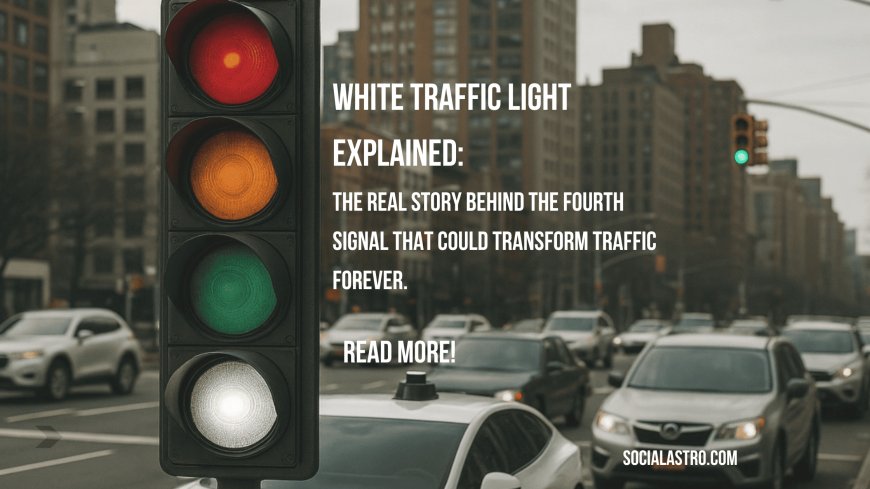
If you've seen social media posts or headlines about a new "white traffic light" being added to road intersections, you're not alone. The idea seems like it's from a science fiction movie - one in which cars drive themselves, silently communicate, and move through intersections without so much as a honk or halt.
But what is the real score? Is this new light being tested anywhere already? Shall we see it alongside those other familiar red, amber, and green signals we grew up with soon?
Let's break it down.
The Buzz Around a Fourth Traffic Light
"White Traffic Light" is not some initiative of the government's plan or road safety reform, but an academic proposal by a professor and other researchers from North Carolina State University that was pitched at the beginning of 2023.
They were not redesigning traffic lights for the fun of it, but thinking about how to make intersections function more smoothly in a world that would soon include driverless cars-or AVs-out on the road sharing with regular drivers.
 Image Credit: WGRD
Their research showed that, given enough AVs on the road, those capable of communicating with other AVs should be able to handle intersections on their own. That is where the "white light" idea came up.
Put differently, this new light would serve as an indication that AVs are in control of the intersection. When turned on, human drivers would merely follow the vehicles ahead of them by trusting the AVs to coordinate safely through the crossing.
How Would a White Traffic Light Work?
You drive to an intersection, and the green, red, and yellow traffic lights have that fourth color: white. And if it flashes white-it's not any decision on your part, it's just a signal the autonomous vehicles are talking to each other, managing the flow.
This white signal tells all the AVs to initiate a conversation amongst themselves, then negotiate who goes, who waits, and at what speed.
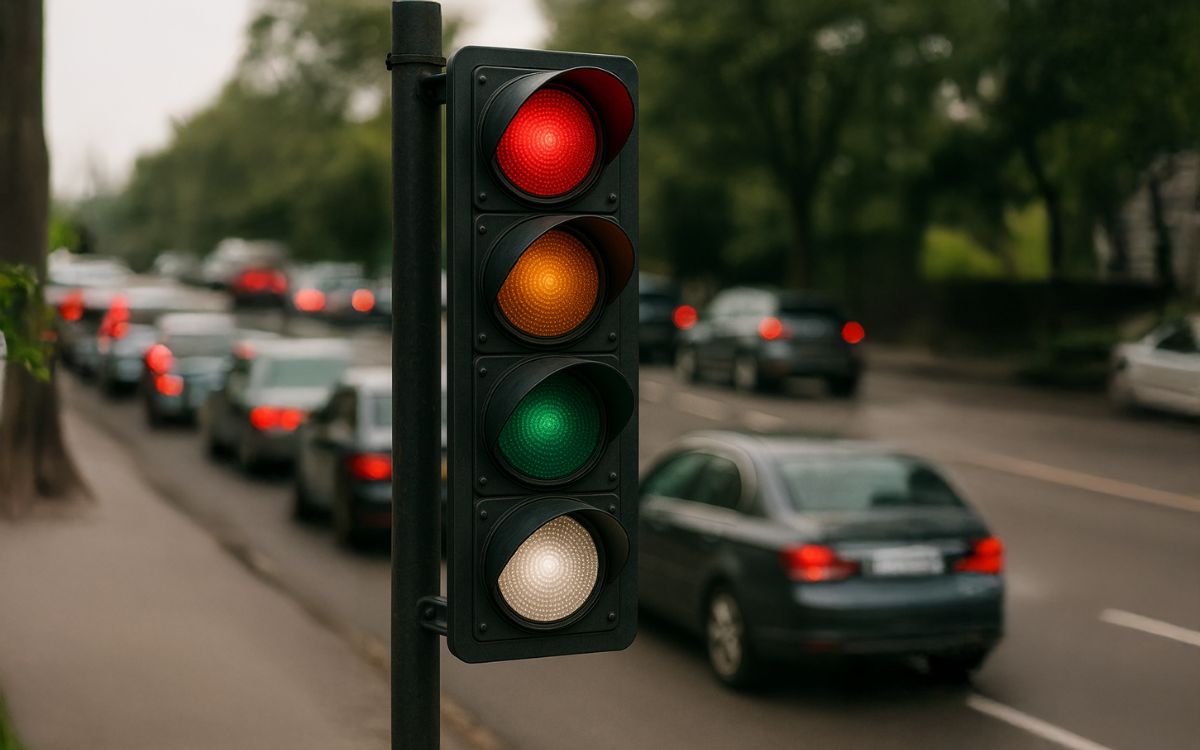 Image Credit: Supercar Blondie
Human drivers would not need to interpret the signal for themselves and could simply follow the car in front of them, knowing that the car in front of them is either an AV or part of the coordinated flow.
The light will revert to the familiar red, amber, and green system if and when coordination of the AVs is done.
What it is essentially designed for is eliminating human hesitation at junctions, that split-second confusion that jams the roads or leads to accidents.
What the Research Found
The simulations performed in the North Carolina State University study had some pretty impressive numbers:
1. Delays at the intersections were reduced by up to 94% when most vehicles were autonomous.
2. Even at 10%, these autonomous vehicles have considerably improved the flow.
3. Smoother coordination means fewer stops and starts, which translates into less fuel use and lower emissions.
What is relevant here is that the actual color needn't be white, for it is a symbolic placeholder. What counts is that it is a unique signal meaning "AV coordination active."
So far, it sounds like a traffic miracle waiting to happen. But here's the catch.
It’s Not Approved Anywhere Yet
Online hype notwithstanding, no transport authority in the world has either adopted or attempted to operate a four-color traffic light system.
In fact, the US Federal Highway Administration, the UK's Department for Transport, and India's Ministry of Road Transport and Highways have made it clear: it does not have an official rollout, nor a pilot program, nor is it legally recognized.
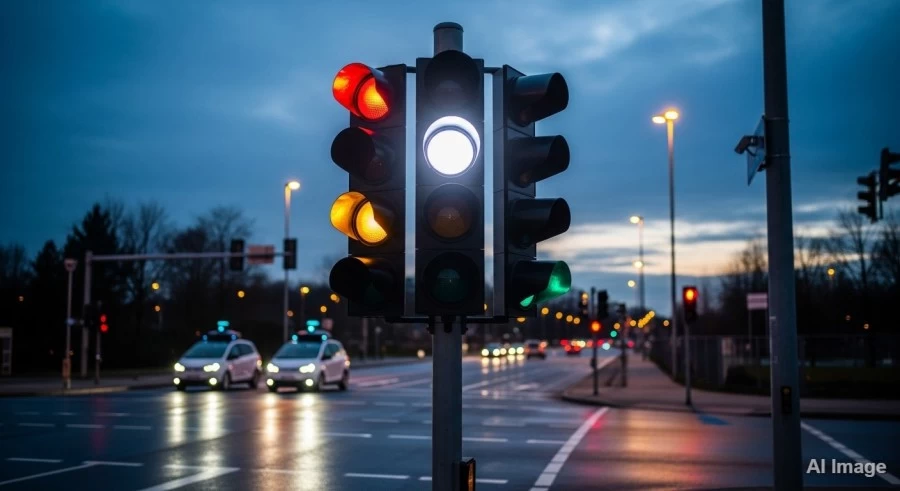 Image Credit: Zoom News
It means the "white traffic light" exists only on paper and in simulations, but not on the road, so to speak.
It's spurred some really valuable discussions about what traffic systems will look like once cars actually drive themselves.
Why It's Hard to Make This Idea Real
The thing is, something as universally applied as traffic lights cannot be changed just by changing light bulbs or adding another color; that would require an overhaul of traffic laws, road design, and driver training everywhere in the world.
Here's why it's tricky:
Global Standardization:
The system of red-amber-green means the same thing everywhere in the world, and adding a fourth color would require a rewriting of global traffic conventions that takes decades of negotiation.
Mixed Traffic Reality:
Even if driverless cars do become popular, we will still have millions of human-driven cars on the roads for years-likely decades-and that mix could be confusing if people don't understand how to respond to a new signal.
Safety Issues:
That would be a dangerous, misinterpreted signal. Until AVs can communicate perfectly with other cars and infrastructure-known as V2X communication-granting them partial control over a vehicle would indeed be unsafe.
Legal and Technical Challenges:
That would require governments to rewrite their traffic codes, new manufacturing standards for lights, and ensure that every vehicle-new and old-could correctly interpret the signal.
Considering all these different challenges, even with smart cars, the three-color system is most likely to prevail during the next decades.
When Could We Actually See It?
Not anytime soon. Even proponents described the project as a vision of what could be, not what would be appropriate for today's roads.
If tests ever happen, they are most likely to begin in the controlled environments of university campuses, tech parks, or smart city zones where traffic can safely be monitored. It would take years of successful trials for the governments even to think of revising the road rules, by which time self-driving cars could finally outnumber the traditional ones.
More realistically, most experts agree it will be 20 to 30 years before we're anywhere near requiring a white light at intersections.
What It Means for Drivers Today
For the time being, nothing will change: You'll still stop on red, get ready on amber, and go on green.
But this discussion reveals something far more important: the future of road technology. The autonomous vehicles aren't about convenience but part of the large movement for safer, cleaner, and more efficient options in transportation.
Just think about it: fewer traffic jams, less human error, and easier coordination are things that could take a lot of stress off driving and congestion in cities.
But that future is contingent upon huge strides in AI reliability, data networks, and public trust. That's why researchers experiment with ideas like the white light, not to confuse drivers, but to prepare for a world where machines and humans share the road.
A Glimpse into Highways of Tomorrow
The "white traffic light" is a good reminder that, more often than not, speculation precedes innovation. It is not an official change, but it does show the way things are going to be-a world where cars make decisions quicker than human beings ever could.
Between such a concept and reality, yes, many barriers do stand. But even the idea of cars driving themselves sounded just as far-fetched 20 years ago.
Intersections will look a little different in decades to come. Maybe we will see that extra light flicker on, not instead of the red, amber, and green, but to show how far technology has taken us.
Till then, it's just an interesting idea, the white light of traffic yet to shine.
Key Takeaways
1. The White Traffic Light was more of a research concept than a system that had been approved.
2. Researchers at North Carolina State University had suggested autonomous coordination, which would allow each vehicle to control the flow of traffic.
3. Simulations indicated that with a majority of the traffic being AVs, delays at signals could be as much as 94% less. No transport authority has yet tested or adopted this idea.
4. To be applied universally, this requires legal reforms and new standards and would take many decades to develop. For now, the familiar red, amber, and green signals continue to rule the roads.
Final Word
Innovation is rarely overnight; it's sometimes just a spark-an idea that flicks conventional thinking into overdrive. The white traffic light will most likely never see reality, or it may someday guide fleets of intelligent vehicles through our cities. Either way, it's a signal of something more-a glimpse of what the future of mobility could look like as man and machine start driving together.
What's Your Reaction?
 Like
0
Like
0
 Dislike
0
Dislike
0
 Love
0
Love
0
 Funny
0
Funny
0
 Wow
0
Wow
0
 Sad
0
Sad
0
 Angry
0
Angry
0

I’m Ryan Rehan, Business Development Executive and a passionate blogger dedicated to sharing insights, tips, and experiences that inspire and inform. Through my blogs, I explore topics that matter, spark curiosity, and encourage thoughtful conversations. Whether I’m breaking down complex ideas, offering practical advice, or simply sharing stories, my goal is to create content that adds real value to a growing community of curious minds and passionate readers.















Comments (0)