

The Red Desert That Looks Like Mars… and Yes, It’s Actually in India
Discover the stunning red desert in Tamil Nadu that looks like Mars. Explore its origins, shifting dunes, and why this surreal Indian landscape feels otherworldly.

If someone told you there was a desert in the Tamil Nadu landscape that has been plucked straight out of a photo clicked from the Mars Curiosity rover, you would raise your eyebrow. But that's a fact: Theri Kaadu is for real, it is stunning, and nothing like anywhere else in South India. This crimson sandscape attracts a slow trickle of travelers, photographers, and geology enthusiasts; yet, it feels like a secret waiting to be discovered.
Now, let's break it down, right from the deep geological roots of Theri Kaadu to the eerie stories the locals still whisper about.
Where is Theri Kaadu located?
Theri Kaadu sits across Thoothukudi and Tirunelveli districts in Tamil Nadu. Depending on how one maps the place, it spreads anywhere between 50 and 500 sq. km - big enough to explore and remote enough to feel out of this world.
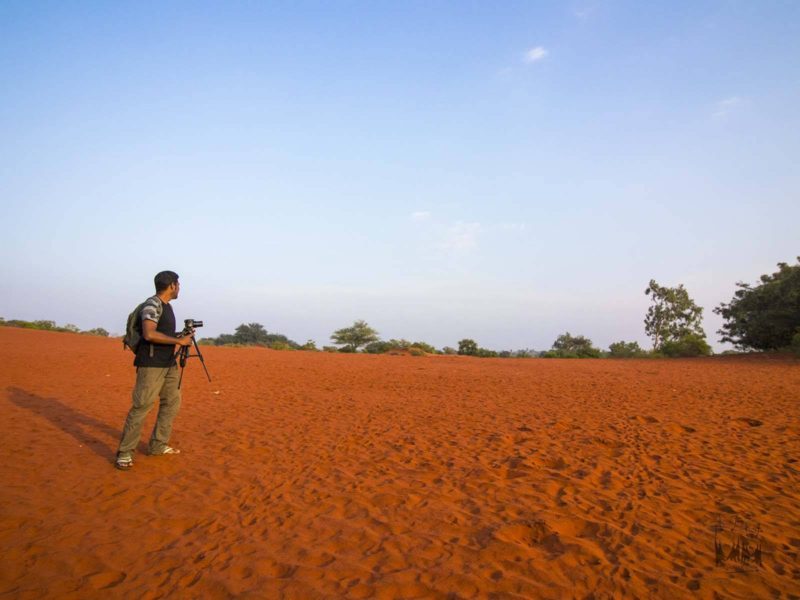 Image Credit: Roaming Owls
The name says it all. "Theri" means "dune", and "Kaadu" means "forest" in Tamil. Put them together and you get red dune forest - a pretty accurate picture of what you'll find here: rust-coloured dunes dotted with patches of hardy green.
The surroundings change abruptly the moment one steps in - the beautiful sights that one might associate with the coastline are all left at the doorstep the minute one steps into this desert colored with burnt oranges and crimsons.
How Theri Kaadu Was Formed: A 10,000-Year Story
Why the Theri Kaadu did not come up is because this region has dried out over centuries, while their origins date to times further back in history.
During the Last Glacial Maximum, sea levels dropped globally. On the coastline of Tamil Nadu, these are iron-rich marine sediments exposed; iron minerals were blown inland by strong winds over thousands of years, mingling with the local soil, thus creating the dunes apparent today.
What Gives It Its Fire Glow?
It is a cocktail of minerals that includes haematite, magnetite, and limonite. It has a natural reddish tint due to the iron oxides. Colors may be blood red to bright orange when the sun hits these dunes, especially at sunrise and sunset.
It is not a desert of the past alone, it is alive and it breathes.
Theri Kaadu: It Is Unique Among The Indian Deserts
Rajasthan may have India's most iconic desert, but Theri Kaadu plays according to different rules altogether.
Because here, the sands are never still. They move continuously.
These dunes are loose and light, and through the coastal winds, they are never at rest. The topography changes all the time, and it is very subtle, meaning every visit is completely new.
It contains extremely low clay content and hence does not bind well. Because of this, the dunes are not fixed as in the Thar Desert. If you stand still for long, you will see small ripples of sand swirling around your feet while being carried effortlessly by the wind.
It is for this reason-that constant movement-that geologists love the place. The landscape is dominated by waves of red sand against pockets of green.
Step into Theri Kaadu, and you immediately get the feeling of having just stepped into a cozy movie theatre. These dunes run along in soft humps and ridges, their shapes dictated by the never-resting wind.
Suddenly, the monotony is broken by a palm tree or the cashew plant. Small tufts of vegetation start building miniature oases, building up their small ecosystems that somehow always manage to survive against all odds.
Water cannot stay in this type of soil: it evaporates before it is able to soak in; hence, farming is impossible. It was the natural barrier that kept the raw look of the desert intact.
This is a dream place for any photographer: such contrasts of red dunes, bright blue sky, and oases often turn even the most banal snapshot into something cinema-like.
Scientific Importance of Theri Kaadu
Besides the beauty, it's a mine of gold for scientific research.
These dunes are all relatively young, and thus geologists studying them are able to gain insight into the development of coastal deserts. Several different methods have been applied-including luminescence dating-to find out exactly how old these dunes are and how the pattern of winds has changed over the course of thousands of years.
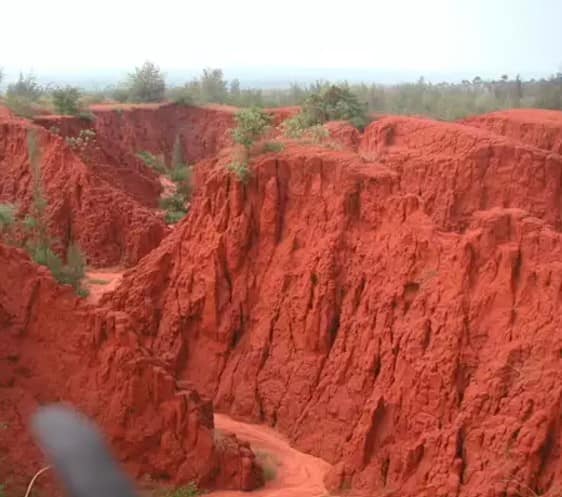 Image Credit: News 18 Tamil
But it is in the shifting sands that climate scientists study for a pattern in desertification processes and soil movement quite important topic today, with shifting global climate conditions.
It may well be imagined as an open-air laboratory in which Nature has recorded history on the strata of the red sand.
Legends and Local Lore: Stories Contributing to Mystery
Outlandish landscapes attract stories, and no different is Theri Kaadu.
One legend repeated by many speaks about a marriage party that did not heed the local warnings and pressed on into the dunes well past sunset; it is said that they all became lost and were never to be seen again. Whether or not it actually has any truth behind it, nobody knows, but it does certainly give a haunting edge to the place.
Locals still warn tourists not to venture too far onto the dunes after dark. The dunes look benign enough; once the light has gone, though, the whole landscape merges into one uniform red-brown colour, and it can be incredibly easy to lose your bearings.
Partly eerie, partly intriguing, just that sort of mystery which adds to the desert's charm.
Life in the Red Desert
Whatever the conditions, there is life in Theri Kaadu.
Vegetation is scanty but hardy; you find palm trees, cashew plants, and a few wild shrubs clinging to life in small clumps.
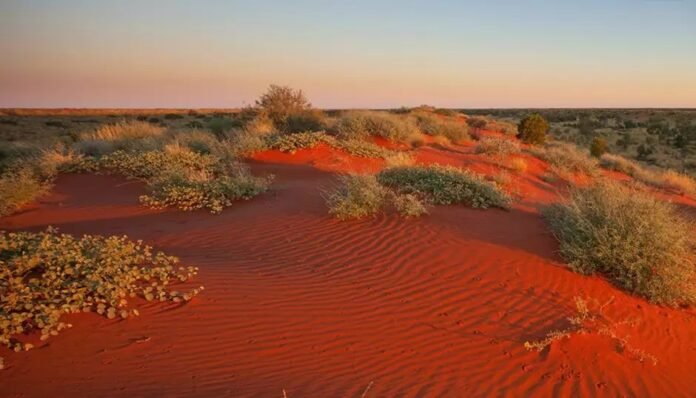 Image Credit: EBNW Story
It is inhabited by insects, birds, and small animals that are acclimatized to heat and low moisture. According to scientists, biodiversity is more than what has been documented so far, and though some surveys are still ongoing, new details have been discovered about how life copes in such an environment. Tourists, Trekkers, and photographers love this destination.
Slowly yet surely, Theri Kaadu is finding its place on the travel map. Dunes beckon adventure lovers to go trekking, naturalists to come and study their unique ecosystems, and photographers to come chasing surreal visuals akin to Mars.
Raw, unblemished, and perfect for each one looking for something unique in Tamil Nadu.
Best Time To Visit
If possible, try to avoid peak summers, as it gets very unforgiving at that time. In November and February, early mornings or late afternoons are the best times for light and nice weather.
Safety Tip
Follow marked trails or explore with someone who knows the territory. All dunes look alike, and it's surprisingly easy to wander off track.
Why Theri Kaadu Deserves More Attention
It is more than a red desert: partly science, partly art, partly myth; Theri Kaadu binds them all together. You get a rare landscape sculpted through thousands of years, colors that look straight out of NASA imagery, stories keeping the mystery of this place alive, and an ecosystem silently coping with extreme conditions.
Tamil Nadu is all about temples, beaches, and classical heritage, but buried down south is this phenomenal, Mars-like world showcase of how much diversity the landscapes of India hold. You simply love finding those places that are untouched, unexplored, and have a beauty nobody expects. Find a place for Theri Kaadu in your bucket-list travels. That itself shows how many times the most unlikely places turn out to be the greatest.
What's Your Reaction?
 Like
0
Like
0
 Dislike
0
Dislike
0
 Love
0
Love
0
 Funny
0
Funny
0
 Wow
0
Wow
0
 Sad
0
Sad
0
 Angry
0
Angry
0

I’m Ryan Rehan, Business Development Executive and a passionate blogger dedicated to sharing insights, tips, and experiences that inspire and inform. Through my blogs, I explore topics that matter, spark curiosity, and encourage thoughtful conversations. Whether I’m breaking down complex ideas, offering practical advice, or simply sharing stories, my goal is to create content that adds real value to a growing community of curious minds and passionate readers.














Comments (0)