

New FDA-Approved Eye Drop Promises Clear Vision Without Glasses: Meet VIZZ
Discover VIZZ, the new FDA-approved eye drop that restores near vision within 30 minutes without affecting distance sight. Learn how this aceclidine-based solution offers a safe, non-surgical alternative to reading glasses for adults with presbyopia.

If you’re over 40 and find yourself constantly reaching for reading glasses, you’re not alone. Presbyopia, the gradual loss of near vision, happens to almost everyone as they age. It’s the reason restaurant menus look blurry in dim light and phone screens seem harder to read than ever. Until recently, the only real solution was reading glasses, contact lenses, or surgery. But now, a brand-new treatment is making waves.
The U.S. Food and Drug Administration has approved VIZZ, an aceclidine-based eye drop that restores near vision within minutes and keeps it clear for up to 10 hours. Unlike earlier options, it sharpens close-up vision without compromising distance vision. For millions of adults dealing with presbyopia, this is big news.
Let’s break down what makes VIZZ different, how it works, and what you can expect once it becomes available.
What Exactly Is Presbyopia?
Presbyopia is one of those age-related changes nobody can really avoid. It usually begins after age 40, when the eye’s lens gradually stiffens. That makes it harder for the eye to focus on nearby objects.
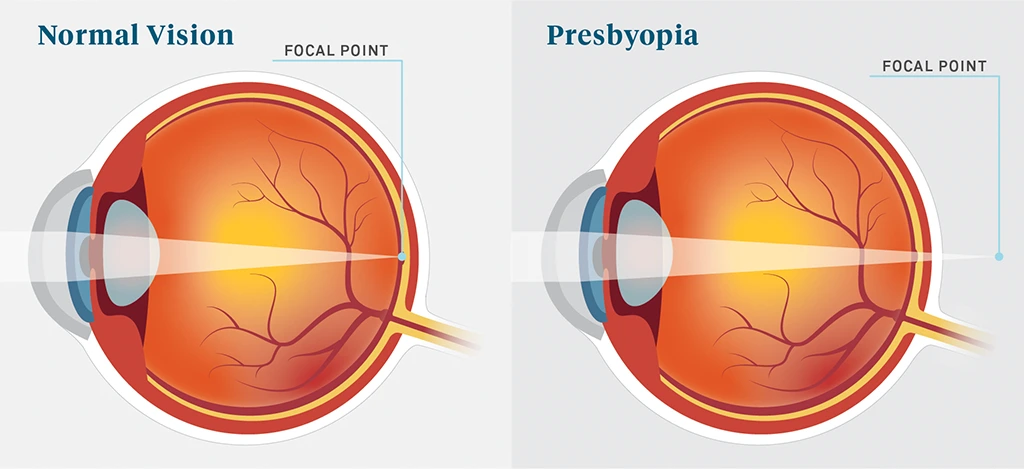 Image Credits: Irisvision
At first, people notice themselves holding books or phones farther away to read clearly. Eventually, reading glasses or bifocals become a daily necessity. The condition isn’t a disease; it’s simply part of aging, but it can still feel frustrating.
Over the past few years, researchers have been working on eye drops designed to improve near vision temporarily. Some, like Vuity and Qlosi, were approved earlier. But VIZZ represents a new approach.
How VIZZ Works
The science behind VIZZ is surprisingly simple yet effective. The drop targets the iris’s sphincter muscle and makes the pupil contract slightly. This creates a “pinhole effect,” which increases the depth of field. Think of it like adjusting the aperture on a camera lens: when the opening gets smaller, more of the scene stays in focus.
 Image Credits: Drug Store News
Here’s the key difference between VIZZ and older drops. Many presbyopia treatments work by stimulating the ciliary muscle, which can sometimes cause temporary nearsightedness. VIZZ avoids that problem. It sharpens near vision while leaving distance vision intact. That means you can put in the drops and go about your day—whether you’re reading emails, driving, or scrolling through your phone without switching between glasses.
Fast Results That Last
One of the most appealing features of VIZZ is how quickly it works. Clinical trials showed that most users noticed clearer near vision within just 30 minutes of applying the drop. Even better, the effect lasted for six to ten hours, long enough to get through a typical workday or evening out.
This makes it practical for everyday use. Instead of juggling multiple pairs of glasses or struggling in situations where reading glasses aren’t convenient, a single drop can provide freedom and flexibility.
What Clinical Trials Showed
The FDA approval was based on data from three Phase 3 trials known as CLARITY 1, 2, and 3. Hundreds of participants tested VIZZ across more than 30,000 treatment days. The results were consistent:
-
Near vision improved reliably within 30 minutes
-
Benefits lasted up to 10 hours after a single dose
-
Distance vision was preserved
-
Side effects were mostly mild and temporary
The most common side effects included slight eye irritation, dim vision in low light, or mild headaches. Importantly, no serious treatment-related problems were reported. For a first-in-class therapy, that’s a strong safety profile.
How VIZZ Compares to Other Options
Before VIZZ, the only FDA-approved drops for presbyopia were pilocarpine-based treatments like Vuity and Qlosi. These also work by constricting the pupil, but they tend to stimulate the ciliary muscle more strongly. That can sometimes make distance vision blurry or trigger discomfort.
VIZZ takes a different approach. Its aceclidine formula is pupil-selective, meaning it focuses its action where it’s most useful, the iris sphincter, while avoiding unwanted side effects.
Compared to glasses, VIZZ offers freedom. You don’t have to carry a pair everywhere or swap them on and off all day. Compared to surgery, it’s temporary and non-invasive. You can use it as needed without committing to permanent changes.
Who Can Benefit Most
VIZZ is designed for adults with presbyopia, especially those over 45 who notice they can’t read comfortably without glasses. If you’re someone who only recently started using readers, this could be a way to delay full-time dependence. For people already wearing glasses regularly, it might provide an occasional break when glasses aren’t convenient.
Since the drops are intended for once-daily use, they fit easily into a morning routine. Apply them before heading out, and you’ll likely have clear near vision throughout the day.
When Will VIZZ Be Available?
According to the approval announcement, samples will begin reaching U.S. optometrists and ophthalmologists in October 2025. A full commercial rollout is expected by late 2025. That means patients may start accessing it through their eye doctors by the end of the year.
Given the excitement surrounding presbyopia-correcting drops, demand will likely be high. Eye care professionals are preparing to integrate VIZZ into treatment plans alongside traditional options.
The Bigger Picture
The approval of VIZZ marks another step forward in the evolving landscape of eye care. For decades, presbyopia management relied on glasses, contacts, or surgical interventions like lens implants. The arrival of prescription eye drops offers a flexible, non-surgical alternative that appeals to a wide range of patients.
VIZZ isn’t the last innovation we’ll see, either. Several other treatments are already moving through the approval pipeline. Together, they point to a future where presbyopia is managed with a variety of tools tailored to individual preferences.
Key Facts at a Glance
-
FDA approval date: July 31, 2025
-
Indication: Presbyopia (age-related near vision loss)
-
Active ingredient: Aceclidine 1.44%
-
Onset of effect: Around 30 minutes
-
Duration: 6 to 10 hours
-
Mechanism: Pupil-selective constriction for sharper focus
-
Side effects: Mild irritation, dim vision, headache (self-limiting)
-
Trial data: Over 30,000 treatment days, no serious adverse effects
-
Availability: Samples in October 2025, nationwide launch by late 2025
Final Thoughts
For years, people with presbyopia had few choices besides putting on glasses or considering surgery. With the approval of VIZZ, there’s now a safe, fast, and convenient way to improve near vision without sacrificing distance clarity.
It won’t replace glasses entirely for everyone, but it offers something many patients have been waiting for: control. Instead of feeling limited by aging eyes, adults now have a way to take back clear vision for the moments that matter most.
VIZZ is set to change how millions approach presbyopia, making everyday tasks easier and freeing people from the constant search for their readers. As eye care continues to evolve, this new drop could very well become the standard choice for managing age-related near vision loss.
What's Your Reaction?
 Like
0
Like
0
 Dislike
0
Dislike
0
 Love
0
Love
0
 Funny
0
Funny
0
 Wow
0
Wow
0
 Sad
0
Sad
0
 Angry
0
Angry
0

I’m Ryan Rehan, Business Development Executive and a passionate blogger dedicated to sharing insights, tips, and experiences that inspire and inform. Through my blogs, I explore topics that matter, spark curiosity, and encourage thoughtful conversations. Whether I’m breaking down complex ideas, offering practical advice, or simply sharing stories, my goal is to create content that adds real value to a growing community of curious minds and passionate readers.













Comments (0)